Missed Call Statistics 2026: 21 Proven Facts, 3 Wrong Myths
Quick answer: the best missed call statistics for 2026 say about 44% of callers to businesses never reach a person (Invoca, 70 million calls), 78% of consumers say they've abandoned a business after an unanswered call (CallRail, 2025), and 69% of missed business calls get no callback within 48 hours (Quo, 2026). The famous claims that "62% of calls go unanswered" and "85% of callers never call back" rest on old or untraceable sources. Every number below links to its source.
Key takeaways
- The strongest missed call statistics come from large datasets: Invoca's 70 million calls and Quo's 16.7 million missed calls.
- Survey numbers (what people say they do) are useful direction, not hard measurement.
- Three widely repeated missed call stats don't hold up, and we explain why.
- Every strong number points to the same fix: answer more calls with a real conversation and follow up in minutes. iThinqAI does both; hear it at 561-715-7686.
What do the latest missed call statistics show?
The latest missed call statistics show that a large share of business calls never reach a person, that most callers don't leave a voicemail, and that most missed calls are never returned quickly. Invoca's 2026 benchmark found 44% of callers never reached a person. Quo found 69% of missed business calls got no callback within 48 hours. CallRail's 2025 survey found only 42% of consumers leave a voicemail.
Those three findings come from different methods: call-tracking data, phone-system data and a consumer survey. When three methods agree, you can trust the direction.
Why we fact-checked these missed call statistics
If you sell anything that answers phones, it's tempting to grab the scariest number on the internet. We get it. We sell AI that answers phones.
But a scary number that's wrong gets your page cited once and then quietly removed. So we went back to the sources. Here's what holds up, what's shaky, and what to stop quoting.
The strong missed call statistics: large samples, clear methods
| Statistic | Source | Sample and date |
|---|---|---|
| 44% of callers to businesses never reach a person | Invoca Lead Conversion Benchmarks 2026 | 70M+ calls, 10 industries, published July 2026 |
| Share of calls answered by a person: business services 56%, healthcare 54%, home services 52%, telecom 51% | Invoca, 2026 | Same dataset |
| Calls referred by ChatGPT had the highest lead rate of any channel, 49% | Invoca, 2026 | Same dataset |
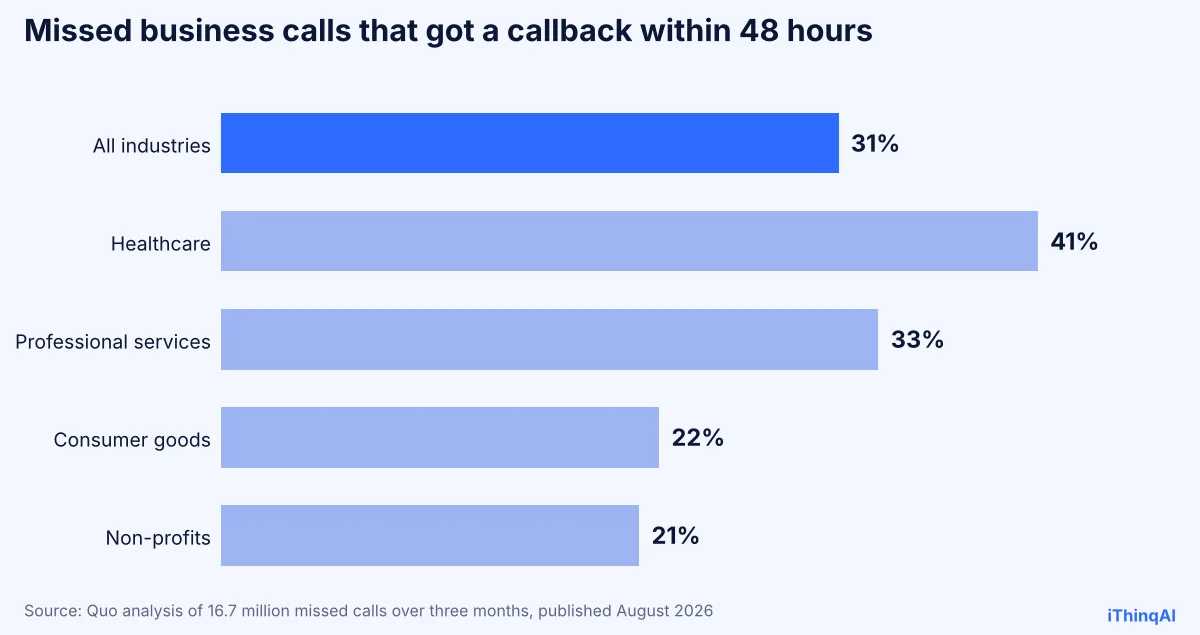
| 69% of missed business calls got no callback within 48 hours | Quo, 2026 | 16.7M missed calls over three months |
| Callback rates by industry: healthcare 41%, professional services 33%, consumer goods 22%, non-profits 21% | Quo, 2026 | Same dataset |
| 86% of people don't answer calls from unknown numbers; 14% answer right away | Hiya State of the Call 2026 | 12,000+ consumers in six countries |
| Firms that tried to reach a web lead within an hour were nearly 7x more likely to qualify it; average response was 42 hours | Harvard Business Review, 2011 | 2,241 U.S. companies audited |
The useful survey statistics: what people say they do
These come from CallRail's survey of 1,000 U.S. consumers, published September 2025 (source). Surveys measure what people say, not what they do, so treat them as direction, not gospel. CallRail also sells phone software, so weigh that too.
| What consumers said | Share |
|---|---|
| Have abandoned a business after an unanswered call | 78% |
| Would call a competitor if a business doesn't answer | 82% |
| Leave a voicemail when a business doesn't answer | 42% |
| Switch to online chat instead | 24% |
| Immediately call another business | 21% |
| Hang up after 1 to 2 minutes on hold | 41% |
| Think businesses using AI assistants after hours give superior service | 52% |
| Would use AI to book an appointment | 50% |
| Wouldn't use AI for any task | 13% |
Missed call statistics by industry
- Law firms: in Clio's 2024 secret-shopper study of 500 firms, only 40% answered the phone, down from 56% in 2019. Counting callbacks, 52% answered or returned the call, leaving 48% essentially unreachable. Only 33% responded to email (Clio).
- Real estate: in NAR's 2026 Profile of Home Buyers and Sellers, 77% of repeat buyers and 67% of first-time buyers interviewed only one agent (Real Estate News). The first agent to connect usually wins.
- Healthcare: a person answered 54% of healthcare calls in Invoca's data, and healthcare had the highest callback rate in Quo's data, at 41%.
- Home services: a person answered 52% of home services calls in Invoca's 2026 benchmark.
Voicemail and unknown-number statistics
Voicemail used to be the safety net. These missed call stats show why it isn't anymore:
- Only 42% of consumers say they leave a voicemail when a business doesn't answer (CallRail, 2025).
- 86% of people don't answer unknown numbers, and 41% let an unknown call ring to see whether the caller leaves a voicemail (Hiya State of the Call 2026, via JustCall).
Put those together and the picture is clear. Customers won't leave you a message, and they won't pick up when you call back from a number they don't recognize.
Speed-to-lead statistics
How fast you respond decides whether a missed call can be recovered:
- Firms that tried to contact a new lead within an hour were nearly 7 times more likely to qualify it than those that waited an hour longer, and more than 60 times more likely than those that waited 24 hours or more (Harvard Business Review, 2011).
- The average first response was 42 hours among firms that responded within 30 days, and 23% never responded at all (same study).
- 79% of consumers in Invoca's 2026 research said they'll switch to a competitor that responds faster (Invoca).
The famous missed call statistics to stop quoting
"62% of calls to small businesses go unanswered." This traces to a 411 Locals study from January 2016 that followed 85 businesses for 30 days. It counted calls that went to voicemail as unanswered: 37.8% were answered live, 37.8% hit voicemail and 24.3% got no answer (SchedulingKit's breakdown). Small, ten years old and not industry-specific. Use Invoca's 44% instead.
"85% of callers whose calls go unanswered will never call back." Researchers who chased the citation chain found it ends at an uncited 2016 vendor blog post, not a study (AInora). Use CallRail's 78% abandonment and 82% "would call a competitor" instead, and say it's a survey.
"Missed calls cost businesses $126,000 a year." JustCall reports this figure has no identifiable primary source (JustCall). There is no credible industry-wide dollar figure. Calculate your own using the cost of missed calls formula.
Why unanswered call statistics disagree
One vendor says home services miss 14% of calls; Invoca says a person answered only 52% of home services calls. Both can be true. They define "missed" differently.
Some count only calls that rang out with nobody picking up. Others count anything that didn't reach a human, including voicemail and callers who hung up in a phone menu. Some measure what happened; surveys measure what people remember. When you quote unanswered call statistics, quote the definition with them.
A short glossary for reading missed call stats
| Term | What it usually means |
|---|---|
| Missed call | A call nobody answered live; may or may not include voicemail |
| Unanswered call | Same idea; check whether voicemail counts as "answered" |
| Abandoned call | Caller hung up before reaching anyone, often while on hold or in a menu |
| Callback rate | Share of missed calls the business called back within a set window |
| Speed to lead | Time from an inquiry to the first attempt to contact the person |
Hold-time statistics
Being "answered" doesn't help if the caller is put on hold and hangs up. These missed call stats from CallRail's 2025 survey show how short patience has become:
| How long consumers say they'll wait on hold | Share |
|---|---|
| Hang up after 1 to 2 minutes | 41% |
| Wait 3 to 5 minutes | 30% |
| Wait more than 5 minutes | 18% |
In the same survey, 39% named long hold times as their biggest complaint, and 49% of Gen Z ranked hold times as their top frustration. A call that sits in a queue is a missed call that just hasn't happened yet.
AI and caller-preference statistics
Owners often worry that callers will reject an AI. The missed call statistics on attitudes tell a more interesting story. In CallRail's 2025 survey, 52% of consumers said businesses using AI assistants after hours provide superior service, rising to 66% of millennials and 61% of Gen Z. Two-thirds said they'd use AI to check business hours or location, and half said they'd use AI to book an appointment, including 91% of Gen Z. Only 13% said they wouldn't use AI for any task. Reported experiences leaned positive: 42% favorable versus 26% negative.
The takeaway isn't that everyone loves AI. It's that most callers care more about getting answered than about who, or what, answers.
Trust and unknown-number statistics
Trust in phone calls is falling, which changes how missed calls should be handled:
- 86% of people don't answer calls from unknown numbers, and only 14% answer right away (Hiya, 2026).
- 31% of consumers in Hiya's six-country survey say they've received a deepfake voice call (Hiya).
For businesses, that means two things. Answer inbound calls live, because that's the moment the customer trusts you most. And call back from the number they already know, with clear identification, because a random number looks like spam.
The misquoted "5-minute rule"
You've probably seen "responding in 5 minutes instead of 30 makes you 21 times more likely to qualify a lead." That figure comes from an earlier study by InsideSales.com and MIT that rested on a small set of companies. The direction matches the larger Harvard audit, but the exact multiple is much less certain. If you quote it, say where it came from and how small the sample was. Better yet, quote the Harvard numbers, which come from 2,241 companies.
What these unanswered call statistics mean in dollars
Percentages are abstract until you attach them to your own phone. Take a business that receives 400 calls a month. If 44% never reach a person, that's 176 calls. If half are real prospects and the business would close a third of them at $400 each, that's about $11,700 a month in revenue at risk. Your mix will differ, but run the arithmetic. Unanswered call statistics turn into a monthly number very quickly.
A checklist for using missed call stats in your own reports
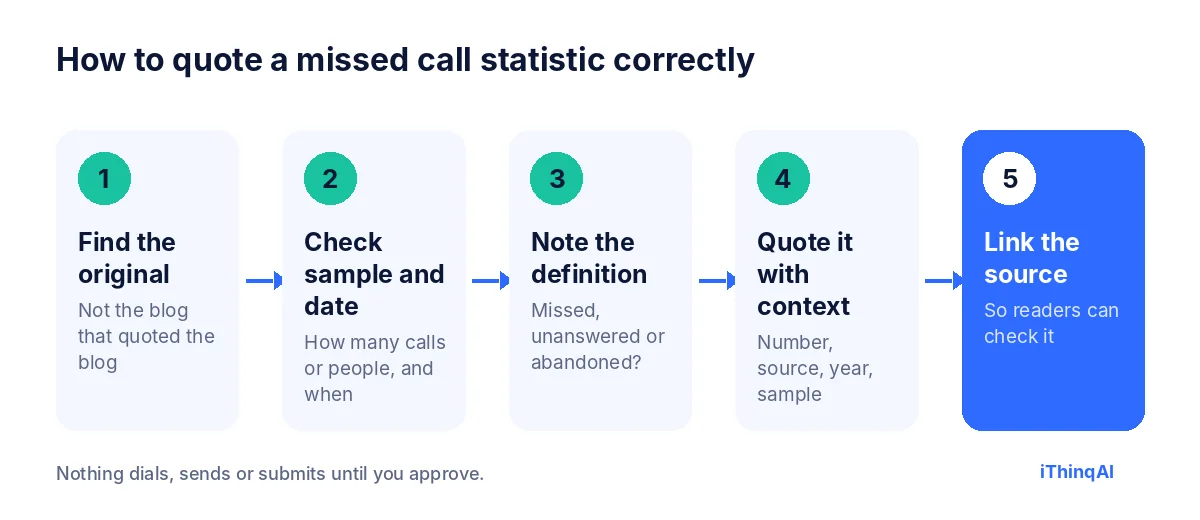
- Use the newest large dataset you can find, and name it.
- Include the sample size and the year next to every number.
- Say whether a figure is a survey or measured call data.
- Define "missed" the way the source does.
- Avoid the three myths above, or flag them as unsourced.
- Link to the original, not to a blog that quoted it.
Follow those six rules and your missed call statistics will hold up to anyone who checks them.
Missed call statistics by channel: phone, web forms and email
Calls aren't the only inquiries that go unanswered. The same pattern shows up across channels, and these unanswered call statistics have close cousins:
- Web forms: in the Harvard audit, the average first response to a web lead was 42 hours, and 23% of companies never responded.
- Email: in Clio's 2024 secret-shopper study, only 33% of law firms responded to an emailed inquiry, down from 40% in 2019.
- Phone: 44% of callers never reached a person in Invoca's 2026 data.
The lesson from these missed call statistics is that the problem isn't the channel. It's capacity and follow-through. A business that answers the phone but ignores web forms has only fixed one leak.
Missed call stats worth tracking in 2027
If you want to beat the averages, measure these five numbers every month in your own business:
- Live answer rate: calls answered by a person or agent, divided by all calls.
- Voicemail return time: median minutes from voicemail to callback.
- Web lead response time: median minutes from form to first contact.
- Booked-on-first-call rate: calls that ended with an appointment.
- After-hours share: calls that arrive outside business hours.
Those five missed call stats tell you more about your growth than any industry report, including this one.
How we chose the missed call statistics on this page
We used four rules. First, we preferred large datasets of real calls over surveys. Second, we included surveys only when they came from a named organization with a stated sample size. Third, we linked to the original publisher wherever we could reach it. Fourth, we labeled every survey as a survey and every vendor as a vendor. If a number didn't meet those rules, it went into the myths section instead.
What the data says to do
Every strong number points the same way. Answer more calls with a real conversation, not voicemail. Follow up in minutes, not days. And make sure the record lands somewhere a person, or an AI, will act on it.
That's what iThinqAI does on your existing number. It answers 24/7, books on the call, calls back missed and web leads after you approve the list and hours, and does the follow-up work on its own computer: the CRM record, the quote, the reminder and the morning report. Plans start at $299 a month (pricing).
How to use these missed call statistics in your own business
Use the industry numbers as a benchmark, then measure yourself. Pull last month's call log and calculate your own answer rate, voicemail rate and callback time. If your numbers look like the averages above, you're leaving money on the table. If they look better, you have a competitive advantage worth protecting. Either way, your own data is the statistic that matters most.
Who collects these numbers, and why that matters
Most missed call statistics come from companies that sell phone software, including us. Invoca, Quo, CallRail and Hiya all have products that benefit when businesses worry about missed calls. That doesn't make their data wrong; their datasets are large and their methods are published. It does mean you should prefer measured call data over opinion surveys, and read every number with its source in mind. The Harvard audit and Clio's secret-shopper study are useful precisely because they measured what businesses actually did.
Cite this page
Writing about missed calls? You're welcome to cite this page. Link to it, and name the original source and year beside each number, the same way we did. That keeps the next writer from repeating a myth.
Hear what the data recommends: call 561-715-7686. Then book a demo, or read why speed to lead matters so much.
P.S. The single most useful statistic for your business is your own. Count last month's missed calls tonight, then call 561-715-7686 and hear how many of them an AI would have answered.
Sources
- Invoca Lead Conversion Benchmarks 2026 (press release)
- Invoca: insights from 70 million calls
- Quo: small business callback statistics (2026)
- CallRail: survey of 1,000 U.S. consumers (2025)
- Hiya State of the Call 2026
- Harvard Business Review (2011), via BYU ScholarsArchive
- Clio 2024 Legal Trends Report highlights
- NAR 2026 Profile via Real Estate News
- SchedulingKit missed call statistics and AInora report
Frequently Asked Questions
What percentage of business calls go unanswered?
Invoca's 2026 analysis of more than 70 million calls found 44% of callers never reached a person.
Is it true that 62% of calls to small businesses go unanswered?
That figure comes from a 2016 study of 85 businesses that counted voicemail as unanswered. It's dated and small.
How many callers leave a voicemail?
In CallRail's 2025 survey, 42% of consumers said they leave one.
How many missed calls get returned?
Quo's 2026 analysis of 16.7 million missed calls found 69% got no callback within 48 hours.
Which industry returns the most missed calls?
In Quo's data, healthcare had the highest callback rate, at 41% within 48 hours.