Cost of Missed Calls: The Hidden Tax You're Losing (5 Steps)
Quick answer: the cost of missed calls equals the chance a caller would have bought, times what they would have spent, times the share who never come back. In CallRail's 2025 survey, 78% of consumers said they had abandoned a business after an unanswered call, and 82% said they'd call a competitor. For most service businesses, a handful of missed business calls a week adds up to thousands of dollars a month. The formula below takes three minutes.
Key takeaways
- Unanswered calls are a tax you pay without ever seeing the bill: no invoice, no line on your P&L.
- The tax is collected twice: once when nobody answers, and again when nobody calls back.
- Only 42% of consumers say they leave a voicemail. Most missed callers leave you nothing at all.
- iThinqAI answers every call on your existing number, books on the spot, calls back from lists you approve and does the follow-up on its own computer. Hear it at 561-715-7686.
What is the cost of missed calls for a small business?
The cost of missed calls is the revenue you lose when callers who would have bought from you can't reach you and buy elsewhere. Calculate it as missed prospect calls per month multiplied by your close rate and your average customer value. For a typical service business, that figure is usually in the thousands of dollars a month, and it compounds, because lost customers don't come back next year either.
There's no industry-wide dollar figure you can trust for your business. You have to calculate your own. That's good news: it means you can measure it, and anything you can measure, you can fix.
You're already paying the missed-call tax
There's a tax your accountant has never seen.
It doesn't show up on your P&L. There's no invoice. Nobody emails you a receipt.
But every week, you pay it. It's the missed-call tax: the money that rings your phone, hears nothing, and dials your competitor instead. You never meet these customers. You never know their names. You only feel them as growth that should have been bigger.
How big is the leak?
The research on missed business calls is consistent, and it isn't kind:
- 44% of callers to businesses never reach a person, according to Invoca's 2026 analysis of more than 70 million calls (Invoca).
- 78% of consumers have abandoned a business after an unanswered call. 82% say they'll call a competitor, and 21% say they do it immediately (CallRail, 2025).
- Only 42% say they leave a voicemail. The rest leave you nothing: no name, no number, just a missed-call line in your log.
- And even when there is a message, 69% of missed business calls get no callback within 48 hours (Quo, 2026).
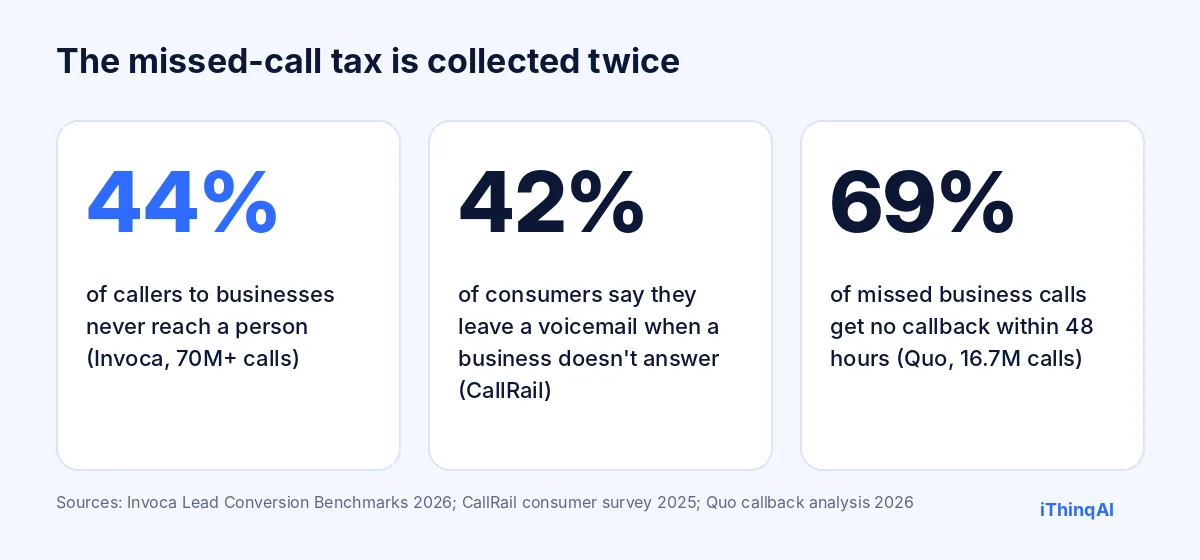
So the tax is collected twice. Once when you don't answer. Again when you don't call back.
Find the cost of missed calls for your business in three minutes
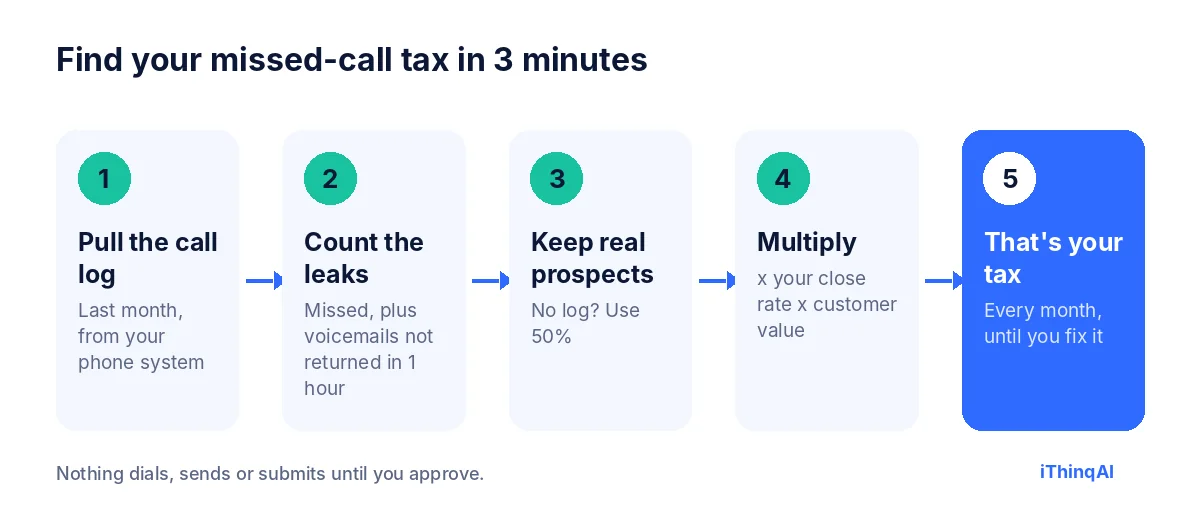
Grab your phone system's call log for last month. Then fill in four numbers:
- Missed calls per month: unanswered calls, plus voicemails not returned within an hour.
- Share that were real prospects: not spam, vendors or existing customers checking in. If you don't know, use 50%.
- Your close rate on prospects who actually reach you.
- Average value of a new customer: the first job, or lifetime value if you track it.
Missed calls × prospect share × close rate × customer value = your monthly missed-call tax.
Three examples (illustrations, not studies)
| Business | Missed calls/mo | Prospects | Close rate | Value | Tax per month |
|---|---|---|---|---|---|
| HVAC company | 60 | 50% | 40% | $450 | $5,400 |
| Dental office | 80 | 50% | 50% | $300 | $6,000 |
| Personal injury firm | 20 | 40% | 20% | $5,000 | $8,000 |
These are made-up but realistic inputs. Your numbers will be different. Run them anyway, because most owners guess low. They remember the calls they returned and forget the ones that never left a message.
Quick reference: monthly cost by call volume
If you don't want to run the full formula yet, this table gives a rough feel. It assumes half of missed calls are real prospects, a 30% close rate and a $400 average customer value. Swap in your own numbers when you can.
| Missed calls per month | Missed prospects | Lost customers | Approximate monthly cost |
|---|---|---|---|
| 10 | 5 | 1.5 | $600 |
| 25 | 12.5 | 3.75 | $1,500 |
| 50 | 25 | 7.5 | $3,000 |
| 100 | 50 | 15 | $6,000 |
Even the smallest row is enough to pay for an AI receptionist that answers every call. The larger rows explain why some owners feel busy every day yet never seem to grow.
How AI changes the math on unanswered calls
The formula has four inputs, and an AI front office moves three of them at once. It cuts the number of unanswered calls to near zero by picking up on the first ring at any hour. It raises your close rate by booking callers while their intent is highest, instead of hours later. And it protects customer value by remembering returning customers and following up on every open quote. You can't change your prices overnight, but you can change who answers the phone tonight.
Why the cost of missed calls compounds over time
The monthly number understates the damage, for three reasons.
Lifetime value walks out the door. A homeowner who books your competitor for a furnace repair will probably call them for the AC tune-up too. A patient who books a cleaning elsewhere tends to stay there for years.
Referrals go with them. Satisfied customers tell neighbors and friends. Every customer you lose to an unanswered call takes their referrals to someone else.
Marketing gets more expensive. You paid for the ad, the listing or the referral that made the phone ring. When the call is missed, that marketing spend is wasted, and your real cost per customer quietly rises.
That's why the true cost of missed calls is almost always bigger than the formula's first answer.
The cost of missed calls by industry
The cost of missed calls varies by industry because customer value and urgency vary. Here's how it usually plays out:
| Industry | Why missed business calls hurt | What one missed call can cost |
|---|---|---|
| Home services | Urgent problems; callers dial the next company immediately | A service call, plus the install that follows |
| Law firms | People call several firms; the first to respond often gets the case | A client relationship worth thousands |
| Real estate | Most buyers interview only one agent | A commission |
| Dental and medical | New patients book wherever they get through first | Years of visits |
| Insurance | A renewal question unanswered becomes a shopped policy | A policy and its renewals |
In every row, the cost of missed calls is bigger than the first transaction. That's why a few unanswered calls a week can outweigh the cost of fixing the problem many times over.
Unanswered calls vs. slow callbacks: which costs more?
Both cost money, in different ways.
Unanswered calls cost you the customers who never leave a message. You can't call back someone you don't know about, and in CallRail's survey only 42% of consumers said they leave a voicemail.
Slow callbacks cost you the customers who did leave a message but found someone faster. Harvard research found that firms trying to reach a lead within an hour were nearly seven times more likely to qualify it than firms that waited even one hour longer.
So the cost of missed calls isn't only about the ring nobody picked up. It's also about the gap between the message and the callback. Fix one without the other and you still leak.
How to track missed business calls every week
You can't fix what you don't measure. Set up this simple weekly review:
- Pull the call log every Monday for the previous week.
- Count missed business calls by day and hour. Look for the clusters.
- Count voicemails and check how many were returned within an hour.
- Check web forms the same way: time from submission to first contact.
- Write down one number: missed and unfollowed prospects. Watch it every week.
That one number tells you whether the cost of missed calls is shrinking or growing. Most owners have never seen it, which is exactly why the tax keeps getting collected.
How to cut the cost of missed calls this week
Even before you buy anything, you can reduce unanswered calls with four changes:
- Shorten your voicemail greeting and give callers one alternative, like a text number you actually monitor.
- Set a one-hour callback rule for every voicemail and web form, with one person responsible.
- Stagger lunch breaks so someone covers the phone between noon and one.
- Check after-hours voicemails first thing, before email.
Those steps help. They won't catch the callers who never leave a message, and they won't cover nights and weekends. For that, you need something that answers every call, every hour.
Why it happens (it's not laziness)
You're not missing calls because you don't care. You're missing them because:
- You're with a customer, on a ladder, in a procedure or in court.
- Calls bunch up: Monday mornings, lunch hour, right after your ad runs.
- Half your customers call after 5 PM, when they're finally off work.
- The callback lives on a sticky note, not in a system.
- Your front desk is doing four jobs at once, and the phone is only one of them.
None of those are fixed by "trying harder." They're fixed by changing who answers, and what happens after the answer.
When unanswered calls happen most
Missed business calls aren't spread evenly through the week. They cluster in a few predictable windows:
| Window | Why calls get missed |
|---|---|
| Monday 8 to 10 AM | Everyone calls about the weekend's problems at once |
| 12 to 1 PM | The front desk is at lunch, and customers call on theirs |
| After 5 PM on weekdays | Customers are off work; your office is closed |
| Saturday and Sunday | High intent, no staff |
| Right after a marketing push | A spike your team wasn't staffed for |
If your call log shows most unanswered calls in those windows, you don't have a people problem. You have a coverage problem, and coverage is exactly what an AI is good at.
How to stop paying the missed-call tax
The fix has three layers, and you need all three:
- Answer every call. iThinqAI's voice agent answers 24/7 on your existing number, in your business's name, and says it's an AI. It handles many calls at once, so nobody waits on hold.
- Finish the job on the first call. It answers questions from your knowledge base, books into your calendar and texts a confirmation before the caller hangs up.
- Call back what slips through. For web leads and any call that slips through, it calls back after you approve the list, the script and the calling window, and logs every attempt in the CRM.
Plug the leak behind the leak
Answering the call stops the first leak. The second leak is everything after it: the quote that never got sent, the record nobody updated, the reminder nobody made.
iThinqAI's agent has its own computer, with a browser, files and your connected tools, so it can:
- Send the quote, price sheet or intake form the moment the call ends.
- Update the CRM and move the deal to the right stage.
- Set the follow-up on the calendar so it actually happens.
- Hand you a daily list of every open lead, on a schedule, so nothing quietly expires.
That's the difference between an answering tool and an AI employee.
The reason why this works
Albert Lasker's whole philosophy fit in two words: reason why. So here's ours, plainly.
Missed calls aren't caused by a lack of effort. They're caused by a lack of capacity at the exact moments customers call. You can't hire your way out of that cheaply, because the moments are unpredictable and spread across 168 hours a week. An AI front office has unlimited capacity at every hour, follows the same rules every time, and writes down everything it does. It doesn't get tired at 7 PM or busy at 8 AM on Monday.
Fix capacity and the missed-call tax stops being collected.
Before and after: one week at a busy office
Before: 46 calls go unanswered. 19 leave voicemails. Seven of those get returned the same day. The owner spends Saturday morning calling back the rest; four have already hired someone else. Nobody knows what happened to the 27 who left no message.
After: every call is answered. 31 bookings land directly on the calendar. 9 callers get answers and say they'll call back when ready, and they're in the CRM with a follow-up set. 4 calls transfer to the owner with notes. Web leads get a call back within minutes. Saturday morning is free.
Those numbers are an illustration, not a promise. Run your own week.
What to do with the number once you have it
Write your monthly missed-call tax on a sticky note and put it on your monitor. Then compare every option against it: a part-time hire, a staffed answering service, a basic answering tool, or an AI front office. The right choice is the one that recovers the most of that number for the least money and effort. For most small businesses, that's the option that answers every call, books on the spot and follows up without anyone remembering to.
Common objections
"We don't miss that many calls." Check the log, not your memory. Most owners are surprised by after-hours and lunch-hour numbers.
"Callers will hang up on an AI." Some will. More hang up on voicemail. In CallRail's survey, 52% of consumers said businesses using AI assistants after hours provide superior service.
"I'll just call everyone back faster." Harvard Business Review's audit of 2,241 companies found the average response to a new lead was 42 hours (HBR, 2011). Good intentions don't scale. Systems do.
What it costs to stop the leak
| Plan | Price | Best for |
|---|---|---|
| Starter | $299/mo | Answering every call, booking, inbox and CRM |
| Growth | $799/mo | Adds callbacks, calling campaigns, dialer and automations |
| Scale | $1,999/mo | Adds computer use and multiple locations |
Prices as of November 2026 at ithinq.ai/pricing. Compare that to the number you just calculated.
The two-minute test
Call 561-715-7686 and ask it to book you an appointment. That's the sound of the tax being refunded.
Then book a demo and bring your three-minute number. We'll show you exactly where the leak is. Want the full data? Read our fact-checked missed call statistics, and see why after hours answering service coverage pays first.
P.S. The tax compounds. The caller who reached your competitor tonight will call them again next year and tell a neighbor. Call 561-715-7686 today, before another month of it goes on the books.
Sources
Frequently Asked Questions
How much does a missed call cost a small business?
Multiply your missed prospect calls by your close rate and average customer value. For many service businesses that's thousands of dollars a month, before lifetime value and referrals.
What percentage of callers don't leave a voicemail?
In CallRail's 2025 survey, 42% of consumers said they leave a voicemail, so most do not.
Do people call back if I miss their call?
Many don't. 82% of consumers in the same survey said they'd call a competitor instead.
When do businesses miss the most calls?
Monday mornings, lunch hour, after 5 PM and weekends, plus spikes after marketing pushes.
What's the fastest way to stop missing calls?
Put an AI agent on your existing number that answers every call, books appointments and follows up automatically.