AI Marketing Assistant: 7 Proven Ways to Win More Customers
Quick answer: an AI marketing assistant is an AI employee that does your day-to-day marketing work instead of just suggesting it. It drafts and sends email marketing from its own inbox, posts to all the major social networks, builds and publishes landing pages on your domain, and follows up with every lead the campaign creates by phone and text. You approve everything before it goes out. iThinqAI's AI marketing assistant also answers your business phone, so the calls your marketing creates never go to voicemail.
Key takeaways
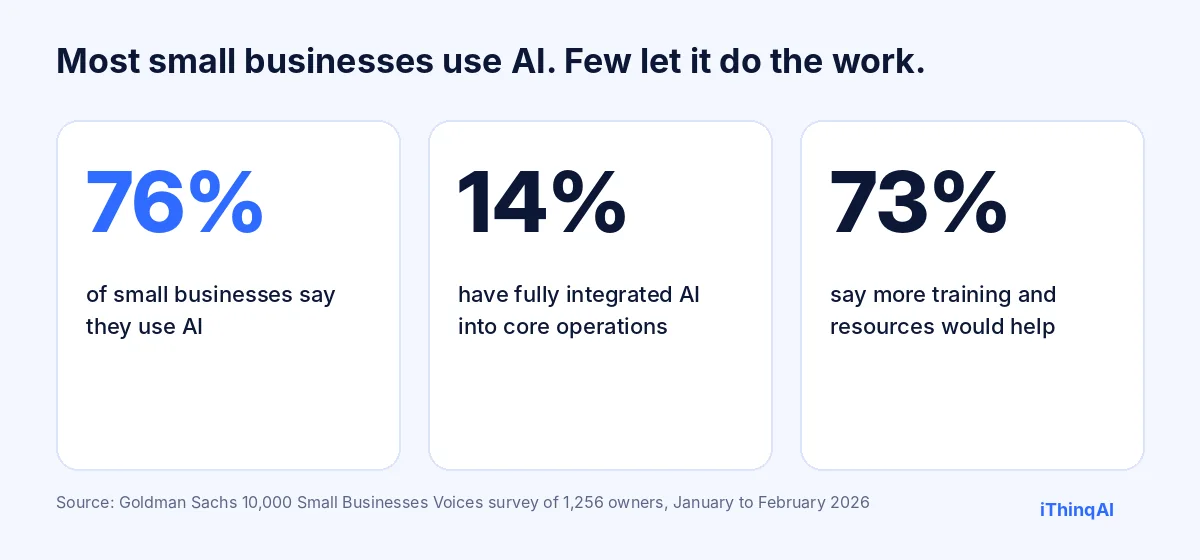
- Most owners already have AI tools. Goldman Sachs found 76% of small businesses use AI, but only 14% have fully built it into their operations.
- The gap isn't ideas. It's execution: sending, posting, publishing and following up, every week.
- An AI marketer that also answers calls and follows up closes the loop between marketing and revenue.
- iThinqAI drafts, publishes, sends and follows up, with your approval first. Hear it at 561-715-7686.
What is an AI marketing assistant?
An AI marketing assistant is software that handles marketing tasks for a business the way a junior marketer would: writing and sending emails, creating and publishing social posts, building landing pages, tracking responses and following up with leads. Unlike a writing tool, it carries the work through to the finish line, within permissions the owner sets. The best ones work across channels and keep every response in one place.
The marketing plan that lives in a notebook
Every owner has one. A notebook, a notes app or a whiteboard with the marketing you'd do "if you had time": a monthly email, three posts a week, a spring promotion, a page for the new service, a reminder to past customers.
Then the week happens. Customers call. A tech calls in sick. A supplier is late. The notebook stays closed.
That's not a strategy problem. It's a capacity problem. And it's exactly the problem an AI marketing assistant solves.
Why AI hasn't fixed marketing for most businesses (yet)
The tools are everywhere. Goldman Sachs' 2026 survey of 1,256 small business owners found 76% use AI, yet only 14% have fully integrated it into core operations, and 73% say more training and resources would help (Goldman Sachs).
Here's why. Most AI marketing tools write a draft and hand it back to you. You still have to edit it, schedule it, post it, send it, and then deal with the replies. The bottleneck was never the first draft. It was everything after.
Seven proven ways an AI marketing assistant wins more customers
1. It sends the email marketing you keep postponing
Monthly newsletters, promotions, seasonal reminders and win-back emails, drafted in your voice, approved by you and sent from the AI's own inbox on schedule. When people reply, it answers.
2. It posts to social media every week
It creates posts for all the major social networks from your photos, services and promotions, and publishes them on the schedule you approve. Consistency beats bursts.
3. It builds landing pages and funnels
Tell it the offer, and it builds a simple page with a form or booking link, published on the domain you choose. See our guide to the AI funnel builder.
4. It follows up with every lead the campaign creates
This is the step most marketing skips. When someone fills in the form, the AI texts within seconds and calls if they asked to be called, then books them. Read why speed to lead matters.
5. It answers the phone when your ad works
Marketing creates calls. iThinqAI answers every one on your existing number, so a successful promotion doesn't turn into a pile of voicemails.
6. It brings back past customers
Reactivation campaigns to past customers and old leads, from lists you approve, with reasons to come back. See reactivate old leads.
7. It reports in plain language
What went out, who replied, who booked and what to try next week. No dashboards to decode.
How a campaign runs
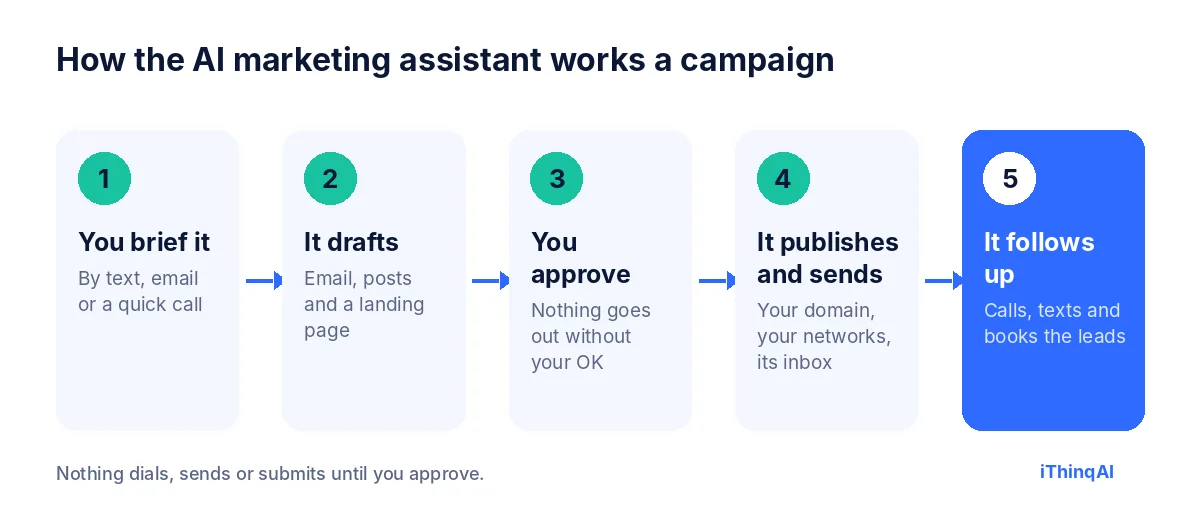
- You brief it by text, email or a quick call: "Spring tune-up special, $89, book by April 30."
- It drafts the email, the social posts and a landing page in your brand voice.
- You approve or ask for changes. Nothing goes out without your OK.
- It publishes and sends: posts to your networks, the page on your domain, the email from its inbox.
- It follows up: answers replies, calls and texts leads who asked, and books them on your calendar.
It has its own computer
What separates an AI marketer from a writing tool is the ability to actually do the work. On the Scale plan, iThinqAI's agent has its own computer, with a browser, files and your connected tools. It can:
- Build and publish a landing page, then test the form itself.
- Log into the web apps you use and update listings or promotions.
- Pull your customer list from a spreadsheet, clean it and segment it.
- Prepare a simple weekly report from your CRM.
You can watch every step and stop it at any time. It asks before publishing or sending anything.
The reason why this works
Albert Lasker built his agency on the definition his copywriter John E. Kennedy gave him: advertising is "salesmanship in print." Salesmanship doesn't stop at the pitch. It follows up, answers questions and asks for the order. An AI marketing assistant that writes the message and then answers the phone, replies to the email and books the appointment is salesmanship carried all the way through. That's why it produces customers, not just impressions.
Plain words convert better
Lasker preached simple, specific copy, and the data backs him. Unbounce's analysis of more than 41,000 landing pages found pages written at a fifth-to-seventh grade reading level converted at a median of 11.1%, versus 5.3% for pages written at a college level (MarketingProfs). Your AI marketing assistant should write the way your customers talk: short sentences, concrete offers, one clear next step.
What it does, and what you still own
| The AI marketing assistant handles | You still own |
|---|---|
| Drafting emails, posts and pages | The offer and the price |
| Publishing and sending on schedule | Final approval |
| Answering replies and calls | Big customer decisions |
| Following up and booking leads | Brand direction and strategy |
| Weekly reporting | What to try next |
Email marketing done right
Email marketing still works when it's relevant and respectful. The rules: send to people who gave you their email or are customers, use honest subject lines, include your postal address and a working unsubscribe, and honor opt-outs quickly. The FTC's CAN-SPAM guidance spells out the requirements (FTC). The AI follows them on every send, and it handles unsubscribe requests automatically.
Industry examples
| Business | Monthly campaign | What the AI follows up on |
|---|---|---|
| HVAC and plumbing | Seasonal tune-up special | Booking calls and texts from the page |
| Dental and medspa | New patient offer, recall reminders | Booking requests and DMs |
| Insurance agency | Policy review season | Review requests and callbacks |
| Real estate | Market update, home value check | Valuation requests and showings |
| Law firm | Educational newsletter | Consultation requests (no legal advice) |
A brief that becomes a campaign
Owner (by text): "Need a Mother's Day promo. Facials 20% off, book by May 10. Post it and email past clients."
AI: "Got it. I'll draft one email, three social posts and a booking page. Want to see them by 2 PM?"
2 PM: drafts arrive. The owner changes one line and approves.
3 PM: the email goes to past clients who opted in, posts are scheduled, the page is live on the business domain.
That evening: 14 clicks, 6 bookings, 2 questions answered by text, 1 call answered and booked.
What to measure
- Campaigns shipped per month (consistency first).
- Email reply and click rates.
- Landing page conversion rate.
- Leads followed up within five minutes.
- Bookings and revenue from each campaign.
AI marketer vs. marketing tools vs. agency
| Writing and scheduling tools | Marketing agency | AI marketer (iThinqAI) | |
|---|---|---|---|
| Creates content | Drafts | Yes | Yes |
| Publishes and sends | You do it | Yes | Yes, after your approval |
| Answers replies and calls | No | Rarely | Yes |
| Follows up with leads | No | Sometimes | Yes, within seconds |
| Works nights and weekends | No | No | Yes |
| Typical cost | Low | High monthly retainer | Plan price |
An agency is still great for brand strategy, big ad budgets and creative campaigns. An AI marketer covers the weekly production and follow-up most small businesses never get to.
The weekly marketing rhythm it runs
Marketing works when it's steady. A simple rhythm the AI marketing assistant can run for you:
- Monday: plan the week's posts from your calendar, promotions and recent jobs.
- Tuesday: publish posts and send any scheduled email marketing.
- Wednesday: follow up with every lead from the weekend and early week.
- Thursday: a second round of posts and a reminder to anyone who clicked but didn't book.
- Friday: a short report: what went out, who responded, who booked.
You spend ten minutes approving drafts on Monday and five minutes reading the report on Friday. Everything in between happens on schedule.
Email marketing ideas that work for local businesses
Email marketing doesn't need to be clever. It needs to be useful and regular. Ideas the AI can draft each month:
- A seasonal reminder: tune-ups, cleanings, policy reviews, tax season.
- A customer story: a real job, with permission, and what it solved.
- A how-to tip: something your customers ask about all the time.
- A limited offer: with a real deadline and a real reason.
- A thank-you: to loyal customers, with a referral offer.
Each email has one goal and one link. Replies get answered by the AI, and anyone ready to book gets booked.
How the AI marketer learns your voice
Give it examples: past emails you liked, posts that performed, the words you use with customers and the words you never use. It drafts in that style, and every edit you make teaches it more. Within a few weeks, most owners find the first drafts need only light changes. The goal isn't to sound like a marketing agency. It's to sound like you on a good day.
A month of marketing, before and after
Before: you post twice in the first week, then nothing for three weeks. The newsletter you meant to send in March goes out in May. A promotion runs, the phone rings, and half the calls go to voicemail while you're on a job. By the end of the month, you can't tell what worked.
After: posts go out three times a week. One email goes to past customers on the first Tuesday. A landing page for the monthly offer goes live on your domain. Every lead from the page gets a text in seconds, and every call is answered and booked. On the last Friday, you read a one-page summary of what went out, who replied and how many bookings came in. Next month's plan takes ten minutes.
Reviews and referrals on autopilot
Some of the best marketing happens after the job. A day after each completed job or appointment, the assistant can send a short thank-you with a review link, and a note about your referral offer. Happy customers leave reviews when they're asked at the right moment. Unhappy ones get flagged to you first, so you can fix the problem before it becomes a public complaint.
What it needs from you to start
Your AI marketing assistant can only be as good as what it knows. Before the first campaign, share:
- Your services, prices and the offers you're comfortable making.
- Photos of real work, your team and your location.
- Two or three emails or posts you liked.
- Words and claims to avoid, such as guarantees you can't make.
- Who approves content, and how fast you can review drafts.
That's an hour of setup. After it, the work runs every week, and you stay in charge of every word that goes out.
Guardrails that protect your brand
- Approval first: every email, post and page waits for your OK until you decide otherwise.
- No invented claims: no fake reviews, results or testimonials, ever.
- Respect opt-outs: unsubscribe and stop requests are honored automatically.
- Real names only: customer stories go out only with permission.
When to bring in a person
Some marketing still needs a human expert: a rebrand, a big paid-ads budget, a sensitive announcement or a crisis. The assistant doesn't replace that judgment. It frees up the time and money to get it when you need it, because the weekly production work is already handled. Think of it as the reliable junior teammate who keeps the basics running, so your occasional expert can focus on the big moves.
Seasonal campaigns you can plan once
Plan the year in one sitting: a campaign for each season or holiday that matters to your customers. Approve the outline once, and the assistant drafts each campaign a few weeks ahead, so nothing sneaks up on you.
Common objections
"AI content sounds generic." It sounds generic without direction. Give it your voice, your offers and real customer stories, and approve every piece.
"I'll lose control of my brand." Nothing publishes without your approval, and you can watch every step.
"I already use a scheduler." A scheduler posts what you made. An AI marketing assistant makes it, posts it and handles what happens next.
What it costs
iThinqAI's published plans, as of November 2026:
| Plan | Price | Marketing capabilities |
|---|---|---|
| Starter | $299/mo | Answers every call from your marketing, books, gives the AI its own email address, unified inbox and CRM (2 seats, 1,000 AI minutes) |
| Growth | $799/mo | Adds email and calling campaigns, dialer, prospect discovery and automations (5 seats, 5,000 AI minutes) |
| Scale | $1,999/mo | Adds computer use for building and publishing pages, plus multiple locations and numbers (15 seats, 15,000 AI minutes) |
Prices at ithinq.ai/pricing. Compare with the cost of a part-time marketer in our guide to the cost to hire a marketing assistant.
Who it's not for
If you have a full marketing team with clear processes, you may only need an AI to answer calls and follow up. It pays off for owners who know what marketing they should do and never have time to do it.
Your first two weeks
Days 1 to 3: share your services, prices, photos, brand voice and past emails. Connect your social accounts and domain.
Days 4 to 7: approve your first campaign: one email, three posts and one landing page.
Week 2: let it follow up with every lead, then review results and plan next month's calendar together.
Hear it now
Call 561-715-7686. Ask about a promotion, the way a customer who just saw your ad would. Then imagine that call coming from your own campaign.
Then book a demo and bring one promotion you've been meaning to run. Related: AI social media manager and AI personal assistant for business owners.
P.S. The promotion in your notebook could be live by tomorrow. Call 561-715-7686 today and hear the employee who would run it.
Sources
Frequently Asked Questions
What does an AI marketing assistant do?
It drafts, publishes and sends marketing (email, social posts, landing pages), then follows up with the leads it creates.
Can it post to social media for me?
Yes. iThinqAI posts to all the major social networks on a schedule you approve.
Can it send email marketing?
Yes. On every plan, the AI has its own email address to send approved emails and answer replies. Email campaigns to lists start on the Growth plan.
Will it publish without my approval?
No. Nothing goes out until you approve it.
Is an AI marketer better than hiring?
It handles production and follow-up at a lower cost. Strategy and big decisions stay with you.