AI Funnel Builder: 5 Simple Steps to a Funnel That Wins
Quick answer: an AI funnel builder turns a short description of your offer into a working sales funnel: a landing page with clear copy, a form or booking link, and automatic follow-up for every lead. With iThinqAI, you text the offer, approve the page, and it publishes on the domain you choose. Then the same AI texts and calls each new lead within seconds and books them on your calendar. The page gets the click; the follow-up gets the customer.
Key takeaways
- Most funnels fail after the form, not before it. Leads that wait for a callback go cold.
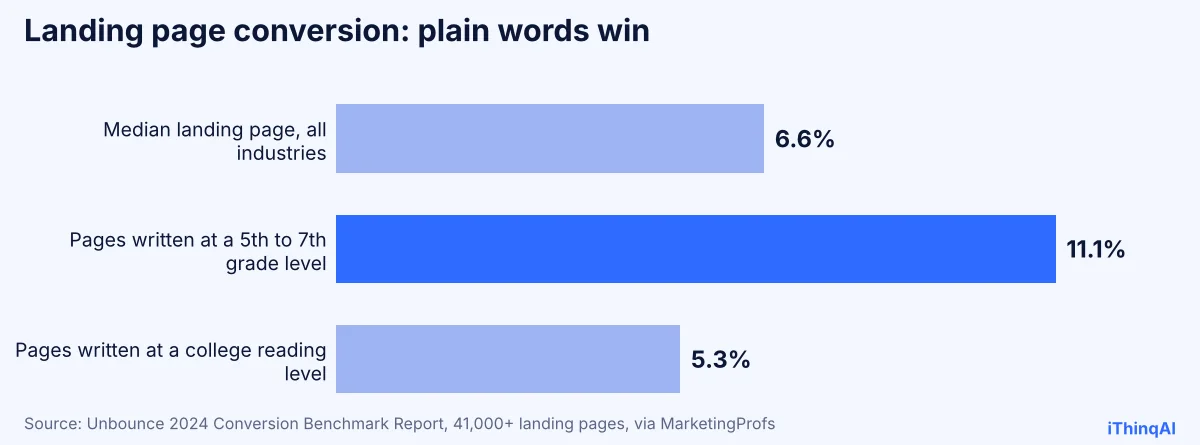
- Plain copy converts. Unbounce found landing pages written at a 5th to 7th grade reading level converted at 11.1%, versus 5.3% at a college level.
- An AI funnel builder that also follows up closes the gap between "lead" and "booked."
- iThinqAI builds the page, publishes it on your domain and follows up with every lead. Hear it at 561-715-7686.
What is an AI funnel builder?
An AI funnel builder is a tool that creates the parts of a sales funnel for you: a landing page, a lead form or booking link, a thank-you step and the follow-up messages. You describe the offer and the audience; it writes the copy, builds the page and connects the pieces. The most useful ones also handle what happens after someone fills in the form, by texting, calling and booking the lead.
The idea that never got a page
Every owner has had it. A slow week, a new service, a seasonal special. "We should run a promotion." You know what the offer would be. You even know who it's for.
Then you think about building the page. The website login you don't remember. The designer who takes two weeks. The form that needs to connect to something. The leads that will need calling back while you're on jobs.
So the promotion never runs.
An AI funnel builder removes every one of those steps. You describe the offer in a text. It does the rest.
Why most funnels leak
Picture a sales funnel as four steps: someone sees your offer, clicks to a landing page, fills in the form, and becomes a customer. Most businesses obsess over the first two. The money leaks out of the last two.
The landing page itself matters: Unbounce's analysis of more than 41,000 landing pages found a median conversion rate of 6.6%, with pages written at a 5th to 7th grade reading level converting at 11.1% versus 5.3% for college-level copy (MarketingProfs).
But even a great page fails if the lead waits. The 2011 Harvard Business Review study of 2,241 companies found firms that contacted leads within an hour were nearly seven times as likely to qualify them as firms that waited longer (HBR). A funnel without fast follow-up is a leaky bucket.
Five simple steps to a funnel that wins
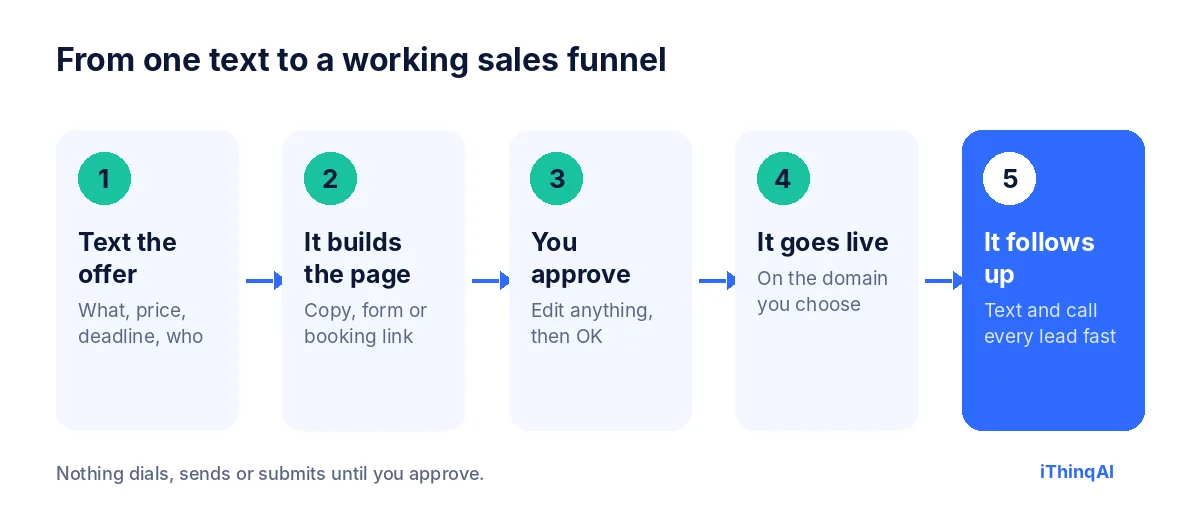
1. Text the offer
Tell it four things: what you're offering, the price, the deadline and who it's for. "Spring AC tune-up, $89, book by April 30, homeowners in Henderson and Summerlin."
2. It builds the page
It writes a headline, a short explanation, three reasons to act, a clear price, and one call to action: a form or a booking link. It uses your photos and brand colors.
3. You approve
You see the page before anyone else does. Change a word, swap a photo, then approve. Nothing goes live without your OK.
4. It goes live on your domain
The page publishes on the domain you choose: your main website's domain or a separate one for campaigns. Your brand, your address.
5. It follows up with every lead
When someone fills in the form, they get a text within seconds. If they asked to be called, the AI calls, answers questions and books them on your calendar.
What goes on a landing page that converts
| Section | What it says | Why it works |
|---|---|---|
| Headline | The offer and the outcome in plain words | Tells visitors they're in the right place |
| Subhead | Who it's for and the deadline | Creates relevance and urgency |
| Three reasons | Specific benefits, not adjectives | Gives the reason why |
| Proof | Real reviews or photos, with permission | Builds trust |
| Price | The real number | Removes doubt |
| One button | Book now or get a quote | One clear next step |
| Consent line | Permission to call and text about the request | Keeps follow-up compliant |
Short pages work for simple offers. Longer pages work for bigger decisions. The AI picks a length that fits the offer and keeps the copy simple.
It has its own computer
Here's what makes iThinqAI's AI funnel builder different. On the Scale plan, the agent works on its own computer, with a browser, files and your connected tools. It builds the page the way a person would, publishes it, then tests the form itself to make sure leads arrive in your inbox and CRM. If something breaks, it tells you. You can watch each step and stop it at any time. It asks before publishing anything.
The reason why this works
Albert Lasker's whole philosophy was "reason why" advertising: tell people plainly why they should act now. A funnel is that philosophy in a page: one offer, specific reasons, a deadline and a clear next step. Then follow-up does what a great salesperson does, and answers questions while interest is high. Combine both, and you turn attention into appointments instead of page views.
Funnels for every kind of business
| Business | Funnel idea | Follow-up that books |
|---|---|---|
| HVAC and plumbing | Seasonal tune-up special | Text and call to pick a time |
| Dental | New patient exam offer | Booking with insurance questions answered |
| Medspa | Limited-time treatment package | DM and text booking |
| Insurance agency | Free policy review | Review booked with a licensed agent |
| Real estate | Free home value report | Valuation appointment |
| Law firm | Free guide or consultation request | Intake and consult booking, no legal advice |
A funnel built by text
Owner (7:55 AM): "New offer: gutter cleaning plus roof inspection, $199, this month only. Homeowners in Las Vegas. Use our truck photo."
AI (8:20 AM): "Draft ready: headline, three reasons, price, booking form and a consent line. Publish on yourdomain.com/gutters?"
Owner: "Change 'roof inspection' to 'free roof check'. Then publish."
AI (8:31 AM): "Live. The form sends leads to your inbox and CRM. I'll text each lead within seconds and call anyone who asks."
That evening: 9 form fills, 6 texts answered, 4 calls, 5 jobs booked.
Keep the follow-up compliant
This is general information, not legal advice.
Calls and texts that use an AI voice or automated systems are regulated. AI-voice calls fall under the TCPA's artificial-voice rules, which generally require prior consent (Mayer Brown). Every landing page the AI builds includes a clear consent line next to the form, so people who ask for a callback agree to be contacted about their request. Stop requests are honored automatically.
What to measure
- Page conversion rate: form fills divided by visitors.
- Speed to first contact: seconds from form fill to first text.
- Contact rate: leads who answered a text or call.
- Booked rate: appointments per lead.
- Revenue per funnel: compare it with what the promotion cost.
Then test one change at a time: a new headline, a different photo, a shorter form.
The sales funnel, explained in one minute
A sales funnel is the path a stranger takes to become a customer. For most local businesses it has five stages:
- Attention: they see a post, an ad, an email or a search result.
- Interest: they click to a page about one specific offer.
- Action: they fill in a form, book a time or call.
- Conversation: someone answers their questions quickly.
- Purchase: they book the job or appointment.
Most owners build stage one and skip the rest. An AI funnel builder handles stages two through five, so the attention you already get turns into paying customers.
AI funnel builder vs. website builders and agencies
| Website builder | Funnel software | Agency | AI funnel builder (iThinqAI) | |
|---|---|---|---|---|
| Who builds the page | You | You | Them | The AI, from your text |
| Time to launch | Days | Days | Weeks | Hours |
| Writes the copy | No | Templates | Yes | Yes |
| Publishes on your domain | Yes | Usually | Yes | Yes |
| Follows up with every lead | No | Email only, usually | Rarely | Text, call and book |
| Answers your phone | No | No | No | Yes |
Website builders and funnel software are good tools if you have time to use them. Agencies are great for big brands with budgets. The AI funnel builder is for the owner who wants the offer live this week and every lead called back today.
Writing a landing page in plain words
Lasker's copywriters had a simple test: would a salesperson say this out loud to a customer? Use it on every landing page.
- Bad: "Leveraging industry-leading expertise to deliver comprehensive climate solutions."
- Good: "Your AC checked, cleaned and ready for summer. $89. Book by April 30."
Short sentences. Real numbers. One offer. One button. That's why plain pages outperform clever ones in the data above, and it's the style the AI writes in by default.
Five funnels to launch this quarter
- The seasonal special: a tune-up, cleaning or check-up with a deadline.
- The new customer offer: a first-visit price that brings people in the door.
- The free assessment: a home value report, policy review or inspection.
- The win-back: a page for past customers who haven't booked in a year.
- The referral page: a simple page your happy customers can share.
Each one is a single text to start. Run one a month, measure the bookings, and keep the winners running.
How the follow-up turns leads into bookings
The moment a form is submitted, the follow-up starts:
- Within seconds: a text confirming the request and offering two times.
- Within minutes: a call, if they asked to be called.
- Same day: a second text if they didn't answer, with a booking link.
- Next day: a final friendly check-in.
Every step stops the moment they book or ask to stop. That speed is what makes a sales funnel profitable, because the business that responds first usually wins the job.
Choosing a domain for your campaigns
You have two good options. Publish offers on your main website's domain, for example yourbusiness.com/spring, so every visit builds trust in the name customers already know. Or use a separate short domain just for promotions, which keeps your main site clean and makes campaign links easy to read on a truck wrap or a flyer. Either way, the page carries your brand, your phone number and your address, and the leads go to the same inbox and CRM as everything else.
Where to send traffic
A great offer page needs visitors. The cheapest sources are the ones you already have:
- Your social posts: link the offer in this week's posts.
- Your email list: one short email to past customers who opted in.
- Your Google Business Profile: add the offer as a post with a link.
- Your phone line: when callers ask about specials, the AI texts them the link.
- Your trucks, signs and receipts: a short, easy-to-type address.
Paid ads can come later, once you know the offer converts.
Testing without the guesswork
Change one thing at a time and give each version enough visitors to judge fairly. The most valuable tests are usually the simplest: the headline, the price framing, the photo and the length of the form. The AI tracks visits, form fills and bookings for each version and tells you which one won in plain words. Keep the winner, try the next idea, and the offer gets better every month.
What happens to leads who don't book
Not everyone is ready this week. People who filled in the form but didn't book get a polite check-in a few days later, and again before the offer's deadline. After that, they join your regular customer list, if they agreed to hear from you, so the next offer reaches them too. Nothing is wasted, and nobody is chased forever.
A month of offers, before and after
Before: you have three promotions in mind and launch none. One goes out as a social post with no link and a phone number. Calls come in while you're on jobs, and most go to voicemail. You can't tell whether it worked.
After: each offer gets its own page on your domain, linked from your posts, email and profile. Every form fill gets a text within seconds, and every call is answered. At the end of the month, you see visits, leads and bookings for each offer side by side, and you know exactly which one to run again.
Mobile first, always
Most people will see your offer on a phone. Every page the AI builds is checked on a small screen first: big text, a short form, a button that's easy to tap, and a phone number that dials with one touch. If it's hard to use with one thumb, it gets fixed before it goes live.
Common objections
"I already have a website." Good. A landing page is a focused page for one offer, and it can live on your existing domain.
"Funnels feel salesy." Plain words, real photos and an honest offer don't. Hype does.
"I won't have time to call the leads." You don't need to. The AI texts and calls them and books the ready ones.
What it costs
iThinqAI's published plans, as of November 2026:
| Plan | Price | Funnel capabilities |
|---|---|---|
| Starter | $299/mo | Answers every call from your funnel, books, its own email address, inbox and CRM (2 seats, 1,000 AI minutes) |
| Growth | $799/mo | Adds campaigns, dialer, prospect discovery and automations (5 seats, 5,000 AI minutes) |
| Scale | $1,999/mo | Adds computer use, so it builds and publishes landing pages and funnels on your domain (15 seats, 15,000 AI minutes) |
Prices at ithinq.ai/pricing.
Who it's not for
If you sell complex enterprise products with long sales cycles, you'll want a full marketing team. An AI funnel builder fits local and small businesses with clear offers that customers can book.
Your first funnel this week
Day 1: choose one offer with a real deadline.
Day 2: text it to the AI and approve the page.
Day 3: share the page in your social posts, email and Google Business Profile.
Days 4 to 7: let the AI follow up with every lead, then review bookings and decide on next month's offer.
Hear it now
Call 561-715-7686. Pretend you just filled in a form for a special and hear how it follows up and books.
Then book a demo and bring one offer. We'll build the page together. Related: AI marketing assistant, speed to lead and AI appointment setter.
P.S. The promotion you've been meaning to run could be live on your domain by lunch tomorrow. Call 561-715-7686 today and hear who would follow up with every lead.
Sources
Frequently Asked Questions
What does an AI funnel builder do?
It creates a landing page, form and follow-up for an offer, from a short description you give it.
Can the funnel use my own domain?
Yes. iThinqAI publishes on the domain you choose.
Does it follow up with leads?
Yes. It texts each lead within seconds and calls those who ask, then books them on your calendar.
Do I approve the page first?
Yes. Nothing goes live until you approve it.
Which plan builds landing pages?
Building and publishing pages uses computer use, which is on the Scale plan.