AI Appointment Setter: 6 Proven Ways to Win More Bookings
Quick answer: an AI appointment setter is a voice agent that calls your leads and customers, qualifies them and books them straight into your calendar, then confirms and reminds them. It works every lead within minutes, never forgets to ask for the appointment, and costs a fraction of a human setter. Use it to handle appointment setting and book more appointments; keep your people for the appointments themselves.
Key takeaways
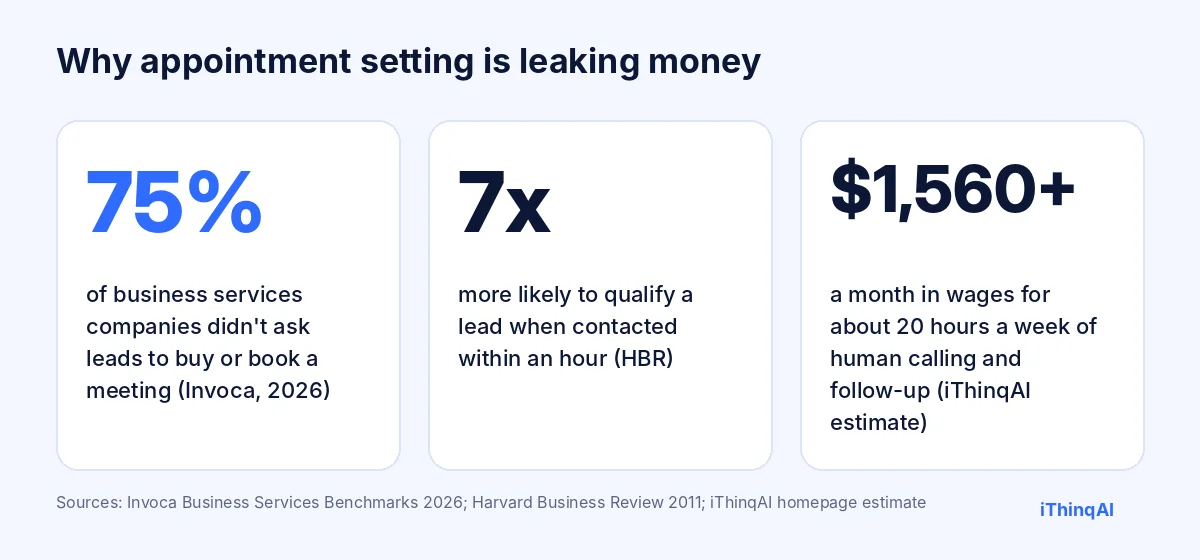
- 75% of business services companies didn't ask leads to book on the call, according to Invoca's 2026 research.
- Hiring for about 20 hours a week of calling and follow-up runs roughly $1,560 to $2,170 a month in wages alone.
- An AI appointment setter calls within minutes, asks for the booking every time, confirms, reminds and reschedules.
- iThinqAI does it from lists you approve, and does the prep and paperwork on its own computer. Hear it book you at 561-715-7686.
What is an AI appointment setter?
An AI appointment setter is an AI voice agent that contacts leads and customers by phone, asks qualifying questions, and books appointments directly into your calendar. It also sends confirmations, makes reminder calls and reschedules cancellations. The best ones work only from lists you approve, identify themselves as AI, and hand interested prospects to a human closer with notes attached.
Your calendar has holes. Your CRM has names.
Look at next week's calendar. Now look at your CRM. Somewhere in there are dozens of people who asked about your services and never got a second call.
The gap between those two screens is an appointment setter's whole job. Most small businesses never fill it, because the job is boring, constant and easy to put off.
The question nobody asks
Here's a number that should make every owner wince. In Invoca's 2026 research on business services companies, 75% didn't ask leads to buy or book a meeting on the call (Invoca).
Three out of four. The lead called, the team was friendly and helpful, and then nobody said: "Can I get you on the calendar for Thursday?"
An AI appointment setter asks every single time. Not because it's pushy. Because you told it to.
Why speed matters in appointment setting
Appointment setting is a race. Harvard Business Review's audit of 2,241 U.S. companies found that firms trying to reach a lead within an hour were nearly 7 times more likely to qualify it than firms that waited an hour longer, and the average response took 42 hours (HBR, 2011). A human setter working a queue can't call every lead within minutes. An AI can.
The human option, priced honestly
On our homepage we estimate that hiring someone for about 20 hours a week of outbound calling and follow-up, whether an appointment setter, virtual assistant or SDR, runs roughly $1,560 to $2,170 a month in wages alone in the U.S., before benefits, training and turnover.
That person can make one call at a time, during their shift. They'll get sick, get bored and eventually leave. We're not knocking them; great setters are worth every penny. But most small businesses can't afford one, and the ones who can still can't cover nights and weekends.
What an AI appointment setter does all day
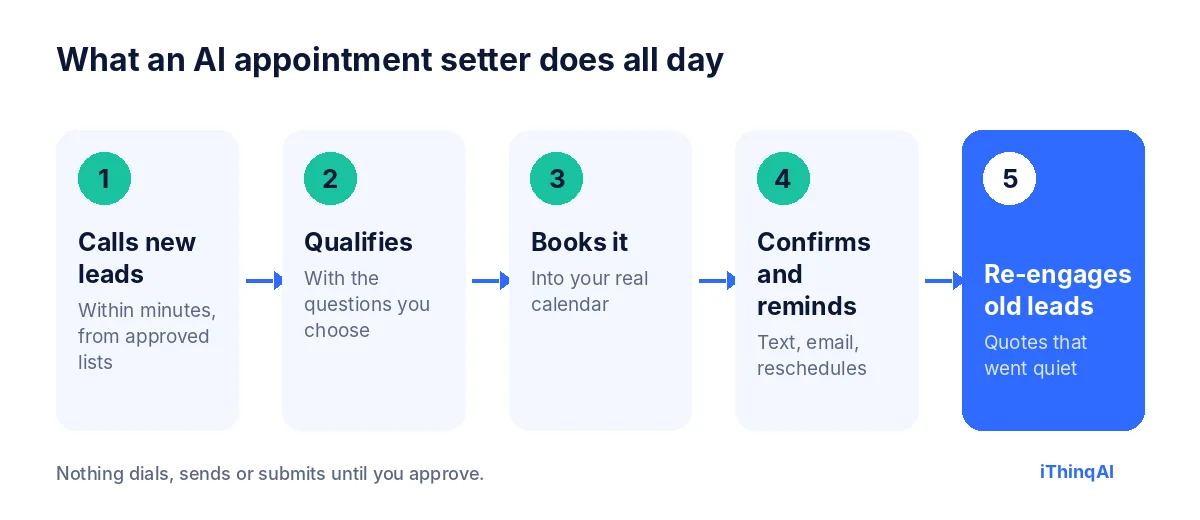
- Calls new leads within minutes of a form, a portal inquiry or a missed call.
- Qualifies with the questions you choose: need, timing, budget, location.
- Books into your real calendar, on the call.
- Confirms and reminds by text or email, and calls to reschedule if they cancel.
- Re-engages old leads you approve: quotes that went quiet, the "call me in spring" list.
- Logs everything in the CRM with notes, and transfers hot prospects to your team live.
All outbound work starts only after you approve the list, script and calling window. Daily limits and Do Not Call controls are built in.
An appointment setter with its own desk
A human setter spends half the day on prep and paperwork. iThinqAI's agent has its own computer, with a browser, files and your connected tools, so it does that part too:
- Researches the lead's business online before calling.
- Remembers past conversations, so the second call picks up where the first left off.
- Sends the calendar invite, the prep email and the reminder.
- Hands your closer a short brief before every meeting.
That's how an AI appointment setter helps you book more appointments without adding work for anyone.
The reason why it books more appointments
Albert Lasker built advertising on giving people a reason why. Here's ours: appointments come from three things, and an AI is better than a busy human at all three.
Speed. It calls within minutes, while interest is highest.
Consistency. It asks for the booking on every call, offers two specific times and confirms before hanging up.
Persistence. It follows up on schedule: the second call, the reminder text, the reschedule. Most lost appointments aren't refusals; they're conversations nobody continued.
5 ways to book more appointments with the leads you already have
You don't need more leads to book more appointments. You need to work the ones you have:
- Call every new lead within minutes. Interest fades by the hour, and the first to call usually gets the meeting.
- Offer two specific times. "Thursday at 10 or Friday at 2?" books more appointments than "When works for you?"
- Follow up at least three times. Call, text, call again. Many people book on the second or third touch.
- Work the quiet quotes. People who asked for a price last month are some of your warmest prospects.
- Rebook every cancellation the same day. A canceled slot is a prospect who still has the need.
An AI appointment setter does all five automatically, from lists you approve, without anyone on your team having to remember.
Appointment setting scripts that work
The best appointment setting scripts are short. A simple structure:
- Open: who's calling, that it's an AI, and why: "calling about the quote you requested."
- Qualify: two or three questions that matter. Need, timing, location.
- Offer: two specific times.
- Confirm: repeat the time and send a text or calendar invite.
- Exit: a polite way to opt out, every time.
Write one script per lead source. A web-form lead, a renewal and an old quote each need a different first sentence. Your AI appointment setter uses the right one automatically.
How to reduce no-shows after the booking
A booked appointment only counts if the person shows up. Add three touches: a confirmation right after booking, a reminder the day before, and a short message the morning of. Let people reschedule in the same conversation, so a conflict becomes a new time instead of a no-show. An AI appointment setter handles all three and updates the calendar when plans change.
Appointment setting for small teams vs. sales teams
For a small business, appointment setting usually means the owner calling leads at night. The AI takes that job completely and leaves the owner with a calendar of booked visits.
For sales teams, appointment setting is the work SDRs do before handing off to closers. Here the AI handles first contact and the routine follow-ups, and passes qualified, booked prospects to people. The team stays the same size while the number of qualified conversations grows.
What your closers gain
When the AI handles booking, your closers stop spending mornings dialing and afternoons chasing. They walk into each meeting with a brief: who the person is, what they asked about and what they care about. They spend their day doing the one thing only they can do, which is helping people decide.
How the AI handles objections on the call
Prospects push back, and a good script plans for it. Common objections and how the agent responds:
- "I'm just looking." "That's fine. A 15-minute visit gives you a firm price, with no obligation. Would Thursday or Friday be easier?"
- "Send me something instead." "Happy to. I'll email the details now. Would you also like a time to talk them through?"
- "It's too expensive." "Prices depend on the job. Our advisor can give you options at different budgets. Want me to hold a time?"
- "Call me next month." "No problem. I'll set a reminder for early next month. Is a morning or afternoon call better?"
Each response keeps the door open without pressure, and every outcome lands in the CRM with the next step already scheduled.
Which leads to give the AI first
Start where the payoff is fastest. Recent web-form inquiries are first: they asked to be contacted, and speed matters most. Missed calls from the last week come next. Then quotes sent in the last 90 days that never closed. Past customers due for routine service follow after that. Save older, colder lists for last, and only if you have a clear reason and permission to contact them. Starting with the warmest leads gives you quick wins and a clean baseline for measuring results.
When someone wants a human
Some prospects will ask for a person, and that's a good sign; they're engaged. The agent can transfer the call live to whoever is available, or book a call with the right person and send both sides a confirmation. Either way, the notes travel with the prospect, so nobody has to start the conversation over.
Mistakes to avoid in the first month
- Turning on every list at once. Start with one source, learn from the calls, then expand.
- Writing a long script. Long calls lose people. Keep the first call under three minutes.
- Offering open-ended times. Two specific options book more than "whenever works."
- Skipping reminders. A booking without reminders invites no-shows.
- Not reading the summaries. The first week of calls tells you exactly how to improve the script, so set aside twenty minutes a day to read them.
How to judge success after 30 days
Compare the month before and the month after on four numbers: time from lead to first contact, the share of leads that got at least three attempts, booked meetings, and show rate. If all four moved in the right direction, expand to the next list. If one stalled, the call summaries will show you why, usually a script line that confuses people or a time window that doesn't suit them. Fix it, run another month, and keep the lists growing only as fast as your team can handle the meetings. A full calendar is only good news if the people in those meetings get your best attention.
Where humans still win
AI sets the appointment. Humans should usually run it.
If your sale is complex, emotional or high-dollar, your best closer belongs on that call, with the AI's notes in front of them. That's the setup we recommend: the AI fills the calendar, and your people spend their day talking to qualified, booked prospects instead of chasing voicemails.
AI appointment setter vs. human setter
| Human appointment setter | AI appointment setter | |
|---|---|---|
| Speed to first call | When they get to it | Within minutes |
| Hours covered | Their shift | Your approved calling window, every day |
| Calls at once | One | Many |
| Asks for the booking | When they remember | Every call |
| Notes and CRM updates | Often incomplete | Automatic |
| Follow-up and reminders | Manual | Scheduled |
| Complex conversations | Strong | Hands off to your team |
Appointment setting by industry
| Industry | What gets booked | Where leads come from |
|---|---|---|
| Home services | Estimates, service calls, tune-ups | Web forms, missed calls, past customers |
| Insurance | Policy reviews, quote calls | Renewal lists, quote forms |
| Real estate | Showings, listing consultations | Portals, sign calls, past clients |
| Dental and medspa | Consultations, cleanings, treatments | Web forms, Instagram, recall lists |
| B2B services | Discovery calls, demos | Inbound inquiries, event lists, referrals |
A sample booking call
AI: "Hi Maria, this is the AI assistant for Summit Insurance, calling about the quote you requested this morning. Do you have a minute?"
Maria: "Sure."
AI: "Are you looking at home, auto or both?"
Maria: "Both, we just moved."
AI: "Congratulations. Our agent can review both with you Wednesday at 4 or Thursday at 11. Which works?"
Maria: "Thursday."
AI: "You're booked for Thursday at 11. I'm sending a calendar invite and a short list of what to have ready."
That's appointment setting done right: fast, honest, specific and confirmed.
How to set up an AI appointment setter in a week
- Day 1: Choose one lead source, usually your website form.
- Day 2: Write four qualifying questions and two booking options.
- Day 3: Connect your calendar and set appointment types and lengths.
- Day 4: Approve the list, calling window and daily limit.
- Day 5: Test calls to yourself and your team. Tune the script.
- Days 6 and 7: Go live and read every call summary.
Metrics to watch
Track four numbers weekly: minutes from lead to first call, connect rate, booking rate per connected call, and show rate. If show rate is low, add a reminder call the day before. If booking rate is low, simplify the offer to two specific times.
Common objections
"Leads will know it's an AI." They should. It says so up front, and most people care more about getting a time than about who offered it.
"Our sales process is too complex." Then let the AI book the discovery call and let your expert handle the complexity.
"We tried a call center once." An AI appointment setter follows your script exactly, every time, logs everything and never gets tired. That's the part call centers struggled with.
What it costs
AI calling campaigns and the dialer come in the Growth plan: $799 a month with 5 seats, 5,000 AI minutes, prospect discovery and automations. Starter ($299) covers inbound booking only. Prices as of November 2026 (ithinq.ai/pricing).
The math that matters: what's one extra booked appointment worth to you? Now multiply by the number of leads sitting untouched in your CRM.
Picture Friday afternoon
You open next week's calendar. It's full. Every slot has a name, a note and a confirmation sent. Tuesday's cancellation was rebooked to Wednesday by text. You didn't make a single call.
Book yourself first
Call 561-715-7686 and ask the AI to book you an appointment. Pay attention to how it asks for the booking. Then imagine that happening on every lead in your CRM.
Ready? Book a demo, and yes, the AI will happily confirm it for you. For the speed side, read speed to lead; for old leads, see reactivate old leads.
P.S. Pull 20 leads from your CRM that never booked. Those are your first test. Call 561-715-7686 today, then let us show you what happens when every one of them gets a call this week.
Sources
Frequently Asked Questions
What is an AI appointment setter?
A voice agent that calls leads and customers, qualifies them and books appointments into your calendar, then confirms and reminds them.
Can an AI appointment setter replace an SDR?
It can handle first contact, qualification and booking for most small businesses. Complex sales still benefit from a human closer.
Does it call people without permission?
No. iThinqAI calls only lists you approve, inside calling hours you set, with Do Not Call controls.
What does an AI appointment setter cost?
iThinqAI's outbound calling is in the Growth plan at $799 a month.
Can it reschedule cancellations?
Yes. It can call or text to rebook and update your calendar automatically.