AI vs Human Receptionist: 7 Proven Facts Owners Love
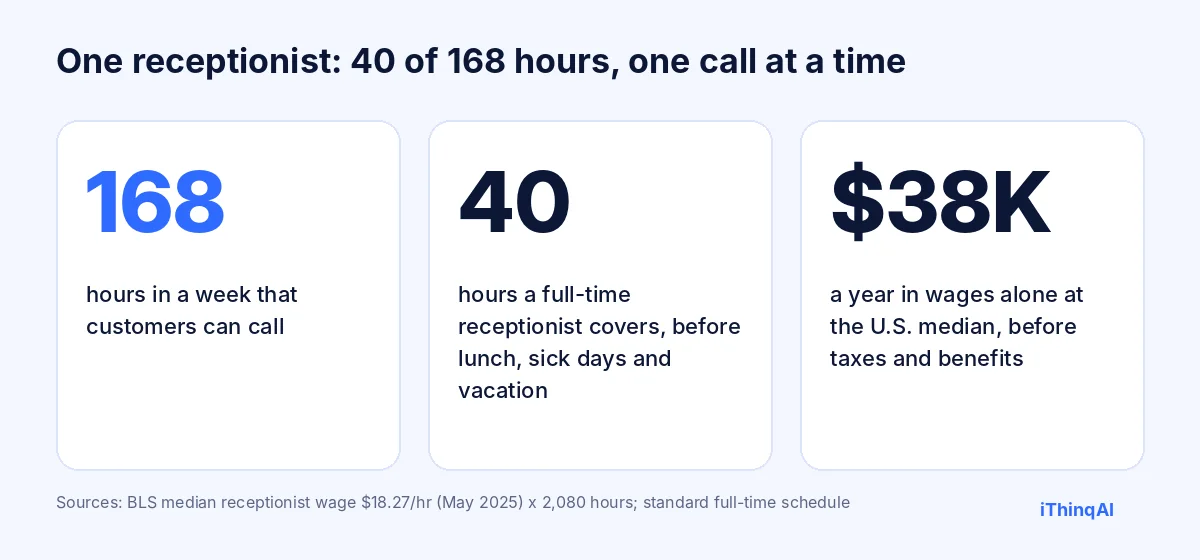
Quick answer: in the AI vs human receptionist decision, cost and coverage favor AI, and judgment and empathy favor people. A full-time receptionist costs about $38,000 a year in wages alone at the U.S. median, covers roughly 40 of the week's 168 hours and handles one call at a time. An AI receptionist like iThinqAI starts at $299 a month, answers around the clock, takes many calls at once and can call leads back. The best front desk uses both.
Key takeaways
- The cost of hiring a receptionist is far more than the wage: payroll taxes, benefits, training, turnover and the hours they can't cover.
- One person covers about 24% of the week. Customers call during the other 76%.
- AI wins on coverage, capacity, follow-up and paperwork. People win on empathy, judgment and reading the room.
- iThinqAI is an AI employee with its own computer: it answers, books, follows up and does the admin, and hands hard calls to your team. Hear it at 561-715-7686.
AI vs human receptionist: which is better for a small business?
For most small businesses, the better answer is both. Let an AI receptionist answer every ring, handle routine questions, book appointments and do the follow-up work, and let your human receptionist handle the calls that need judgment or empathy. On cost and coverage alone, AI wins clearly. On difficult, emotional conversations, a skilled person still wins.
That's not a dodge. It's the conclusion the math forces once you look at all of it, not just the hourly wage.
The question every owner asks at 6 PM
You're closing up. The phone rings. You let it go. Then you lie awake wondering if that was the big one.
So you think about hiring someone for the front desk. Before you post the job, run the numbers the job board won't show you.
The cost of hiring a receptionist, line by line
Wages
The U.S. median wage for receptionists was $18.27 an hour in May 2025 (Bureau of Labor Statistics). Full time at 2,080 hours a year, that's about $38,000 in wages.
Everything on top of wages
The real cost of hiring a receptionist adds employer payroll taxes, benefits if you offer them, paid time off, equipment, training time and the cost of replacing someone when they leave. Every owner who has hired for a front desk knows the last one: the weeks of recruiting, interviewing and training, and the calls that slip while the seat is empty.
Coverage
A week has 168 hours. One full-time person covers 40 of them, about 24%. Lunch, sick days and vacations come out of that. To answer every hour of every day, you'd need more than four people.
Capacity
One person, one call. When three people call at 9:05 AM on Monday, two of them hear ringing or hold music. In CallRail's 2025 survey, 41% of consumers said they hang up after one to two minutes on hold (CallRail).
Follow-up
Answering is half the job. On our homepage we estimate that hiring someone for about 20 hours a week of outbound calling and follow-up runs roughly $1,560 to $2,170 a month in wages alone, before benefits and training.
AI vs human receptionist: the side-by-side
| Full-time human receptionist | iThinqAI AI receptionist | |
|---|---|---|
| Typical cost | About $38,000/yr in wages at the U.S. median, plus taxes and benefits | From $299/mo (Starter) or $799/mo with outbound calling (Growth) |
| Hours covered | About 40 of 168 a week | 24/7, including nights and weekends |
| Calls at once | One | Many |
| Calls leads back | When there's time | Automatically, after you approve the list, hours and script |
| Logs every call in a CRM | If they remember | Every call, automatically |
| Paperwork after the call | Takes the rest of the day | Done on its own computer, with your approval |
| Languages | Usually one or two | 12 languages |
| Sick days, turnover, training | Yes | No |
| Judgment, empathy, reading the room | Excellent | Good on routine calls; transfers the rest |
Where AI wins
Coverage that never clocks out
Your customers call when they have time, which is usually when you don't: lunch, evenings, Saturday morning. An AI receptionist answers on the first ring at 9:47 PM exactly the way it does at 9:47 AM.
Capacity at the busiest moment
The Monday-morning pile-up, the hour after your ad runs, the first hot day of summer. The AI answers every line at once. Nobody waits on hold, and nobody hangs up to call your competitor.
Follow-up that actually happens
Across 16.7 million missed business calls, Quo found 69% got no callback within 48 hours (Quo). That isn't laziness. It's a busy front desk. An AI receptionist calls back new and missed leads within minutes, from lists you approve.
Paperwork that disappears
This is where the AI vs human receptionist comparison really tilts. A receptionist answers the phone, then spends the rest of the day on admin: updating records, confirming appointments, chasing paperwork. iThinqAI's agent has its own computer, so it can take that on too:
- Confirm tomorrow's appointments and update the calendar.
- Keep the CRM current after every call, without anyone typing.
- Send and answer email from its own address, on every plan.
- Work in web portals on the Scale plan, asking for approval before it submits anything.
- Send you a summary of the day, every day, on a schedule.
Where humans still win (and why we say so)
We sell AI, and we'll still tell you this: a great receptionist is a gift. They remember your best customer's dog's name. They calm down the furious caller. They notice the thing that isn't in any script.
AI is not that, and anyone who tells you it is wants your money more than your trust. iThinqAI also needs oversight: someone on your team should review calls, update the knowledge base and approve outbound lists.
Humans are the right choice for:
- Emotional calls: grief, fear, anger, a crisis.
- Judgment calls: exceptions, negotiations, anything off-script.
- Relationship calls: your biggest clients, your longest-standing customers.
- Licensed advice: legal, medical, insurance and financial questions.
The reason why the AI-plus-human front desk wins
Albert Lasker told advertisers to give people the reason why. Here it is: your best people should spend their time on the calls that need a human, not on the calls that don't.
Most calls are routine. Hours. Prices. "Can I book Thursday?" "Did you get my message?" When a skilled receptionist spends the day on those, the calls that really need them get rushed, put on hold or missed.
Let the AI handle the routine calls every hour of the day, and send the rest to your team with the notes already in the CRM. Your front desk gets calmer and your customers get faster answers. The cost of hiring a receptionist stops being a choice between one expensive person and nobody.
How the hybrid front desk works day to day
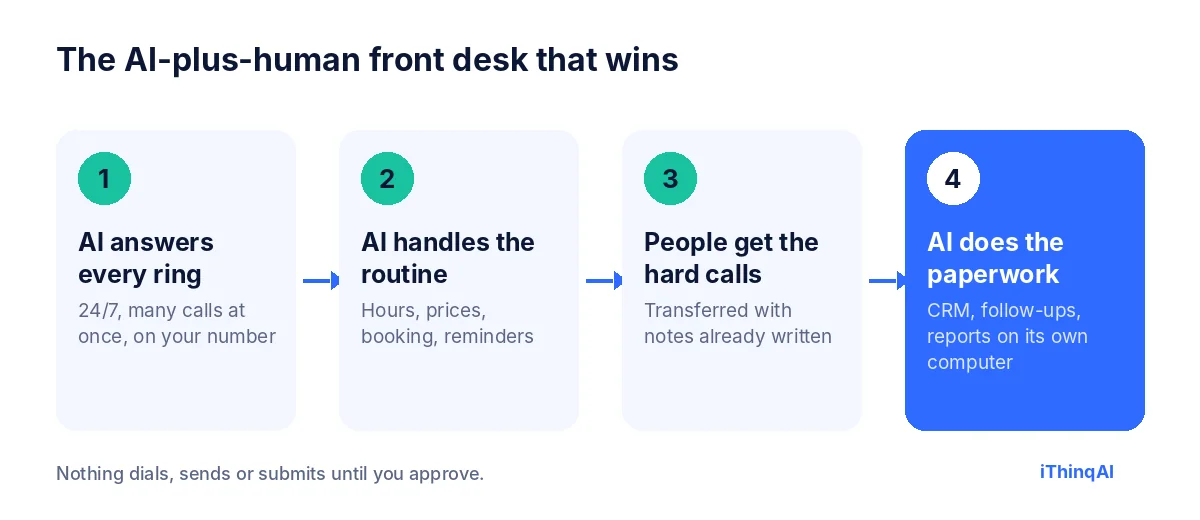
- The AI answers first, on your existing number, and says it's an AI.
- Routine requests are finished on the spot: answers from your knowledge base, bookings into your calendar, confirmations by text.
- Complex or sensitive calls transfer to your receptionist or the right person, with a summary attached.
- After the call, the AI does the paperwork: CRM updates, follow-up emails, reminders and the daily report.
- Your receptionist reviews and improves the knowledge base each week, becoming the AI's manager instead of its backup.
That last step matters. Many owners worry an AI will replace their receptionist. In practice, the best setups promote that person: from answering every ring to running the front office.
A day at the front desk: before and after
Before: one person, every job
8:00 AM. Your receptionist unlocks the door to four voicemails from last night. Two callers have already booked elsewhere. 8:30: three lines ring at once; she answers one and the others go to voicemail. 10:00: a walk-in, a delivery and a ringing phone, all at the same moment. Noon: lunch at the desk, phone in hand. 2:00 PM: she finally starts on yesterday's callbacks, gets through half. 4:30: data entry into the CRM, mostly from memory. 6:00 PM: she leaves, and the phone keeps ringing into an empty office.
She works hard all day. The front desk still leaks.
After: the AI takes the volume, she takes the people
8:00 AM. Your receptionist opens a summary: nine overnight calls, six booked, two questions answered, one flagged for her. 8:30: three lines ring at once; the AI answers all three and books two. She takes the third because it's a long-time client who asked for her by name. 10:00: the walk-in gets her full attention while the AI handles the phone. 2:00 PM: callbacks are already done; the AI worked the approved list within minutes of each missed call. 4:30: she reviews the day's calls and adds two answers to the knowledge base.
Same person, same salary. Completely different front desk.
AI vs human receptionist by industry
The right mix depends on what your callers need. Here's a practical starting point for the AI vs human receptionist split in common industries:
| Industry | Let the AI handle | Keep a human for |
|---|---|---|
| Home services | Booking, quotes, emergency triage, after hours | Upset customers, complex jobs |
| Law firms | Intake questions, scheduling consultations, after hours | Sensitive matters, anything resembling advice |
| Real estate | Sign calls, showing requests, lead callbacks | Negotiation, relationship calls |
| Insurance | Renewal reminders, quote intake, service requests | Coverage advice and claims conversations |
| Medical and dental | Booking, reminders, rescheduling, directions | Clinical questions, anxious patients |
| IT support | After-hours triage, ticket intake, status updates | Outages and security incidents |
In every row, the human column is smaller than the AI column, and much more valuable. That's the point. The AI frees your front desk to spend its time where it matters most.
The hidden costs inside the cost of hiring a receptionist
The wage is the number everyone sees. These are the ones they don't:
- Recruiting time. Writing the post, screening applicants, interviewing and checking references, usually done by the owner.
- Training time. Weeks of learning your services, prices, systems and the way you like things done.
- Coverage gaps. Every sick day, vacation and lunch break is a stretch when the phone goes to voicemail.
- Turnover. Front-desk roles tend to turn over, and every departure restarts recruiting and training.
- Management time. Scheduling, reviewing work and covering when someone is out.
None of these show up on a pay stub, but all of them show up in your week. When you compare the cost of hiring a receptionist with an AI plan, include them.
How to talk to your current receptionist about AI
If you already have a great person at the front desk, the conversation matters. Here's how owners who do it well frame it:
- Lead with what they'll stop doing: the voicemails, the double-booked lines, the end-of-day data entry.
- Make them the manager of the AI. They know the customers and the answers better than anyone. They should own the knowledge base.
- Give them the important calls. The AI transfers the conversations that need a human, and those are the ones that build loyalty.
- Review results together after the first month: calls answered, appointments booked, hours saved.
Handled this way, AI doesn't threaten the front desk. It makes your best person more valuable.
Picture the next 90 days
Instead of a job post, you set iThinqAI up on your existing number this week.
Night and weekend calls get answered and booked. Web leads get a call back within minutes, not tomorrow. Your front-desk person stops drowning and starts handling the conversations that actually need them. And you finally stop checking your phone at dinner.
When hiring a human receptionist is the right call
The honest answer, because trust matters more than one sale:
- Your callers are mostly in distress. Hire people, and use AI for overflow and nights.
- Your business is a walk-in front desk where greeting people in person is half the job.
- You need someone physically present to handle packages, payments or patients in a waiting room.
In those cases the cost of hiring a receptionist buys something AI can't. Add AI to cover the phone when that person is busy, and you get the best of both.
AI vs human receptionist: what it costs over a year
Here's the plain comparison, wages only, with no assumptions about benefits:
| Option | Annual cost | Hours covered per week |
|---|---|---|
| Full-time receptionist at the U.S. median wage | About $38,000 | About 40 |
| Part-time follow-up help, 20 hours a week | About $18,700 to $26,000 | 20 |
| iThinqAI Starter ($299/mo) | $3,588 | 168 |
| iThinqAI Growth ($799/mo, with outbound calling) | $9,588 | 168 |
Prices as of November 2026; see ithinq.ai/pricing. Annual billing includes two months free, which lowers the AI numbers further.
Three myths about the AI vs human receptionist choice
Myth 1: "Customers hate talking to AI." What customers hate is waiting. In CallRail's 2025 survey, 52% of consumers said businesses using AI assistants after hours provide superior service, and 50% said they'd use AI to book an appointment.
Myth 2: "AI means firing my receptionist." The strongest setups keep the person and change the job: less answering, more managing the customer experience and the calls that matter.
Myth 3: "It's all or nothing." You can start with nights and weekends only, then add overflow during the day, then follow-up. Each step is reversible, and each one shows you the results before you commit to the next. Most owners know within a month which mix works for their callers.
5 questions to decide in 10 minutes
- How many calls did we miss last month, and when?
- How many of those were new customers?
- How many hours does our front desk spend on paperwork after calls?
- Which calls truly need a human voice?
- What would one extra booked appointment a day be worth?
If the answers point at nights, overflow and paperwork, start with AI. If they point at emotional or in-person work, hire, and add AI behind that person.
Hear the difference yourself
Call 561-715-7686. Ask the questions your customers ask. Ask it to book you for Thursday. Then picture that voice answering every call you missed last month.
Ready to run the math on your own business? See plans and ROI or book a demo. For the full pricing breakdown, read AI answering service cost, and to choose a vendor, use the best AI receptionist tests.
P.S. Before you post that job listing, call 561-715-7686 at 10 PM tonight. A new hire won't be answering then. This will.
Sources
Frequently Asked Questions
Is an AI receptionist cheaper than a human receptionist?
In most cases. A full-time receptionist costs about $38,000 a year in wages at the 2025 U.S. median; iThinqAI starts at $299 a month.
Can an AI receptionist replace my front desk?
It can take over routine calls, after-hours coverage and paperwork. Most businesses keep a person for complex, sensitive or in-person work and let the AI handle the rest.
Can the AI transfer a caller to a human?
Yes. iThinqAI transfers calls to your team when a caller needs a person, with notes attached.
Does it work when my receptionist is on another call?
Yes. The AI can answer several calls at once, so nobody sits on hold.
What is the real cost of hiring a receptionist?
Wages, plus payroll taxes, benefits, paid time off, training and turnover, plus the hours one person can't cover. Wages alone were about $38,000 a year at the U.S. median in 2025.