Cost to Hire a Marketing Assistant: 5 Hidden Costs, 1 Risk
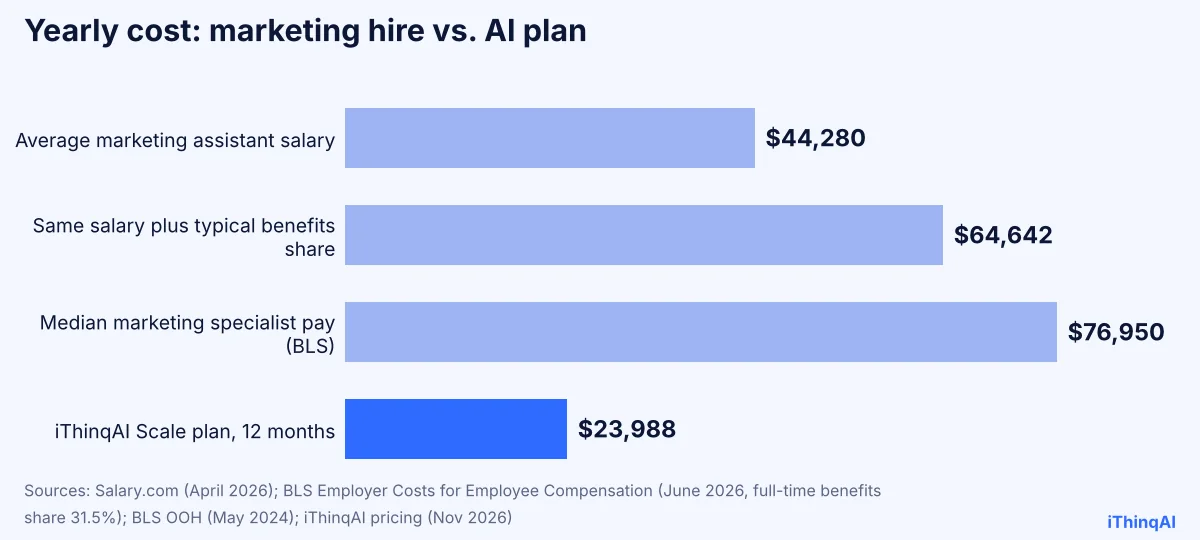
Quick answer: the cost to hire a marketing assistant in the U.S. starts with salary, which Salary.com put at an average of $44,280 a year in April 2026, and grows once you add benefits, payroll costs, recruiting, tools and management time. BLS data shows benefits make up 31.5% of total compensation for full-time private workers, so a $44,280 salary implies about $64,600 in total yearly cost. An AI marketing assistant costs a flat plan price and covers production and follow-up every hour, but it doesn't replace human strategy.
Key takeaways
- Marketing assistant salary is the visible cost; benefits and hidden costs often add a third or more.
- A full-time hire covers about 40 hours a week. Leads and messages arrive in the other 128.
- An AI marketing assistant handles production and follow-up for a flat price; strategy and judgment stay human.
- iThinqAI drafts, publishes, sends and follows up, with your approval. Hear it at 561-715-7686.
How much does it cost to hire a marketing assistant?
The cost to hire a marketing assistant includes salary, employer payroll taxes and benefits, recruiting and onboarding, software and equipment, and the owner's management time. In 2026, published averages for marketing assistant salary range from about $20 an hour (Indeed) to $44,280 a year (Salary.com). For a full-time employee, benefits typically add roughly 31.5% of total compensation on top of wages, according to the Bureau of Labor Statistics.
The job post you almost wrote
You've drafted it in your head. "Marketing assistant wanted. Social media, email newsletters, flyers, website updates, help with events." It would be great to have someone.
Then you start doing the math, and the math gets uncomfortable. Not because a good marketer isn't worth it, but because the number on the job post isn't the number on your books.
Let's do that math honestly, line by line.
Line 1: salary
Published 2026 data puts the average marketing assistant salary at $44,280 a year, or about $21 an hour, as of April 2026 (Salary.com). Indeed's job-posting data shows an average of $20.15 an hour, based on about 2,500 salaries, updated July 2026 (Indeed). Pay varies a lot by city and experience.
If you need someone with more experience, such as a marketing coordinator or a marketing specialist who can plan campaigns and analyze results, expect more. The BLS median for market research analysts and marketing specialists was $76,950 in May 2024 (BLS).
Line 2: benefits and payroll costs
Salary isn't the whole paycheck. In June 2026, wages and salaries made up 68.5% of employer costs for full-time private industry workers, and benefits made up the remaining 31.5% (BLS). That includes paid leave, insurance, retirement and legally required benefits like Social Security and unemployment insurance.
Apply that ratio to a $44,280 salary, and total compensation comes to roughly $64,600 a year. Your actual number depends on the benefits you offer.
Line 3: hidden costs (the five most owners forget)
- Recruiting: job ads, screening, interviews and your time.
- Onboarding: weeks before a new hire is fully productive.
- Tools: design software, scheduling tools, email platform, stock photos, a laptop.
- Management: your time reviewing work, answering questions and setting direction.
- Coverage gaps: vacation, sick days and the hours outside the workday.
Every business has different numbers for these. Write yours down. They're real costs, even when they don't appear on payroll.
The one big risk: turnover
The risk most owners underestimate is turnover. When a marketing hire leaves, you lose the knowledge in their head, the momentum of their campaigns and the time you spent training them, then you pay to recruit again. For a small business, one departure can set marketing back by months.
Line 4: what you actually get
A good marketing assistant brings real value: creativity, relationships, judgment about your brand, the ability to run an event or shoot a photo. That's worth paying for. But much of the role, week to week, is production: writing posts, sending emails, updating pages, chasing leads, reporting. That's the part an AI can do.
How the AI marketing assistant compares
| Full-time marketing assistant | AI marketing assistant (iThinqAI) | |
|---|---|---|
| Yearly cost | Salary plus benefits and hidden costs | Flat plan ($23,988 a year on Scale) |
| Hours | About 40 a week | Every hour |
| Writes and publishes posts | Yes | Yes, after your approval |
| Sends email | Yes | Yes, from its own email address |
| Builds landing pages | Depends on skills | Yes, on your domain (Scale) |
| Follows up with every lead in seconds | Rarely | Yes |
| Answers your phone | No | Yes |
| Strategy, creativity, events | Yes | Supports, doesn't replace |
| Turnover risk | Yes | No |
Work out your real number
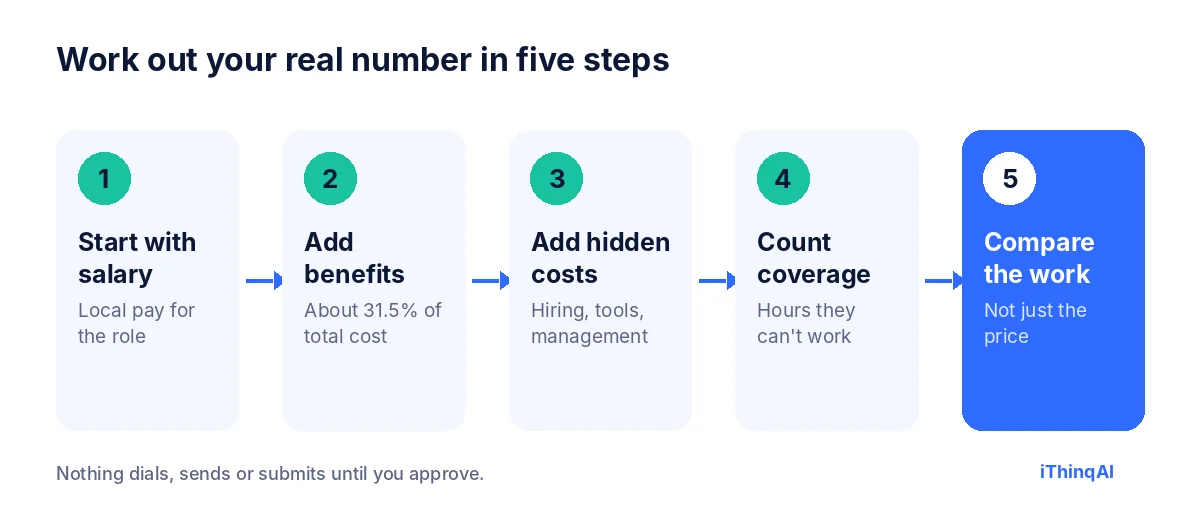
- Start with salary: look up local pay for the role you'd hire.
- Add benefits: multiply salary by about 1.46 to estimate total compensation (that's what a 31.5% benefits share implies).
- Add hidden costs: recruiting, onboarding, tools and your management time.
- Count coverage: note the hours your hire can't work, and what happens to leads in those hours.
- Compare the work: list the tasks you need done, and see which ones the AI can handle.
It has its own computer
Price comparisons only matter if the AI can actually do the work. iThinqAI's agent works on its own computer on the Scale plan, with a browser, files and your connected tools. It builds and publishes landing pages on your domain, updates listings in web apps, prepares reports from your CRM and posts to all the major social networks, asking before it publishes anything. You can watch every step and stop it at any time.
The reason why this works
Albert Lasker built his career on the reason why, and here's ours: the cost to hire a marketing assistant buys you about 40 hours a week of someone's time. What you actually want is marketing that goes out every week and leads that get answered every hour. When you separate those two things, you can buy each one at the right price: AI for consistent production and follow-up, and human expertise for strategy when you need it.
When hiring a person makes sense
Hire a marketing person when you need strategy, brand building, partnerships, events or creative work that depends on being in the room. Many growing businesses do both: the AI handles weekly production and follow-up, and a part-time marketing coordinator or consultant sets direction once a month. That combination often costs less than one full-time hire and covers more hours.
A worked example
Say you're weighing a full-time marketing assistant at the published average:
| Item | Full-time hire | AI marketing assistant |
|---|---|---|
| Salary | $44,280 | — |
| Benefits (at a 31.5% share of total cost) | about $20,360 | — |
| Plan price | — | $23,988 a year (Scale) |
| Hidden costs (recruiting, tools, management) | Your number | Your setup time |
| Hours covered per week | about 40 | 168 |
Your numbers will differ. The point is to compare the whole cost and the whole coverage, not just the salary line.
What to measure after you decide
- Campaigns shipped per month.
- Leads generated and response time to each.
- Bookings and revenue traced to marketing.
- Your hours spent on marketing.
- Total monthly cost, including tools and time.
Marketing assistant salary by experience and role
Marketing assistant salary depends heavily on experience and on what the job really includes. As a rough guide:
| Role | What they usually do | Pay direction |
|---|---|---|
| Entry-level marketing assistant | Posts, emails, scheduling, basic design | Near the published averages |
| Experienced marketing assistant | Campaign execution, reporting, some strategy | Above average |
| Marketing coordinator | Plans and runs campaigns, manages vendors and calendars | Higher than an assistant |
| Marketing specialist | Strategy, analysis, channel ownership | BLS median $76,950 (May 2024) |
Job titles overlap, so read the duties, not just the title. If the job post describes a marketing coordinator's responsibilities, budget for a marketing coordinator's pay.
Full-time, part-time, freelance or AI?
| Option | Cost profile | Coverage | Best for |
|---|---|---|---|
| Full-time hire | Salary plus benefits and hidden costs | About 40 hours a week | Growing teams with steady, varied marketing work |
| Part-time marketing coordinator | Lower payroll, fewer hours | 15 to 25 hours a week | Strategy and planning without full-time cost |
| Freelancer or agency | Project or retainer fees | When contracted | Specific projects, campaigns or ads |
| AI marketing assistant | Flat plan price | Every hour | Weekly production and lead follow-up |
Many small businesses find the best value in mixing two of these: the AI for production and follow-up, plus a part-time marketing coordinator or freelancer for strategy.
The cost to hire a marketing assistant vs. the cost of doing it yourself
There's a third option owners rarely price: doing it all yourself. If you spend six hours a week on posts, emails, page updates and lead follow-up, that's more than 300 hours a year. Put your hourly value on those hours, and the cost to hire a marketing assistant, or an AI, often looks small next to the cost of your own time, especially when those hours could go to selling or serving customers.
Questions to answer before you post the job
- What exactly will this person do each week?
- Which tasks are production, and which need judgment?
- What happens to leads that arrive after 5 PM?
- Who will manage and review the work?
- What does success look like after 90 days?
If most answers point to production and follow-up, price the AI first. If they point to strategy and relationships, price a marketing coordinator first.
How marketing assistant salary trends affect your decision
Competition for good marketing people is real, and pay moves with the job market. That's fair to workers and a planning challenge for small businesses. A flat AI plan doesn't rise with the job market, and it doesn't need a raise to stay. That predictability is part of the value when you budget for the year.
A 90-day plan if you hire a person
If you decide to hire, set the person up to win:
- Days 1 to 30: learn the business, your customers and your voice. Ship one email and a steady posting schedule.
- Days 31 to 60: own the monthly campaign calendar and one landing page per offer.
- Days 61 to 90: report on results and propose next quarter's plan.
Pair them with an AI for lead follow-up and after-hours calls, so the leads their marketing creates never go cold. The cost to hire a marketing assistant pays off faster when every lead gets an answer.
A 30-day plan if you start with AI
If you start with the AI marketing assistant instead:
- Week 1: share your services, prices, photos and brand voice, and approve the first posts and email.
- Week 2: launch one offer with a landing page on your domain, and turn on lead follow-up.
- Week 3: review results and adjust the posting mix.
- Week 4: compare the month with the one before: campaigns shipped, leads, response time and bookings.
At the end of the month, you'll know whether you still need a full-time hire, a part-time marketing coordinator for strategy, or neither for now.
What the numbers don't show
Some costs and benefits don't fit in a table. A person brings energy to the office and ideas from their own life. A person also needs a desk, a manager and a reason to stay. An AI brings consistency and coverage but needs clear direction from you. Weigh the intangibles honestly, then decide with both the numbers and your gut.
A year of marketing, two ways
With a new hire: the first month goes to recruiting and onboarding. By month three, posts and emails are going out regularly. In month seven, your hire takes two weeks of vacation and the calendar goes quiet. In month ten, they accept another offer, and you start recruiting again. Your marketing worked, in stretches.
With the AI plus occasional expert help: posts and emails start in week two and never stop. Every lead gets an answer in seconds. Once a quarter, a part-time marketing coordinator or consultant reviews results and sets the next plan. Your marketing works every week, and your spending is predictable.
Neither path is wrong. The question is which one fits your business, your budget and how much you want to manage.
What to put in your budget either way
Whatever you choose, budget for the things marketing always needs: good photos of real work, a simple website that loads fast on a phone, a small ad budget to test offers, and your own time to approve and give direction. Those costs don't go away with a hire or with AI. They're what make either one effective.
How to talk to your team about it
If you have staff, tell them what's changing and why: the AI takes the repetitive posting, emailing and follow-up so people can spend time with customers. Invite them to send photos of good work and ideas for posts. The best results come when the team feeds the AI real stories from the field, and the AI turns them into marketing that goes out every week.
Check your local market
National averages are a starting point. Before you decide, look up pay for the role in your city on two or three salary sites, and ask a local recruiter what candidates expect. In some markets the numbers run well above the national figures, and in others below. Use your local number in the worksheet above.
Common objections
"AI can't be creative." It drafts from your direction, your photos and your stories. You bring the creative spark; it does the production.
"A person knows my customers." True, and that's valuable. The AI also remembers every customer conversation in your CRM, so nothing is lost.
"I'll still need a marketer someday." Maybe. When you do, they'll spend their time on strategy instead of posting and chasing leads.
What it costs
iThinqAI's published plans, as of November 2026:
| Plan | Price | Marketing capabilities |
|---|---|---|
| Starter | $299/mo | Answers every call your marketing creates, its own email address, inbox and CRM (2 seats, 1,000 AI minutes) |
| Growth | $799/mo | Adds email and calling campaigns, dialer, prospect discovery and automations (5 seats, 5,000 AI minutes) |
| Scale | $1,999/mo | Adds computer use for building and publishing pages, plus multiple locations and numbers (15 seats, 15,000 AI minutes) |
Prices at ithinq.ai/pricing.
Who it's not for
If your business depends on in-person marketing such as events, partnerships or sponsorships, a human marketer should lead. The AI fits owners whose marketing problem is consistency and follow-up.
Hear it now
Call 561-715-7686. Hear the AI that would answer the calls your marketing creates.
Then book a demo and bring the job post you almost wrote; we'll show you which tasks it covers. Related: AI marketing assistant, AI social media manager and AI vs human receptionist.

P.S. Before you post that job ad, run the numbers above with your own figures. Then call 561-715-7686 and hear the alternative.
Sources
Frequently Asked Questions
What is the average marketing assistant salary in 2026?
Salary.com reported an average of $44,280 a year in April 2026; Indeed showed about $20 an hour.
How much do benefits add?
For full-time private industry workers, benefits were 31.5% of total compensation in June 2026, per BLS.
Is an AI marketing assistant cheaper?
For production and follow-up work, usually yes, and it covers every hour. Strategy still benefits from a person.
What's the difference between a marketing assistant and a marketing coordinator?
Titles vary, but a marketing coordinator usually plans and manages campaigns, while an assistant supports with production tasks.
Can I use both?
Yes. Many owners pair the AI with a part-time marketer or consultant for strategy.