AI Employee vs Virtual Assistant: Which Wins? 5 Proven Tests
Quick answer: when comparing an AI employee vs virtual assistant, the AI employee wins on coverage, speed and cost for repeatable work: it answers every call, replies in seconds, works every hour and handles many conversations at once. A human virtual assistant wins on judgment, relationships and unusual tasks. Most small businesses get the best result from both: the AI handles the phone, follow-up, scheduling and admin around the clock, and a person handles the work that needs a human touch.
Key takeaways
- "Virtual assistant" can mean a remote person or an AI tool. This guide compares a human virtual assistant with an AI employee that does real work.
- An AI employee covers all 168 hours of the week; a full-time person covers about 40.
- A human virtual assistant brings judgment and relationships an AI can't match.
- iThinqAI's AI employee answers calls, handles email, books and follows up, with your approval. Hear it at 561-715-7686.
AI employee vs virtual assistant: what's the difference?
A virtual assistant is usually a remote person who handles administrative tasks such as email, scheduling, data entry and customer messages, often part-time. An AI employee is software that does many of the same tasks itself: it answers calls, sends and answers email, books meetings, follows up and updates records, working inside your phone line, inbox, calendar and CRM. The key difference is that the AI works every hour and in parallel, while the person brings judgment and human relationships.
The owner who hired a virtual assistant (and still missed calls)
Picture Dana, who runs a cleaning company. Last year she hired a part-time human virtual assistant overseas to handle email and scheduling. It helped. Her inbox got cleaner, and invoices went out on time.
But the phone still rang during dinner. Leads still came in on Saturday and waited until Monday. When her assistant was sick for a week, everything piled up again.
Dana didn't make a bad choice. She just hired for one problem and still had another. That's the real AI employee vs virtual assistant question: which problems do you actually have?
The numbers behind the decision
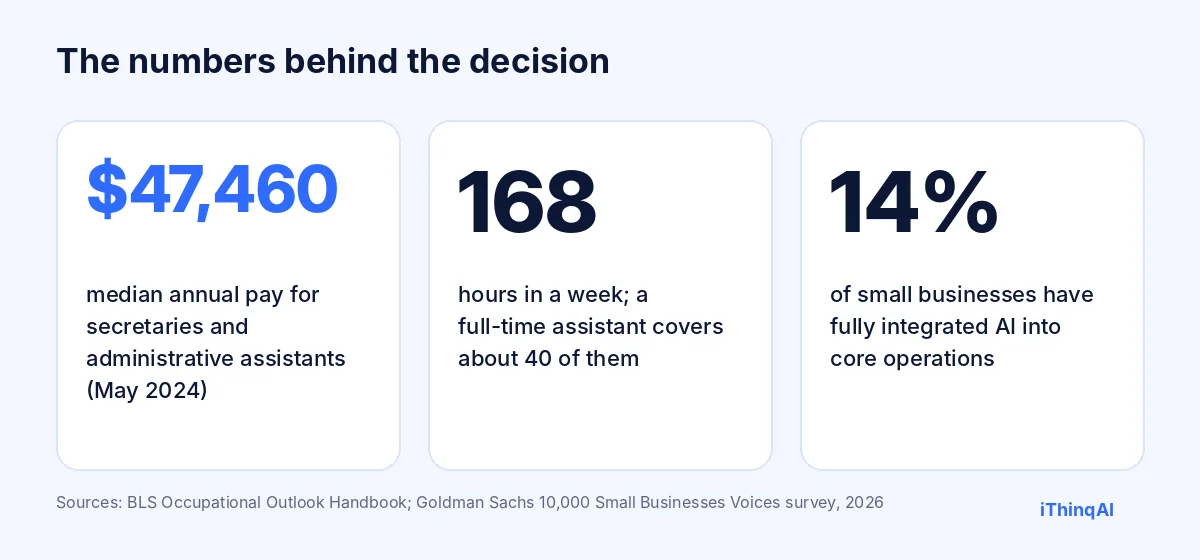
The median pay for secretaries and administrative assistants in the U.S. was $47,460 a year in May 2024 (BLS). Remote and offshore virtual assistant cost varies widely by country, skills and hours, but even a part-time person covers only a slice of the 168 hours in a week.
On the AI side, adoption is broad but shallow: Goldman Sachs found 76% of small businesses use AI, yet only 14% have fully integrated it into core operations (Goldman Sachs). Most owners have tried AI tools. Few have given AI a real job.
Five proven tests
Test 1: Coverage
Who answers at 9 PM on a Saturday? A human virtual assistant works set hours. An AI employee answers every call and message, every hour, including holidays.
Winner: AI employee.
Test 2: Speed
How fast does a new lead get a reply? A person replies when they see it. The AI replies in seconds, and calls back within a minute if the lead asked.
Winner: AI employee.
Test 3: Cost
What does an hour of coverage cost? Virtual assistant cost is lower than a local hire, but it still scales with hours. The AI's cost is a flat plan with minutes included, whether it handles 10 calls or 200.
Winner: AI employee for volume; a person for occasional, varied work.
Test 4: Judgment
Who handles the upset customer, the unusual request or the delicate negotiation? A good person, every time. The AI is set up to recognize these and hand them off.
Winner: human virtual assistant.
Test 5: Scale
What happens when five people call at once? A person handles one. The AI handles all five.
Winner: AI employee.
Side by side
| Human virtual assistant | AI employee (iThinqAI) | |
|---|---|---|
| Hours | Set schedule | Every hour |
| Answers your business phone | Sometimes, if set up | Every call, on your existing number |
| Parallel conversations | One at a time | Many at once |
| Yes | Yes, from its own email address | |
| Scheduling and follow-up | Yes | Yes, in seconds |
| Judgment and relationships | Strong | Escalates to you |
| Sick days and turnover | Yes | No |
| Training needed | Onboarding and ongoing | Your instructions and approvals |
| Cost | Hourly or monthly | Flat plan |
How to decide in an afternoon
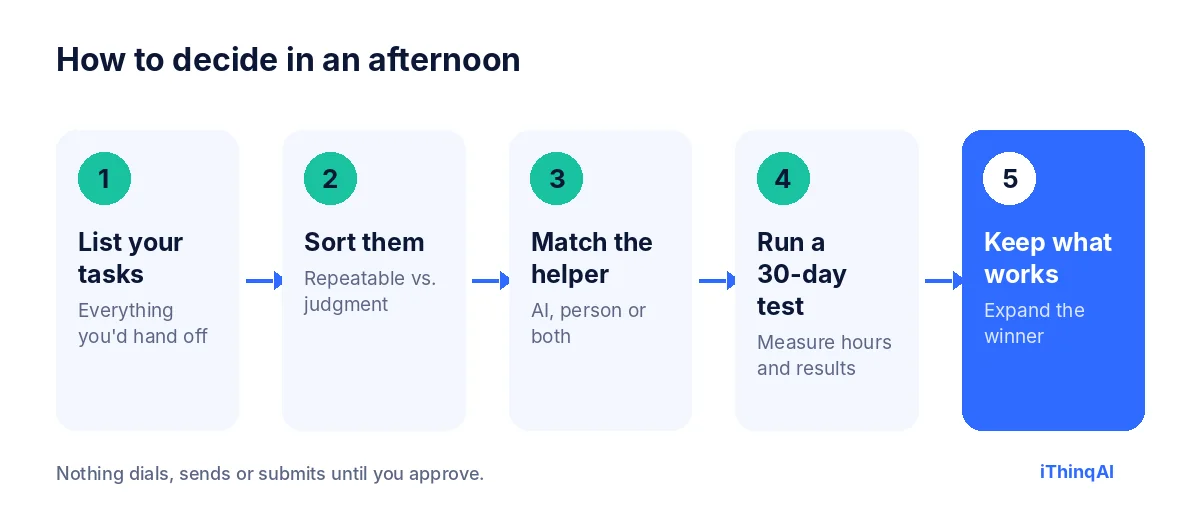
- List every task you wish someone else would do.
- Sort them into "repeatable and time-sensitive" and "needs judgment."
- Match the helper: repeatable tasks to the AI, judgment tasks to a person.
- Run a 30-day test and measure hours saved, calls answered and bookings.
- Keep what works, and give the winner more.
It has its own computer
Here's what changes the AI employee vs virtual assistant comparison. A human assistant can log into your web apps and do things. Until recently, AI couldn't. iThinqAI's agent works on its own computer on the Scale plan, with a browser, files and your connected tools, so it can update listings, download invoices or fill in forms in web apps without an integration, asking before it submits anything. You can watch each step and stop it at any time.
The reason why this works
Albert Lasker's rule was to give the reason why. Here's the reason the hybrid wins: your business has two kinds of work. One kind is high volume, time-sensitive and repeatable: calls, replies, reminders, follow-ups. The other is rare, sensitive and personal. Hiring a person for the first kind wastes their judgment. Giving the second kind to AI wastes your customers' trust. Split the work by type, and both helpers do what they're best at.
The hybrid setup most owners land on
| The AI employee handles | The human virtual assistant handles |
|---|---|
| Every inbound call and message | Escalated or sensitive conversations |
| Lead follow-up and booking | Special projects |
| Reminders and confirmations | Relationship calls with key clients |
| Email replies to routine questions | Complex email threads |
| CRM updates and faxes | Quality review of the AI's work |
This setup often lets a part-time assistant do higher-value work, while the AI covers every hour.
Virtual assistant cost, honestly compared
Virtual assistant cost depends on location, skills, hours and agency fees. A local full-time assistant costs wages plus benefits; for full-time private industry workers, benefits were 31.5% of total compensation in June 2026 (BLS). Offshore assistants cost less per hour but work fewer of your hours, often across time zones. Compare your real quote against the AI plan, then remember to compare coverage too: an assistant who works 20 hours a week is unavailable for the other 148.
Questions to ask before you hire either
- Which tasks happen after hours or on weekends?
- How many calls and messages arrive at the same time?
- Which tasks need judgment or a personal relationship?
- What happens to the work when your helper is out?
- How will you measure whether it's working?
What to measure
- Calls answered and response time to new leads.
- Tasks completed per week.
- Bookings and revenue from conversations each helper handled.
- Hours of your time saved.
- Customer feedback on both.
When a human virtual assistant is the better choice
There are clear cases where a human virtual assistant is the right hire, and pretending otherwise would be bad advice:
- Relationship-heavy work: calling your top ten clients to check in, handling VIP requests, building rapport with partners.
- Unusual, one-off projects: planning an event, researching a new market in depth, organizing a messy archive.
- Sensitive conversations: refunds, complaints, collections or anything emotional.
- Creative judgment: choosing which photos represent your brand, or writing a heartfelt thank-you.
If most of your workload looks like that list, start with a person. If most of it is calls, replies, reminders and follow-ups, start with the AI.
When an AI employee is the better choice
The AI employee wins whenever volume, speed or hours decide the outcome:
- Every inbound call, including evenings, weekends and lunch hours.
- New lead follow-up, where the first reply wins.
- Appointment reminders and confirmations, sent on time, every time.
- Routine email and messages, answered from your approved information.
- Data entry, like updating the CRM after every conversation and filing faxes.
- Busy moments, when five people call or message at once.
In the AI employee vs virtual assistant comparison, these are the tasks where hours and speed matter more than nuance.
Virtual assistant cost: the hidden pieces
When owners compare virtual assistant cost with an AI plan, they often compare only the hourly rate. Add the pieces that don't show up on the invoice:
- Your time training them, and retraining when they leave.
- Coverage gaps during sick days, holidays and time-zone differences.
- Management time checking their work and answering their questions.
- Missed opportunities in the hours they aren't working.
None of this means a human virtual assistant isn't worth it. It means the real virtual assistant cost is higher than the rate, and the comparison should include coverage, not just price.
Managing a human virtual assistant and an AI together
The hybrid works best with a clear division of labor. Give the AI every first touch: calls, messages, form fills and reminders. Give your human virtual assistant everything the AI flags: escalations, special requests and quality checks. Ask your assistant to review a sample of the AI's conversations each week and suggest better answers. The AI gets smarter, your assistant does more interesting work, and customers get fast answers plus a human when they need one.
A 30-day test you can run
Week 1: turn on the AI for after-hours calls and messages only. Keep your assistant on daytime tasks.
Week 2: add lead follow-up and reminders to the AI.
Week 3: move routine email to the AI's own address; your assistant handles the escalations.
Week 4: compare: calls answered, response time, bookings and hours your assistant spent on higher-value work. The data will tell you how to split the work going forward.
A week with each, side by side
With only a person: Monday through Friday, 9 to 5, things run smoothly. Friday at 6 PM, a lead fills in your form; it waits until Monday. Saturday, three calls go to voicemail. Wednesday, your assistant is out sick and the inbox piles up. The work is good, but the gaps are real.
With only the AI: every call is answered, every lead gets a text in seconds, every reminder goes out. But a long-time client calls upset about a billing mistake, and the AI's job is to apologize, take details and hand it off, which means someone still has to call them back.
With both: the AI answers everything first and books what it can. The person handles the upset client within the hour, with the full conversation in front of them. Nobody waits, and nobody gets a robotic answer to a human problem.
What owners say they underestimated
Owners who move to the hybrid setup tend to mention the same surprises. They underestimated how many calls came in after hours. They underestimated how much faster leads book when someone replies in seconds. And they underestimated how much better their human helper's work became once the repetitive tasks were gone. The point of the AI employee vs virtual assistant choice isn't to pick a winner. It's to stop asking one helper to do two very different jobs.
Training either one
Both need good instructions. For a person, that means a written process and time to learn it. For the AI, it means your hours, services, prices, policies and the answers you want customers to hear, plus clear rules about what needs approval. In both cases, the first two weeks decide the quality of the next two years. Write it down once, review the results weekly, and improve the instructions as you go.
Security and access for both
Whoever helps you will see customer details, calendars and messages. Treat access the same way for a person and for the AI. Give each one only the accounts and permissions they need. Use two-step verification. Keep a log of who did what, and review it now and then. With iThinqAI, team roles, session controls and a full activity log are built in, and important actions wait for your approval. For a remote person, use shared password managers and separate logins rather than sharing your own passwords.
Questions customers ask about each
Customers rarely ask who answered. They ask whether their problem got solved. When an AI answers, say so plainly in the greeting, and make it easy to reach a person. When a person answers, make sure they have the full history so the customer doesn't repeat themselves. Either way, the experience customers remember is speed, clarity and follow-through.
Growing from one helper to a team
As the business grows, the split scales well. The AI absorbs the extra calls and messages without a new hire, and your human helpers move into roles that need people: account management, operations, training. Instead of hiring a second assistant to answer more phones, you hire someone to grow the business.
Common objections
"My customers want a person." Most want a fast answer and a booked time. The AI hands off to a person whenever asked.
"I already pay a virtual assistant." Keep them. Give the AI the phone, the follow-up and the after-hours work, and give your assistant better projects.
"AI makes mistakes." So do people. Approvals on important actions, clear instructions and a full log keep both accountable.
What it costs
iThinqAI's published plans, as of November 2026:
| Plan | Price | Best for |
|---|---|---|
| Starter | $299/mo | Answers every call, its own email address, calendar, inbox and CRM (2 seats, 1,000 AI minutes) |
| Growth | $799/mo | Adds campaigns, dialer, prospect discovery and automations (5 seats, 5,000 AI minutes) |
| Scale | $1,999/mo | Adds computer use for web apps and portals, plus multiple locations and numbers (15 seats, 15,000 AI minutes) |
Every business number also receives faxes. Prices at ithinq.ai/pricing. For more, see our page on virtual assistant artificial intelligence.
Who it's not for
If your work is mostly personal errands or one-off creative projects, a human virtual assistant may be all you need. The AI employee fits businesses where phones ring, leads need fast replies and admin repeats every day.
Hear it now
Call 561-715-7686 at any hour. That's test one. Ask it a customer question. That's test two.
Then book a demo and bring your task list; we'll sort it together. Related: AI personal assistant for business owners, AI vs human receptionist and AI employee for small business.
P.S. The right answer is often "both." Call 561-715-7686 today and see which half of your work the AI can take off your plate.
Sources
Frequently Asked Questions
What's the main difference between an AI employee and a virtual assistant?
An AI employee works every hour and handles many conversations at once. A human virtual assistant brings judgment and relationships.
Is an AI employee cheaper than a virtual assistant?
For high-volume, repeatable work, usually yes. Compare your quotes and your coverage hours.
Can an AI employee replace my virtual assistant?
For calls, follow-up, scheduling and routine email, often. For sensitive work, keep a person.
Can they work together?
Yes. Many owners give the AI the phone and follow-up, and give their assistant higher-value projects.
Does the AI employee have its own email?
Yes. On every plan, you connect an email address for the AI to send and answer email.