AI Answering Service Cost 2026: The Hidden $800 Mistake
Quick answer: in 2026, a basic AI answering service costs roughly $25 to $50 a month for a small bucket of calls or minutes. A complete AI front office that also calls leads back, books appointments and runs your CRM costs more; iThinqAI starts at $299 a month. The real AI answering service cost is the sticker price plus every tool you still have to buy, plus the revenue you lose when nobody follows up.
Key takeaways
- AI answering service pricing comes in four models: per minute, per call, flat monthly, and seats plus usage.
- The hidden costs are the dialer, CRM, scheduling, texting and fax tools you still need, plus the hours your team spends stitching them together.
- The biggest cost never shows on an invoice: 78% of consumers say they've abandoned a business after an unanswered call.
- iThinqAI publishes its prices: $299, $799 and $1,999 a month, and you can hear it work at 561-715-7686 before you pay anything.
How much does an AI answering service cost in 2026?
A basic AI answering service costs about $25 to $50 a month for entry plans that answer calls and take messages. Mid-tier plans with booking and integrations often run $100 to $300 a month. Platforms that add outbound calling, a dialer, a CRM and automation run from about $300 to $2,000 a month depending on seats and minutes. Always check overage rates.
Those ranges come from what vendors publish, and they move often. Treat them as a starting map, not a quote.
Here's the trouble with that map: it only shows the road to the phone. It doesn't show what happens after the phone is answered, and that's where most of the money is made or lost.
Why the $29 plan is so tempting
You search "AI answering service cost," and the first page is full of $29 offers. Unlimited calls! Live in five minutes!
For some businesses, that's genuinely enough. If you get a handful of calls a week and all you need is a polite voice that takes a name, buy the $29 plan and close this tab.
But most owners who buy the cheapest plan discover the same thing within a month: the phone is answered, and nothing else changed. The messages pile up. The callbacks still wait for you. The CRM still doesn't get updated.
The 4 AI answering service pricing models
Every vendor uses one of these four models, or a blend:
| Pricing model | How it works | Watch out for |
|---|---|---|
| Per minute | A monthly bucket of minutes, then a per-minute overage | Long calls and busy seasons |
| Per call | A set number of calls, then a fee for each extra call | Your bill rising exactly when marketing works |
| Flat monthly | One price, often advertised as "unlimited" | Fair-use caps and missing features |
| Seats plus usage | A number of users plus a pool of AI minutes, more features per tier | Read what each tier actually includes |
None of these models is wrong. Each one rewards a different kind of business. Per-call pricing is friendly to very low volume. Flat pricing is friendly to predictable volume. Seats plus usage fits businesses that want the AI to do more than answer.
iThinqAI pricing, in plain numbers
iThinqAI uses seats plus usage. Published prices as of November 2026:
| Plan | Price | Seats | AI minutes | What's included |
|---|---|---|---|---|
| Starter | $299/mo | 2 | 1,000 | Inbound AI voice agent, unified inbox, CRM, pipeline, calendar, tasks |
| Growth | $799/mo | 5 | 5,000 | Starter plus AI calling campaigns, dialer, prospect discovery, automations |
| Scale | $1,999/mo | 15 | 15,000 | Growth plus computer use, multiple locations and numbers, priority support |
| Enterprise | Custom | Volume | Volume | SSO, SLA, DPA, onboarding, dedicated success manager |
Annual billing gives two months free. Extra AI minutes are billed at listed rates, and telecom pass-through charges may apply. Always check ithinq.ai/pricing for current numbers.
The hidden costs no pricing page shows
Here's what happens after you buy the cheapest plan.
The AI answers and emails you a summary. Now somebody has to call the lead back, so you need a dialer. Somebody has to log it, so you need a CRM. Then you need online booking, a texting tool for reminders, and if you're in healthcare, insurance or law, a fax service.
When we added up six popular tools for answering, outbound calling, dialing, CRM, scheduling and fax at their list prices, the total came to about $813 a month. The breakdown is on our homepage; check current prices yourself. And that stack still doesn't talk to itself. Your team becomes the glue, copying notes from one app into the next.
These are the hidden costs that turn a $29 decision into an $800 one:
- Extra software you still need to finish the job.
- Staff hours spent moving information between tools.
- Overages when a good month pushes you past your bucket.
- Handoff fees some services charge to transfer to a human.
- Lost customers when the follow-up never happens.
The biggest hidden cost: the call nobody returned
The most expensive line item is the one you can't see: the customer who called once and never came back.
- In CallRail's 2025 survey of 1,000 U.S. consumers, 78% said they had abandoned a business after an unanswered call (CallRail).
- Across 16.7 million missed calls, Quo found 69% got no callback within 48 hours (Quo).
- Invoca's 2026 benchmark of more than 70 million calls found 44% of callers never reach a person (Invoca).
So here's the only cost formula that really matters:
Missed or unfollowed calls per month × your close rate × the value of a customer = what you're losing now.
An example with made-up but typical numbers: 40 missed or unfollowed calls a month, a 25% close rate and a $400 job is $4,000 a month walking out the door. Run your own numbers. If the answer is bigger than $299, the cheap plan is the expensive one.
AI answering service cost vs. hiring a receptionist
The other comparison owners make is against hiring. The U.S. median wage for receptionists was $18.27 an hour in May 2025 (Bureau of Labor Statistics). Full time, that's about $38,000 a year in wages alone, before payroll taxes, benefits, paid time off, training and turnover.
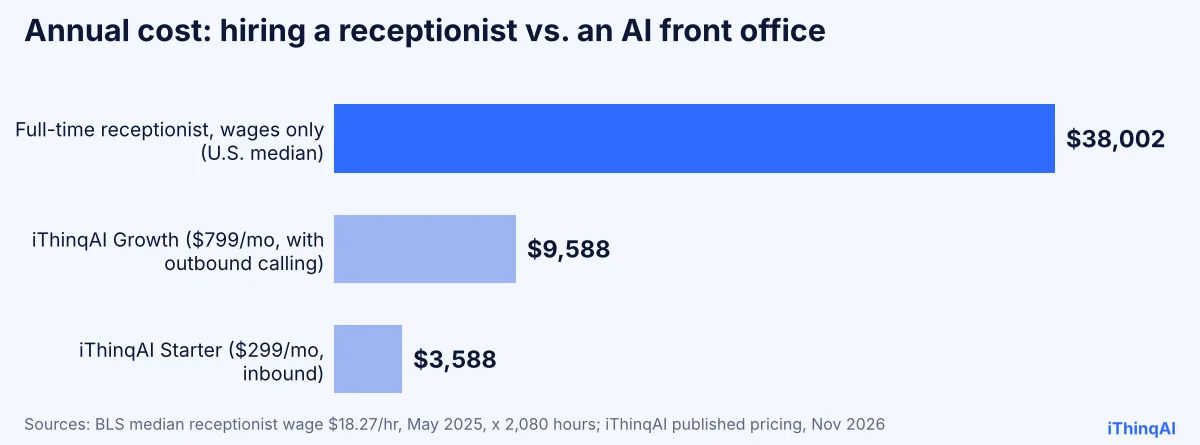
And one person covers about 40 of the week's 168 hours, one call at a time. A good receptionist is worth every penny for the conversations that need a human. For everything else, the math isn't close.
What drives AI answering service pricing up
If two quotes look wildly different, these are usually the reasons:
- Minutes and seats. More calls and more team members cost more.
- Outbound calling. Callbacks, campaigns and a dialer are usually higher-tier features.
- Integrations. Connecting to your calendar, CRM and other tools adds value and sometimes cost.
- Languages. Multilingual answering is often bundled at higher tiers.
- Compliance features. Approval gates, Do Not Call controls, recording notices and a HIPAA Business Associate Agreement matter in regulated industries.
- Human backup. Services that put humans on calls cost more per call than pure AI.
AI answering service cost by business size
What you'll pay depends mostly on how many people need access and how many minutes the AI will spend on calls. Here's a practical way to estimate your AI answering service cost before you talk to any vendor:
| Business size | Typical needs | Likely plan type | Monthly AI answering service cost |
|---|---|---|---|
| Solo owner, light call volume | Answer, take details, book | Basic inbound plan | About $25 to $100 |
| Small office, 2 to 5 people | Answer, book, CRM, after-hours coverage | Inbound plan with CRM (iThinqAI Starter) | About $299 |
| Growing team with web leads | Answer plus callbacks, campaigns, dialer | Inbound plus outbound (iThinqAI Growth) | About $799 |
| Multi-location or portal-heavy office | All of the above plus computer use | Full AI front office (iThinqAI Scale) | About $1,999 |
The jump between rows isn't arbitrary. Each row adds a job the AI does for you. Compare each row's AI answering service pricing to what that job costs you today, in software and in hours.
A worked example: a six-person HVAC company
Numbers make this real, so let's run one. These figures are illustrative, not a study.
A six-person HVAC company gets about 400 calls a month. It misses roughly 15% of them, mostly at lunch, after 5 PM and on Saturdays. That's 60 missed calls. About half are real prospects, and the shop closes 40% of the prospects it reaches. An average job is worth $450.
- Missed prospect calls: 60 × 50% = 30
- Lost jobs: 30 × 40% = 12
- Lost revenue: 12 × $450 = $5,400 a month
Now look at the options. A $29 plan answers those calls but still leaves the callbacks, quotes and booking to the owner at night. A $799 Growth plan answers, books, calls back from approved lists, follows up on quotes and logs everything. Even if it recovers only a third of those lost jobs, the AI answering service cost is covered more than twice over.
Run the same math with your own numbers. It takes three minutes and it ends most pricing debates.
Red flags in AI answering service pricing
Some pricing pages are clear. Others are built to look cheap. Watch for these hidden costs and warning signs:
- "Unlimited" with a fair-use clause that caps you at a level your busy season will exceed.
- Per-call pricing with no overage table. If they won't show what call 101 costs, assume it's expensive.
- Human handoff fees buried in the terms.
- Booking, CRM or integrations locked behind an "enterprise" call.
- No live demo. If you can't hear it before you buy, you're buying a promise.
- Long contracts with no trial period for a product you've never heard on a real call.
One red flag isn't a dealbreaker. Three is a pattern.
The reason why the cheapest plan is often the most expensive
Albert Lasker taught advertisers to give the reason why. Here's ours, in one sentence: a plan that answers but doesn't follow up leaves the most valuable work undone, and the most valuable work is where the money is.
Answering is the cheap part. Turning an answered call into a booked appointment, a sent quote, a reminder and a clean record is the part that pays. Any AI answering service cost comparison that ignores that part is comparing the wrong things.
That's also why the hidden costs deserve more attention than the sticker price. A plan that's $50 cheaper but leaves your team doing two hours of callbacks and data entry every day isn't cheaper. Put a dollar figure on those hours, add it to the quote, and compare again. The AI answering service pricing that looked expensive often turns out to be the bargain, and the hidden costs of the bargain plan finally show up where you can see them.
What else the price buys: an AI employee with its own computer
Price an AI answering service against what it does after the call. iThinqAI's agent works on its own computer, with a browser, files and your connected tools, so the plan that answers your phone also:
- Logs every call in the built-in CRM and moves the deal through your pipeline.
- Sends the confirmation, the quote or the intake form while the caller is still thinking about you.
- Remembers past conversations, so returning customers never start over.
- Runs scheduled jobs on Growth, like a 7 AM summary of overnight calls.
- Sends and answers email from its own address, on every plan.
- Works in web portals on Scale, asking for your approval before it submits anything.
Count the hours of admin that disappear, not just the calls that get answered. That's where the price stops looking high.
How to compare AI answering service pricing in 5 minutes
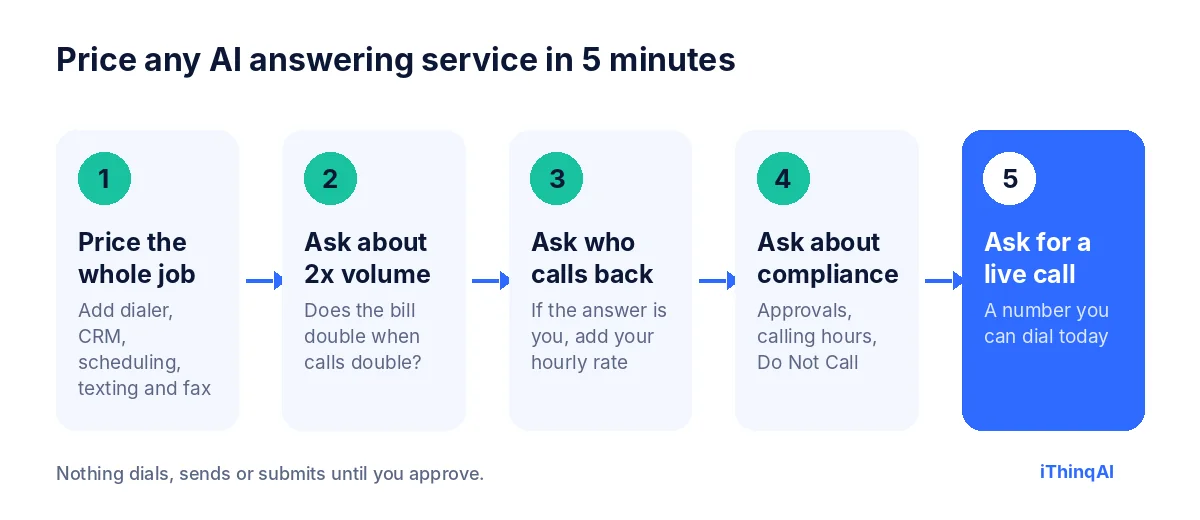
- Price the whole job, not the answering. Add the dialer, CRM, scheduler, texting and fax you'd still need.
- Ask what happens at 2x volume. Does your bill double?
- Ask who calls the lead back. If the answer is "you," add your hourly rate.
- Ask about compliance. Can it call people back only with your approval, inside set hours, honoring Do Not Call?
- Ask for a live call. Not a recording. A number you can dial right now.
Questions to ask before you sign anything
- What exactly happens when I go over my minutes or calls?
- Are there fees to transfer a caller to my team?
- Which features are locked to higher tiers?
- Can it work on my existing number, or do I have to port it?
- Can I cancel, and what happens to my data if I do?
- Will you sign a Business Associate Agreement if I'm in healthcare?
Write the answers down next to each quote. The hidden costs usually reveal themselves by question three.
How to cut your AI answering service cost without cutting results
You don't have to buy the biggest plan to get the biggest result. These moves lower your AI answering service cost while keeping the revenue:
- Start with after-hours coverage. Nights and weekends are where most missed calls happen, so you get the biggest return from the smallest number of minutes.
- Write a tight knowledge base. Clear answers mean shorter calls, and shorter calls mean fewer minutes used.
- Pay annually once you're sure. iThinqAI's annual billing includes two months free.
- Add outbound only when inbound is solid. Move up to Growth when you're ready to call leads back, not before.
- Drop the tools it replaces. If the AI front office covers your dialer, scheduler and fax, cancel them. That's where the real savings in AI answering service pricing show up.
- Review usage monthly. Look at minutes per booked appointment. That one number tells you whether the plan is earning its keep.
Most businesses find the right plan within 60 days, once they can see minutes, bookings and revenue side by side.
When the lowest AI answering service cost is the right choice
We'd rather you trust us than buy from us, so here's when to skip iThinqAI:
- You get fewer than a handful of calls a week.
- You never need to call anyone back.
- You don't use a calendar or CRM and don't plan to.
In that case, a basic plan does the job and you should keep the difference. Everyone else should compare the full picture.
Hear what $299 sounds like
You can spend an hour reading pricing pages, or you can spend two minutes on the phone.
Call 561-715-7686. That's iThinqAI answering. Ask it about hours, services and prices. Ask it to book you. Then compare plans and ROI or book a demo, and we'll price it against your current stack, line by line. If you're also weighing a hire, read AI vs human receptionist; if you're still choosing a vendor, start with the best AI receptionist tests.
P.S. Grab last month's phone log and count the missed calls. Multiply by your close rate and your average sale. Then call 561-715-7686. Most owners who do that math once never look at the $29 plan the same way again.
Sources
Frequently Asked Questions
How much does an AI answering service cost per month?
Basic plans often run $25 to $50 a month. Full platforms with outbound calling and a CRM cost more; iThinqAI is $299 to $1,999 a month, with custom Enterprise pricing.
What hidden costs should I watch for?
Overages, per-call charges, human handoff fees, telecom pass-through, and the extra tools you still need for follow-up, like a dialer, CRM and scheduler.
Is an AI answering service cheaper than a receptionist?
Usually. The U.S. median receptionist wage was $18.27 an hour in May 2025, about $38,000 a year in wages alone, and one person covers about 40 of the week's 168 hours.
Is there a discount for paying yearly?
Yes. iThinqAI annual billing includes two months free.
Can I test it before paying?
Yes. Call the live demo line at 561-715-7686, or enter your number on ithinq.ai and the AI will call you.