Voicemail Alternative: 5 Proven Ways to Stop Losing Calls
Quick answer: the best voicemail alternative is a phone that never sends callers to voicemail: an AI agent that answers on the first ring, solves the routine request, books the appointment and hands you a written summary instead of a recording. Business voicemail asks customers to do work, wait and trust you'll call back. In CallRail's 2025 survey, only 42% of consumers said they leave a voicemail when a business doesn't answer. The rest move on.
Key takeaways
- Most callers won't leave a voicemail. Many call the next business on the list instead.
- Of the voicemails left, most aren't returned quickly: 69% of missed business calls get no callback within 48 hours.
- A voicemail alternative should answer, book and confirm on the same call, not just take a better message.
- iThinqAI answers on your existing number, books, follows up and does the paperwork on its own computer. Hear it at 561-715-7686.
What is the best voicemail alternative for a business?
The best voicemail alternative for a business is an AI receptionist that answers every call in your business's name, handles routine questions, books appointments into your calendar and sends a confirmation before the caller hangs up. Unlike business voicemail, it doesn't ask the customer to wait for a callback. It finishes the request, writes a summary, and transfers anything that truly needs a person.
Other alternatives exist, including a staffed answering service or a faster callback process, and we'll compare them below. But only one of them removes the beep entirely.
The beep is where customers go to leave
"You've reached Smith Plumbing. Please leave a message after the tone."
Beep.
In that half-second, your caller makes a decision. Most of the time, the decision is: hang up and call the next name on Google.
It isn't personal. It's just that the next name might answer. And for a customer with water on the floor, a toothache or a house they want to see this weekend, "might answer" beats "will call back."
What callers actually do at the beep
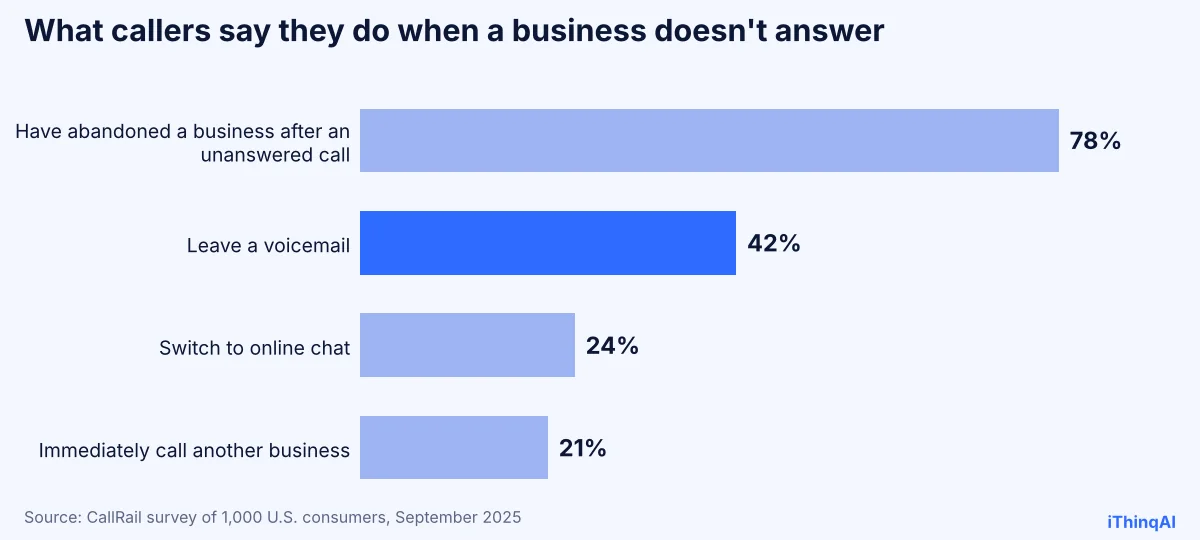
From CallRail's survey of 1,000 U.S. consumers (source):
- 42% say they leave a voicemail.
- 24% switch to online chat.
- 21% immediately call another business.
- 78% say they've abandoned a business after an unanswered call.
And for the ones who do leave a voicemail? Across 16.7 million missed business calls, Quo found 69% got no callback within 48 hours (Quo).
So business voicemail loses most callers up front, then loses many of the rest in your inbox.
Why business voicemail feels safe but isn't
Voicemail feels like coverage. It isn't. It's a to-do list your customer writes for you, which you'll get to later.
And "later" is the problem. Harvard Business Review's audit of 2,241 companies found the average response to a new lead was 42 hours, among firms that responded at all (HBR, 2011). By then, the customer has been helped by someone else.
There's a second problem: people have stopped trusting unknown numbers. Hiya's State of the Call 2026 found 86% of people don't answer unknown calls (Hiya). So even when you call back, the customer who left a voicemail may not pick up.
Why customers won't leave a voicemail anymore
A generation ago, leaving a message was normal. Today, fewer people are willing to leave a voicemail, for three reasons.
They have options. A search shows ten businesses that do what you do. Calling the next one takes five seconds; leaving a voicemail and waiting takes hours.
They don't trust callbacks. Most people have left a voicemail that was never returned. They've learned not to bother.
They text instead. Many customers, especially younger ones, would rather send a message or book online than leave a voicemail and wait for a stranger to call back.
So the question isn't how to get more people to leave a voicemail. It's how to make sure they never have to.
When calls go to business voicemail
Business voicemail doesn't catch calls evenly. It catches them at the worst possible times:
| When | Why it goes to voicemail | What the caller usually wants |
|---|---|---|
| Before 8 AM | Office not open yet | To book before work |
| 12 to 1 PM | Front desk at lunch | A quick answer on their own lunch break |
| After 5 PM | Office closed | To deal with a problem now that they're home |
| Weekends | No staff | To book for next week, or help with an emergency |
| Monday morning rush | Every line busy | Help with what broke over the weekend |
Those are exactly the hours when customers have time to call you, and exactly the hours a voicemail alternative earns its keep.
Voicemail alternatives, ranked
| Option | What the caller gets | Downside |
|---|---|---|
| Better greeting + fast callback rule | A promise | Still depends on someone calling back fast |
| Text-back after a missed call | A text and a link | Many callers have already dialed someone else |
| Human answering service | A person who takes a message | Still a message; cost often rises with volume |
| AI agent on your number | An answer, a booking or a transfer, right now | Needs a good knowledge base and someone to review calls |
What "never goes to voicemail" looks like
With iThinqAI on your existing number, the call that would have hit the beep gets this instead:
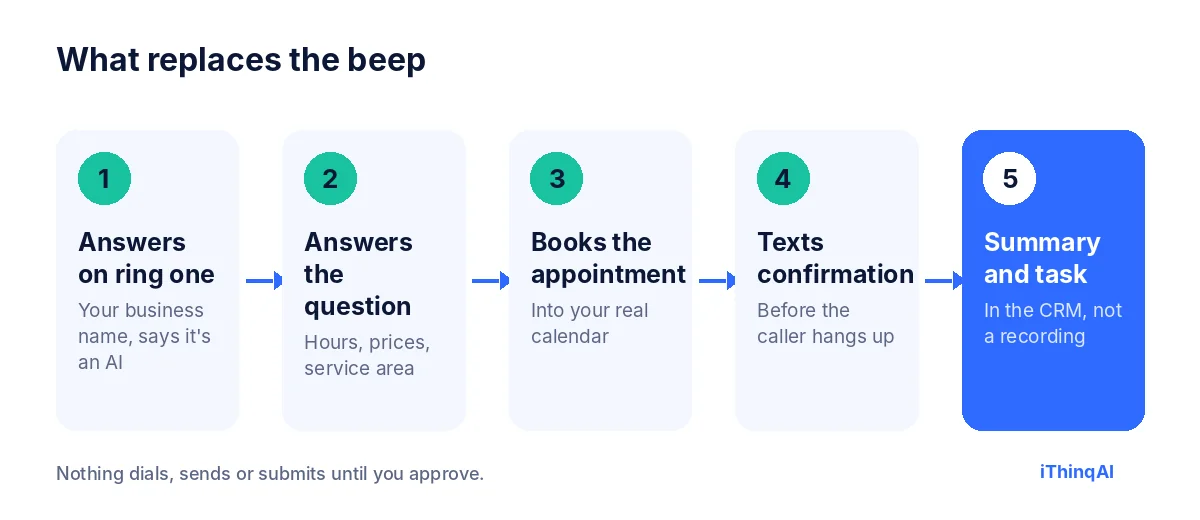
- A natural voice answers in your business's name and says it's an AI.
- It answers questions from the knowledge base you control: hours, services, price ranges, service area.
- It books the appointment into your calendar and texts a confirmation.
- If the caller needs you, it transfers or takes a detailed note and creates a task in the CRM.
- You get a summary, not a 47-second recording of someone mumbling their number.
Better than a message: finished work
When a caller has to leave a voicemail, someone still has to do the work. When iThinqAI answers, its agent can do the work on its own computer, with a browser, files and your connected tools:
- Book the appointment and update the customer record.
- Email the form, price sheet or directions they asked for.
- Add the notes your team needs for the visit or the call.
- Put every open request on a morning list, on a schedule you set.
All of that happens before you'd have listened to a single voicemail.
The reason why answering beats returning
Albert Lasker built his career on giving people the reason why. Here's the reason the beep loses.
A customer calls when the need is fresh. That's the moment they're most willing to book, to pay and to trust you. Business voicemail postpones that moment by hours or days, and by then the need has been met elsewhere or the motivation has faded. An answer on the first ring captures the moment. A voicemail lets it pass.
Nothing about your service changed. Only the timing did. And timing is everything.
If you must keep voicemail, do this today
Not ready to switch? Fine. Make voicemail less deadly in 10 minutes:
- Shorten the greeting to under 10 seconds. Nobody needs your fax number read aloud.
- Give one alternative: "Text this number and we'll reply within 15 minutes." Then actually do it.
- Set a callback rule: every voicemail returned within one business hour, logged somewhere a manager checks.
- Check after-hours voicemails first thing, before email.
Those steps help. They won't help with the callers who never leave a voicemail, and that's most of them.
Voicemail alternative by industry
| Industry | What business voicemail costs you | What the AI does instead |
|---|---|---|
| Home services | The emergency job goes to whoever answers | Triage, book the first slot, transfer true emergencies |
| Dental and medical | New patients book elsewhere | Book, send forms, answer insurance and location questions |
| Law firms | Prospective clients call the next firm | Run intake questions and book a consultation |
| Real estate | Buyers call another agent about the listing | Answer listing questions and book a showing |
| Medspas | Late-night bookers go to a competitor | Answer menu questions and book the consult |
In every industry, the right voicemail alternative turns a missed opportunity into a booked one, at the exact moment the customer is ready.
One week with business voicemail vs. one week with an AI
With business voicemail: 52 calls go to the beep. 22 callers leave a voicemail. The team returns 11 of them the same day and reaches 6. Four book. The other 30 callers left nothing, and nobody knows who they were.
With an AI on the line: the same 52 calls are answered on the first ring. 29 book on the spot. 14 get answers and are saved in the CRM with a follow-up. 6 transfer to the owner with notes. 3 were wrong numbers. Nobody had to leave a voicemail, and nobody had to call anyone back.
Those numbers are an illustration, not a promise. Track your own week and compare.
How to choose a voicemail alternative: 6 questions
- Does it answer on my existing number, or do I have to port?
- Can it answer real questions from my own information?
- Can it book into my calendar during the call?
- Can it transfer to a person, with notes, when needed?
- Where do summaries go, and who acts on them?
- Can I call a live demo line right now?
A voicemail alternative that only takes a better message passes questions 1 and 5. The right one passes all six.
Set it up in an afternoon
You don't need to rip out your phone system. Verify your number, load a short knowledge base (hours, services, price ranges, service area, policies), connect your calendar, set transfer rules, and test it yourself with a few calls. Start with after-hours only. Once you've read a few nights of summaries, expand to overflow during the day. Most owners never go back to the beep.
Common objections
"My customers expect voicemail." They expect to be helped. Given the choice between a beep and an answer, almost nobody picks the beep.
"An AI will sound robotic." Call the demo line and judge for yourself. The agent says it's an AI, and it sounds like a helpful front desk, not a phone tree.
"What about callers who just want to leave a message?" They still can. The AI takes a detailed message, creates a task and sends it to the right person, just faster and clearer than a recording.
What about the voicemails you already have?
Clear them out this week, one last time. Return every message, note which ones turned into customers, and write down how many were too old to save. That number is the best argument you'll find for never letting another call reach the beep.
How the AI handles the tricky calls
Owners worry about the calls that don't fit a script. Here's how a well-set-up AI handles the common ones:
- The wrong number. It politely says so and ends the call. No message clutters your inbox.
- The angry customer. It stays calm, acknowledges the problem, collects the details and transfers to a person or flags it as urgent for a callback.
- The Spanish speaker. It answers in Spanish, one of 12 supported languages, and logs the language in the CRM so your team follows up correctly.
- The sales pitch. It takes the vendor's details and doesn't book them onto your calendar.
- The existing customer checking on a job. It looks up the record, answers what it can and routes the rest to the right person.
- The question it can't answer. It says so honestly and creates a task, instead of guessing.
Each of these used to become a recording somebody had to listen to and sort. Now they're handled, or clearly routed, in the moment.
What your team gains
Removing the beep doesn't just help customers. It changes your team's day. Mornings start with a clean summary instead of a blinking light. Nobody spends an hour playing phone tag. The front desk stops apologizing for missed calls and starts helping the people in front of them. And the owner stops checking messages at dinner, because there aren't any to check. Over a month, that's dozens of hours back, which is often worth as much as the extra bookings. Ask your front desk what they would do with an extra hour every morning; the answer is usually the work customers notice most.
A simple greeting that works
Keep the opening short, honest and useful: "Thanks for calling Rivera Plumbing. I'm the AI assistant, and I can answer questions or book you an appointment right now. How can I help?" In one breath, the caller knows who answered, what it can do and that they won't be sent to a beep. Then let the knowledge base do the rest.
When your team calls customers back
Even with every inbound call answered, your team will still make outbound calls that reach a recording. Make those messages count. Say your name and business in the first five seconds. Mention exactly what the customer asked about, so they know it isn't spam. Offer one easy next step, like replying by text or picking a time from a link. Keep it under 20 seconds. Then send a short text right away, from the same number, because many people read texts long before they check their messages. Small habits like these turn a message into a reply. And log every attempt in the CRM, so two people never call the same customer within the same hour and nobody is forgotten.
What it costs
Plans start at $299 a month (Starter: inbound AI voice agent, unified inbox, CRM, calendar), as of November 2026. Growth, at $799, adds outbound callbacks and campaigns. See current pricing.
What to measure in your first month
Track four numbers before and after the switch, so the decision is based on results rather than opinions:
- Calls answered live, by hour of the day.
- Appointments booked on the first call.
- Messages your team had to return, and how long each took.
- New customers who came from after-hours calls.
Most owners see the biggest change in the last number. Evenings and weekends were never empty; they were just unanswered. Once those calls get a real answer, they show up on the calendar the very next morning, and the difference is visible within the first two weeks.
Hear what replaces the beep
Call 561-715-7686. Notice there's no beep. Ask it a question. Ask it to book you.
Then book a demo and we'll set it up on your number so tonight's callers never hear a tone. Want the numbers behind this? See our missed call statistics and the cost of missed calls formula.
P.S. Call your own business line right now and listen to your voicemail greeting as a stranger would. If you wouldn't leave a voicemail, neither will they. Call 561-715-7686 next.
Sources
Frequently Asked Questions
What can I use instead of voicemail for my business?
An AI agent that answers every call on your number, handles routine requests and books appointments, or a human answering service.
Do customers still leave voicemails?
Some do. In CallRail's 2025 survey, 42% of consumers said they leave a voicemail when a business doesn't answer.
Can an AI answer my calls without changing my number?
Yes. iThinqAI works on your existing business number.
Will I still get messages?
Yes, as written summaries and CRM tasks, plus the full call record.
Is a text-back after a missed call enough?
It helps, but many callers have already called someone else by the time the text arrives. Answering the call is better.