Speed to Lead: The Proven 5-Minute Rule to Win Every Lead
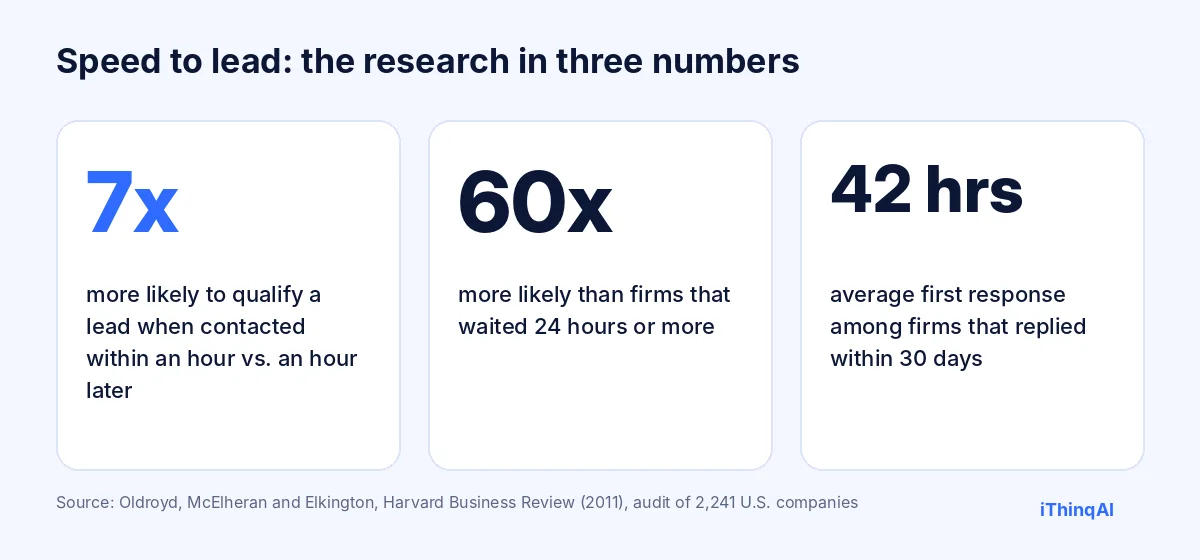
Quick answer: speed to lead is how fast you contact a new inquiry, and it's one of the strongest predictors of whether that inquiry becomes a customer. In a Harvard Business Review audit of 2,241 U.S. companies, firms that tried to reach a lead within an hour were nearly 7 times more likely to qualify it than firms that waited an hour longer, and over 60 times more likely than firms that waited a day. The average lead response time was 42 hours. The fix is to make the first callback automatic.
Key takeaways
- In most markets, the first to respond gets the first real conversation, and often the customer.
- The average business is slow: 42 hours to first response, and 23% never responded at all.
- 79% of consumers say they'll switch to a competitor that responds faster.
- iThinqAI calls new leads back within minutes from lists you approve, books them, and does the follow-up work on its own computer. Hear it at 561-715-7686.
What is speed to lead?
Speed to lead is the time between a new inquiry arriving, whether a web form, a portal lead or a missed call, and your first attempt to contact that person. A fast lead response time means calling within minutes, while the person is still thinking about the problem they asked about. Research consistently shows that faster first contact means more conversations, more qualified leads and more sales.
It's simple to define and hard to do, because leads don't arrive when your team is free.
The race you don't know you're in
A lead fills out your form at 2:14 PM.
What you don't see: they filled out three other forms at 2:11, 2:12 and 2:13.
You're not competing with your rivals on price, reviews or skill. Not yet. Right now you're competing on one thing only: who calls first. The business that's first to respond gets the first conversation, sets the price anchor and books the appointment. Everyone after that is fighting for second place.
What the research says about speed to lead
- Within an hour beats an hour later by about 7 to 1. Firms that tried to contact a lead within an hour were nearly seven times more likely to qualify it than those that waited even one more hour, and more than 60 times more likely than those that waited 24 hours or longer (Oldroyd, McElheran and Elkington, Harvard Business Review, 2011).
- Most businesses are slow. In the same audit, the average lead response time was 42 hours among firms that responded within 30 days, and 23% never responded at all.
- Customers know it. In Invoca's 2026 consumer research, 79% said they'll switch to a competitor that responds faster (Invoca).
- In some industries, there's no second chance. NAR's 2026 profile found 77% of repeat home buyers interviewed only one agent (Real Estate News).
You've probably also heard "5 minutes beats 30 minutes by 21 times." That comes from an earlier and smaller study by InsideSales.com and MIT. The direction is right; the exact multiple is less certain. You don't need the exact number. You need to be first.
What's a good lead response time?
There's no official standard, but here's a practical scale based on the research above:
| Lead response time | What it means |
|---|---|
| Under 5 minutes | Excellent. You're usually the first to respond |
| 5 to 60 minutes | Good. You're competitive in most markets |
| 1 to 24 hours | Risky. Faster competitors have likely reached them |
| Over 24 hours | Most of the opportunity is gone |
| Never | Common, and entirely preventable |
These bands are our recommended targets, not study results. Use them to set a goal your team can measure.
Why good businesses are slow
Not because they're lazy. Because:
- The lead arrives while everyone is with a customer.
- It arrives at 8:47 PM, or on Sunday.
- It lands in an inbox one person checks twice a day.
- The person who should call is in a meeting, on a roof or in court.
- Nobody owns the callback, so everybody assumes someone else did it.
And here's the cruel part: the hotter the lead, the more likely it showed up when you were busy, because busy times are when everybody is shopping.
Speed to lead by industry
| Industry | Why speed matters | Where leads come from |
|---|---|---|
| Real estate | Most buyers interview only one agent | Portals, sign calls, open houses |
| Home services | Urgent problems get solved by whoever shows up first | Search ads, directories, web forms |
| Law firms | People contact several firms and hire the first good response | Web forms, intake calls, referrals |
| Insurance | Shoppers compare quotes quickly | Quote forms, portals, renewals |
| Medspa and dental | New patients book wherever they get an answer tonight | Instagram, web forms, calls |
In every industry on that list, the first to respond has an advantage that better prices or reviews rarely overcome.
Picture this instead
The form lands at 2:14 PM. At 2:15, the lead's phone rings. A friendly voice says it's calling from your business, says it's an AI, mentions what they asked about, answers two questions from your knowledge base, and books them for tomorrow at 10. A text confirmation goes out. The CRM shows a new deal in "booked."
Your three competitors call at 4:30, at 6:00 and tomorrow morning. The lead says, "Thanks, I'm all set."
How iThinqAI makes "first" automatic
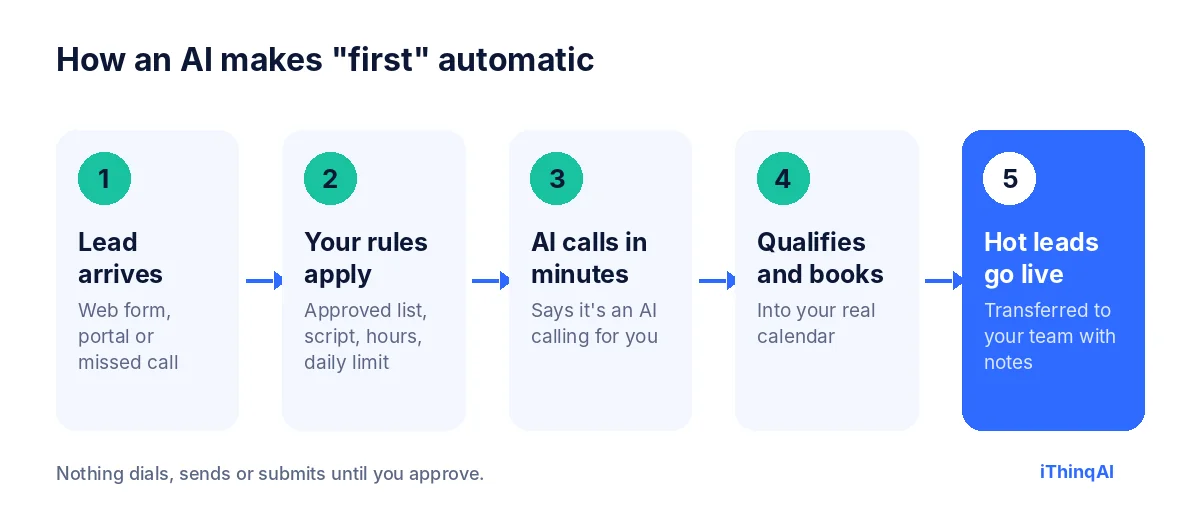
- Leads come in from web forms, portals or missed calls.
- You set the rules once: which lists it can call, the script, your calling window and your daily limit. Nothing dials until you approve.
- The AI calls back within minutes, says it's an AI calling for your business, qualifies the lead and books into your calendar.
- Everything is logged in the built-in CRM, with notes and next steps.
- Hot leads transfer live to your team when they want a person right now.
Outbound calling campaigns and the dialer are in the Growth plan: $799 a month with 5 seats and 5,000 AI minutes. Prices as of November 2026 at ithinq.ai/pricing.
First to call, first to follow through
Speed wins the first conversation. Follow-through wins the customer. Because iThinqAI's agent has its own computer, with a browser, files and your connected tools, it does the prep a good salesperson does:
- It looks up the lead's business before calling, when you allow it.
- It remembers what they asked last time, so the second call picks up where the first ended.
- It sends the info packet, quote or intake form right after the call.
- It puts the next touch on the calendar so it actually happens.
All of it lands in the CRM. Your team inherits warm, documented conversations instead of cold names.
The reason why speed wins
Albert Lasker's advice to advertisers was to give the reason why. Here it is for speed to lead.
Interest decays. The moment someone fills out a form, they're thinking about their problem and ready to talk. An hour later they're in a meeting. A day later they've talked to someone else, or forgotten why they asked. Calling fast isn't pushy; it's catching people at the only moment they actually want to hear from you.
Humans can't guarantee that moment, because humans are busy. A system can.
Why being first to respond beats being best
It's uncomfortable, but true: in most local markets, the first to respond beats the best who responds late. The customer doesn't know yet who's best. They know who called back, who answered their question and who offered a time. By the time the better company calls the next morning, the first to respond has already booked the job, set the price and started building trust.
That doesn't mean quality stops mattering. It means quality only gets a chance to matter if you're in the conversation. Speed to lead is the ticket into the room. Being first to respond is how small businesses beat bigger competitors who are slow because of their size.
Speed to lead for small teams: a realistic playbook
You don't need a sales department to respond in minutes. You need a system:
- Business hours: whoever is free takes new leads first, and a shared board shows who owns each one.
- Busy moments: an AI agent covers the gaps when everyone is with customers, calling back from approved lists.
- Nights and weekends: the AI handles every new lead, books what it can and leaves clear notes for the morning.
- Every Monday: review last week's lead response time and fix whatever slowed it down.
This mix lets a three-person office be first to respond almost every time, without anyone working nights.
What a fast lead response time does to your marketing costs
Every lead you pay for has a cost: the ad click, the directory listing, the referral fee. When the lead goes cold before anyone calls, that money is wasted, and your real cost per customer quietly rises. Improve speed to lead and the same marketing budget produces more customers. Many owners trying to fix their marketing are really fighting a lead response time problem.
Speed to lead checklist
- Every lead source routes to one shared place.
- First contact target: under five minutes in business hours.
- After-hours leads get an approved callback, not a next-day email.
- Calls come from the number the lead already knows.
- Every lead gets at least three attempts across call and text.
- Lead response time is measured weekly and visible to the team.
What to say on the first callback
A fast call only works if it's a good call. Keep the first one short and useful:
- Name and reason: "Hi, this is the AI assistant for Rivera Plumbing, calling about the request you just sent."
- Confirm the need: "You mentioned a leaking water heater. Is water still coming out?"
- Answer one question: give the price range or availability they're most likely wondering about.
- Offer two times: "We can come today at 4 or tomorrow at 8:30. Which works?"
- Confirm and close: "You're booked. I'm texting the details now."
Five steps, about two minutes. The goal isn't to sell everything on the first call. It's to turn interest into an appointment before the next company calls.
How it feels from the customer's side
Picture the customer's evening. They finally sit down at 8:40 PM to deal with the problem they've been putting off. They fill out two or three forms and go back to dinner. Twenty minutes later, one company has already called, answered the question that was bothering them, and given them a time tomorrow. The other companies call the next day, during work, and get voicemail.
From the customer's side, the first company seems more organized, more professional and more interested in the job. They might not be better. They were just there.
A note on the law
AI-voice calls fall under the TCPA's rules for artificial voices. In February 2024 the FCC confirmed that AI-generated voices count as "artificial" voices, so consent rules apply (Mayer Brown). That's why iThinqAI uses approval gates, calling windows, daily limits and Do Not Call controls. Use fast callbacks for people who asked to hear from you, and check your consent language with your own counsel.
How to measure your lead response time
- Pick one source: your website form is easiest.
- Record the timestamp when each lead arrives.
- Record the timestamp of the first call or text attempt.
- Calculate the median, not the average, so one weekend lead doesn't skew it.
- Check it weekly and post the number where the team can see it.
What gets measured gets faster. Most owners who measure their lead response time for the first time are surprised by the weekends.
7 ways to improve speed to lead this week
- Route every form to one shared place, not one person's inbox.
- Set a five-minute target for business hours and post it.
- Text first if you can't call: "Got your request, calling you in 2 minutes."
- Call from the number the lead already knows, so they pick up.
- Cover nights and weekends with an AI that calls back from approved lists.
- Make the first call short: confirm the need, book the next step.
- Review missed or slow leads every Monday and fix the cause, not the person.
Before and after: one month of web leads
Before: 60 web leads arrive. Median first contact: the next business day. Twenty never get a call because they arrived Friday evening. The team books 14 appointments.
After: the same 60 leads arrive. Median first contact: four minutes, day or night. Every lead gets an attempt and a text. The team books noticeably more, because they're the first to respond to almost every one.
That's an illustration, not a guarantee. Run it on your own leads for a month and compare.
What to do when a lead doesn't pick up
Fast calls still go to voicemail sometimes. Don't stop at one attempt. A simple sequence works well: call within minutes, send a short text right after ("Sorry we missed you, here's a link to pick a time, or reply with a good time to call"), try again later the same day, and once more the next morning. Leave short, specific voicemails that mention exactly what they asked about. Most people who don't answer the first call respond to the text, because it costs them nothing and they asked for help in the first place. Log every attempt so nobody calls twice in an hour.
Common objections
"Calling that fast feels pushy." It feels attentive, because the person just asked. Calling three days later is what feels like a sales call.
"Our leads are low quality." Some are. Fast qualification sorts them in minutes instead of letting your team chase them for a week.
"We can't staff for nights." You don't need to. That's exactly what an AI with approved callback lists is for.
Test your speed right now
Fill out your own website's contact form. Start a timer. See how long it takes for anyone to reach you.
Then call 561-715-7686 and hear what an instant response sounds like. Or enter your number on ithinq.ai and it will call you within moments. Ready to set it up? Book a demo. For the legal side, read is AI cold calling legal; to fill your calendar, see AI appointment setter.
P.S. Forty-two hours was the average in that audit. Your leads don't have 42 hours of patience. Call 561-715-7686 today and see how fast first can be.
Sources
Frequently Asked Questions
What is speed to lead?
The time between a new inquiry arriving and your first attempt to contact that person.
What's a good lead response time?
As fast as possible. Harvard research found contact within an hour was nearly 7x more effective than waiting another hour; many teams aim for under five minutes.
Can AI call my leads back automatically?
Yes. iThinqAI calls web, portal and missed-call leads back after you approve the list, script and calling hours.
Is it legal for AI to call leads?
AI-voice calls generally require prior consent under the TCPA. iThinqAI includes approval gates, calling windows and Do Not Call controls. This is not legal advice.
How do I measure lead response time?
Track the time from when each lead arrives to the first call or text attempt, and review the median weekly.