Is AI Cold Calling Legal? 7 Proven Rules (Avoid Mistakes)
This article is general information, not legal advice. Talk to your own attorney about your lists, scripts and states.
Quick answer: AI calling is not banned, but AI cold calling to consumers without consent is a serious legal risk. On February 8, 2024, the FCC ruled that calls using AI-generated voices count as calls using an "artificial or prerecorded voice" under the Telephone Consumer Protection Act (TCPA). That means the TCPA's consent rules apply to AI voice calls. The safe and profitable use of AI calling is to call people who asked to hear from you: inquiries, existing customers, renewals and appointment reminders.
Key takeaways
- The FCC didn't ban AI voice calls. It confirmed that existing artificial-voice rules apply to them.
- Consent comes first. Marketing calls with an artificial voice typically require prior express written consent.
- The legal way to use AI calling is also the profitable way: call people who raised their hand.
- iThinqAI is built so nothing dials until you approve the list, script and schedule, with calling windows, daily limits, Do Not Call controls and AI disclosure. Hear it at 561-715-7686.
Is AI cold calling legal?
AI cold calling, meaning unsolicited sales calls placed with an AI-generated voice to people who never gave consent, is high-risk under federal law. Since February 2024, the FCC treats AI-generated voices as artificial voices under the TCPA, which generally requires the called person's prior consent, and for marketing calls typically prior express written consent. AI calls to people who asked to be contacted, such as new inquiries or existing customers, are far lower risk when done properly.
The details depend on who you call, why, and which states they're in. That's why you should confirm your setup with counsel.
Why so many vendors avoid this question
Search for AI calling tools and you'll see promises like "call 10,000 prospects a day!" What you won't see is the word "consent."
That silence is expensive. Lawsuits under federal calling rules can carry statutory damages per call, and an AI that dials thousands of numbers can multiply a mistake thousands of times before lunch.
We'd rather you hear it from us now than from a plaintiff's lawyer later.
What the FCC actually ruled
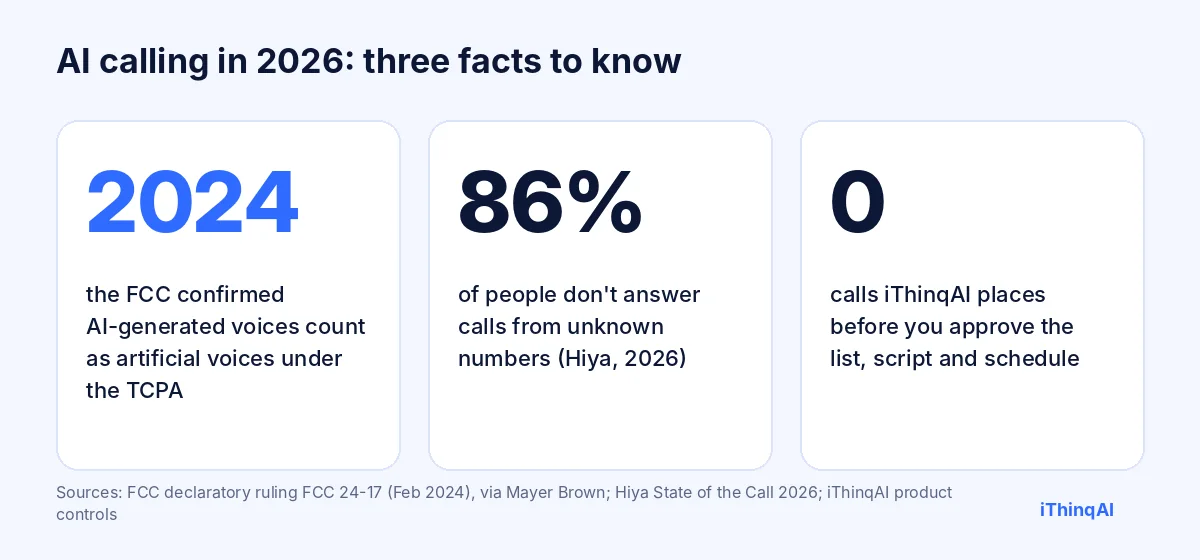
On February 8, 2024, the FCC unanimously adopted a declaratory ruling (FCC 24-17) stating that AI technologies that generate human voices, including voice cloning, fall under the TCPA's restrictions on "artificial or prerecorded voice" calls. It took effect immediately (Mayer Brown).
It did not ban AI voice calls. As one law firm put it, the FCC didn't ban the technology; it confirmed the existing rules apply to it (Orrick).
What the TCPA means for AI voice calls in practice
In plain English, and simplified (your attorney will add the nuances):
- Consent comes first. Calls using an artificial voice generally need the called person's prior express consent. For marketing calls, the bar is typically higher: prior express written consent.
- The type of call matters. An appointment reminder to a customer who booked with you is different from a sales pitch to a stranger.
- Do Not Call rules still apply to telemarketing, including the national registry and your own internal list.
- Identify yourself. Artificial-voice calls must identify the business making the call.
- Time of day matters. Telemarketing calls are restricted to reasonable hours in the recipient's time zone, and some states are stricter.
- States add their own rules. Several states have "mini-TCPA" laws, and many require all parties' consent to record a call.
The calls AI is great for (and the ones to skip)
| Lower-risk, high-value AI calls | Higher-risk calls to avoid without counsel |
|---|---|
| Calling back someone who just asked to be contacted | Dialing purchased lists of consumer cell phones |
| Appointment reminders and rescheduling for existing customers | Blasting a sales message to people who never asked |
| Renewal reminders for current clients | Calling numbers on the Do Not Call registry for marketing |
| Returning a missed call | Calling outside allowed hours |
| Following up on a quote the customer requested | Hiding that the caller is an AI |
The left column is also where the money is. People who raised their hand convert far better than strangers.
Why AI cold calling rarely works anyway
Even ignoring the law, AI cold calling has a practical problem: people don't pick up. Hiya's State of the Call 2026 found 86% of people don't answer calls from unknown numbers, and only 14% answer right away (Hiya). The same report found 31% of consumers say they've received a deepfake voice call, so trust in unexpected AI voice calls is low.
Calls to people expecting to hear from you are different. They answer, because they asked.
How iThinqAI is built for compliance
We designed outbound calling around one principle: nothing dials until you approve.
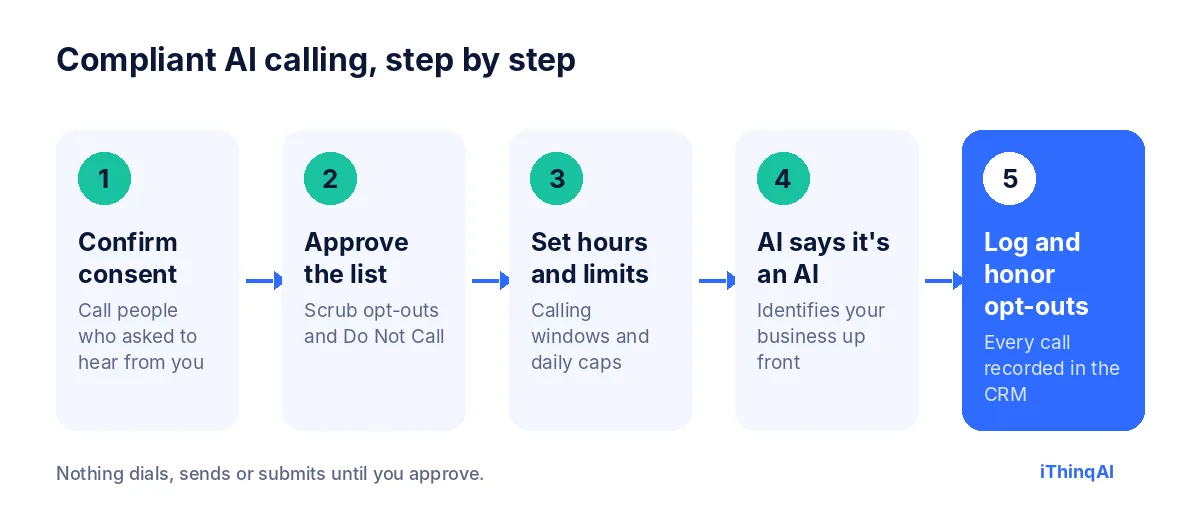
- Approval gates on every campaign: you approve the list, the script and the schedule.
- Daily call limits and calling windows you control.
- TCPA and Do Not Call controls built into the dialer.
- Verified caller ID on your own number.
- AI disclosure: the agent says it's an AI.
- Recording notices where recording is on.
- Two-step sign-in and role-based access, so only the right people can launch campaigns.
These tools help you follow the rules. They don't replace your obligation to get consent and follow the law in your states.
The reason why compliant AI calling wins
Albert Lasker's principle was to give people the reason why. Here's ours: the legal way to use AI calling and the profitable way are the same way.
Calling people who asked to hear from you, within minutes, at reasonable hours, honestly identified, is what converts. It's also what the TCPA expects. AI simply means every one of those people gets a call in minutes instead of days, and nobody on your team has to dial.
AI cold calling vs. AI callbacks: the difference that matters
People use "AI cold calling" to mean very different things, so it helps to separate them:
| AI cold calling | AI callbacks and follow-up | |
|---|---|---|
| Who gets called | Strangers from a list | People who contacted you or are existing customers |
| Consent | Usually missing | Usually given when they asked to be contacted |
| Answer rate | Low; unknown numbers get ignored | Higher; they're expecting you |
| Conversion | Low | High, because intent already exists |
| Legal risk | High | Much lower when consent and rules are followed |
When owners tell us they want AI cold calling, what they usually need is the right column: fast, reliable follow-up with people who already raised their hand.
Consent language: what to check on your forms
Most of the risk in AI voice calls is decided before the call, on the form where someone gives you their number. Review your web forms, quote requests and booking pages with your attorney and check:
- Does the form clearly say you may contact the person by phone and text?
- Does it mention automated or artificial-voice calls if you plan to use them?
- Is the consent tied to your business specifically, not a vague group of "partners"?
- Is there a clear way to opt out later?
- Do you keep a record of when and how consent was given?
Good consent language protects you and sets honest expectations for the customer.
Building a compliant AI calling program in 30 days
Week 1: Audit. List every source of phone numbers you have and how consent was captured. Separate customers, inquiries and everything else.
Week 2: Fix forms. Update consent language with counsel. Set up your internal Do Not Call list and opt-out process.
Week 3: Start narrow. Approve one list of people who recently asked to be contacted. Set a calling window and a modest daily limit. Review every call.
Week 4: Expand carefully. Add appointment reminders and renewal calls for existing customers. Keep reviewing.
That's slower than "10,000 calls a day," and it's the version that actually builds a business instead of a legal file.
Red flags in any AI calling vendor
- It promises massive call volumes but never mentions consent.
- It offers to sell or supply you lists of consumer numbers.
- It can't explain how Do Not Call is handled.
- It lets anyone on your team launch a campaign without approval.
- It hides that the caller is an AI, or makes that optional.
- It has no calling-window or daily-limit controls.
One red flag is a question to ask. Two or more is a reason to walk away from that AI cold calling tool.
What about calling businesses instead of consumers?
Many owners assume business-to-business calls are exempt. The rules are different in some respects, but they aren't simply off. Calls to cell phones, including business owners' cell phones, can still fall under federal restrictions on artificial voices, and some state laws make no distinction. Treat B2B AI voice calls with the same care: call people with a real reason to hear from you, identify yourself, honor opt-outs, and ask your attorney about your specific lists.
Common objections
"My competitors are doing AI cold calling." Some are. Some will also be sued. Your advantage is being the business that calls back fast and legally.
"Asking for consent slows us down." It filters for people who actually want to talk, which is why their calls convert.
"We're too small to be noticed." Calling claims are often brought by individuals, not regulators. Size doesn't protect you; good practices do.
What a good AI follow-up call sounds like
Here's a call to someone who filled out a quote request ten minutes earlier:
AI: "Hi, this is the AI assistant for Rivera Heating and Air, calling about the quote request you just sent for a new furnace. Is now a good time for two quick questions?"
Customer: "Sure."
AI: "Thanks. Is the current furnace still running, and roughly how old is it?"
Customer: "It runs, but it's about 18 years old."
AI: "Got it. Our comfort advisor can come out Thursday at 10 or Friday at 2 to measure and give you options. Which works?"
Customer: "Friday at 2."
AI: "You're booked. I'm texting the details now. If you ever want us to stop calling, just say so and we'll update your preferences."
Notice what's there: who's calling, why, a clear AI disclosure, a useful next step and an easy opt-out. That's the shape of a call people are glad to get.
Handling opt-outs gracefully
Opt-outs aren't a failure. They're a signal and a legal obligation. When someone says "stop calling," the AI should confirm politely, end the call and record the request so nobody contacts that number again for marketing. Review opt-outs monthly. A spike usually means a list, a script or a calling time needs fixing. Honoring opt-outs quickly is one of the simplest ways to protect your reputation and your phone number.
What to tell your team
Make three rules clear to everyone who can launch a campaign. First, only call lists with a documented reason to call. Second, every campaign needs approval from a named person before it starts. Third, when in doubt, don't dial; ask. Role-based access in iThinqAI means only approved people can launch campaigns at all, which makes those rules easier to keep.
A short glossary
| Term | Plain-English meaning |
|---|---|
| Artificial or prerecorded voice | A voice not spoken live by a person; since 2024 this includes AI-generated voices |
| Prior express consent | The person agreed to be called at that number |
| Prior express written consent | Signed or electronically documented agreement, typically needed for marketing calls with artificial voices |
| Do Not Call registry | The national list of numbers that don't want telemarketing calls |
| Internal Do Not Call list | Your own list of people who asked you to stop |
| Calling window | The hours you allow calls to be placed in the recipient's time zone |
How state laws can change the picture
Federal rules set the floor, not the ceiling. Several states have passed their own calling laws with stricter consent requirements, tighter calling hours, limits on how many times you can call the same person, or extra rules about automated systems. Many states also require every party's consent before a call is recorded. If you call customers in more than one state, ask your attorney to map the strictest rules that apply and set your calling windows, daily limits and recording notices to match. It's easier to follow one strict standard everywhere than to juggle many.
What to document, every time
Good records are your best defense and your best management tool. Keep:
- When and how each person gave consent, and what the form said at the time.
- Which list each campaign used and who approved it.
- The script version used on each call.
- Every opt-out request and when it was processed.
- Call recordings or summaries, where recording is lawful and disclosed.
iThinqAI logs calls, approvals and outcomes in the CRM, which makes most of this automatic. Your consent records still need to live wherever your forms collect them.
Questions to bring to your attorney
You'll get more out of a short legal review if you bring specific questions:
- Does our current form language cover phone, text and artificial-voice calls for the purposes we plan?
- Which of our lists are customers, which are inquiries, and which need new consent?
- Which states' rules apply to the people we call, and what are the strictest calling hours?
- Do we need all-party consent to record calls in those states?
- How should we document consent and opt-outs?
Bring a sample script and a screenshot of each form. A focused hour with counsel can save you from years of exposure.
The bottom line
AI calling is legal when it's done the way good businesses already try to call: to people who asked, at reasonable hours, honestly identified, with an easy way to opt out. AI cold calling to strangers who never consented is a risk most small businesses shouldn't take.
Hear a compliant AI call
Call 561-715-7686 and talk to the agent. Notice it tells you it's an AI. Or enter your number on ithinq.ai and it will call you, because you asked it to.
Then book a demo and we'll walk through the approval and compliance controls on screen. For the fast-callback playbook, read speed to lead, and for old leads, see reactivate old leads.
P.S. Before you buy any AI dialer, ask the vendor one question: "What stops this from calling someone who never gave consent?" If the answer is vague, keep looking. Our answer: nothing dials until you approve. Call 561-715-7686 to hear the rest.
Sources
Frequently Asked Questions
Is AI cold calling legal?
AI voice calls are subject to the TCPA's artificial-voice rules, which generally require prior consent. Unsolicited AI sales calls to consumers carry significant legal risk. This is not legal advice.
Did the FCC ban AI robocalls?
No. In February 2024 it confirmed AI-generated voices count as artificial voices under the TCPA, so existing consent rules apply.
Can I use AI to call my own leads?
Calling people who asked to be contacted is far lower risk, but confirm your consent language with counsel.
Does iThinqAI handle Do Not Call?
iThinqAI includes TCPA and Do Not Call controls, approval gates, calling windows and daily limits.
Does the AI have to say it's an AI?
iThinqAI always discloses that it's an AI. Artificial-voice calls must also identify the business making the call.