Mystery Shopper Call: 5 Proven Tests Owners Hate to Fail
Quick answer: a mystery shopper call is a test call to your own business, made the way a real customer would, to see what actually happens. The fastest way to find out how many customers you're losing is to call your own business at the times customers call: a weekday evening, lunch hour, Monday morning, Saturday and through your web form. Score each one on the card below. When Clio ran a secret shopper study on 500 law firms in 2024, only 40% answered the phone.
Key takeaways
- You know your business from the inside. Customers only know what happened the one time they called.
- Five calls at five specific times reveal almost every leak: evenings, lunch, rush hours, weekends and web forms.
- Most businesses fail the evening and weekend calls, and many never offer to book.
- iThinqAI fixes each failure point on your existing number, and you can run the same test on it at 561-715-7686.
What is a mystery shopper call?
A mystery shopper call is a test call made by you or someone you trust, posing as a real customer, to measure how your business handles inquiries. You check whether the call is answered live, whether the caller's question gets answered, whether anyone offers to book, and how long a callback takes if the call is missed. It shows what customers really experience, not what your team believes happens.
You've never heard your business the way customers do
You know your business from the inside. You know the phone is "usually" answered. You know the team "always" calls back.
Your customers don't know any of that. They only know what happened the one time they called.
So let's find out what that was.
Why a secret shopper test works
Secret shopper studies are how researchers measure what businesses actually do, not what they say they do. In its 2024 Legal Trends Report, Clio had the research firm Lux contact 500 law firms as potential clients. Only 40% answered the phone, down from 56% in 2019. Counting callbacks, 52% answered or returned the call, which left 48% essentially unreachable (Clio).
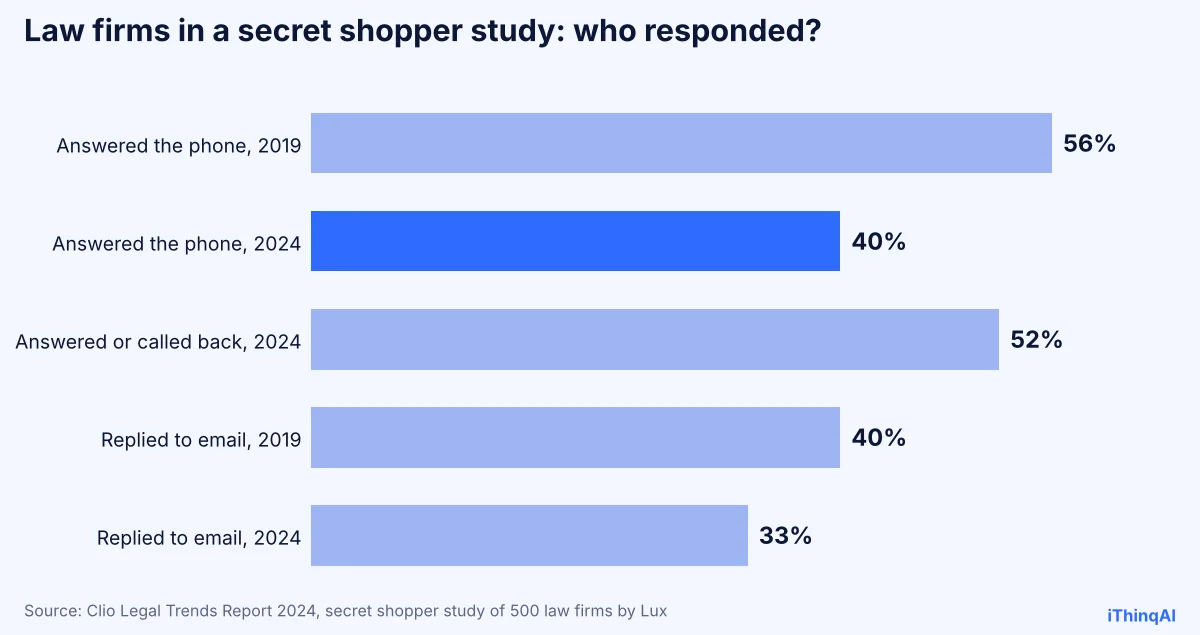
Those firms all believed they were responsive. You might believe the same. A mystery shopper call is how you check.
The five calls
Use a phone your team won't recognize. Pretend to be a real customer with a real question.
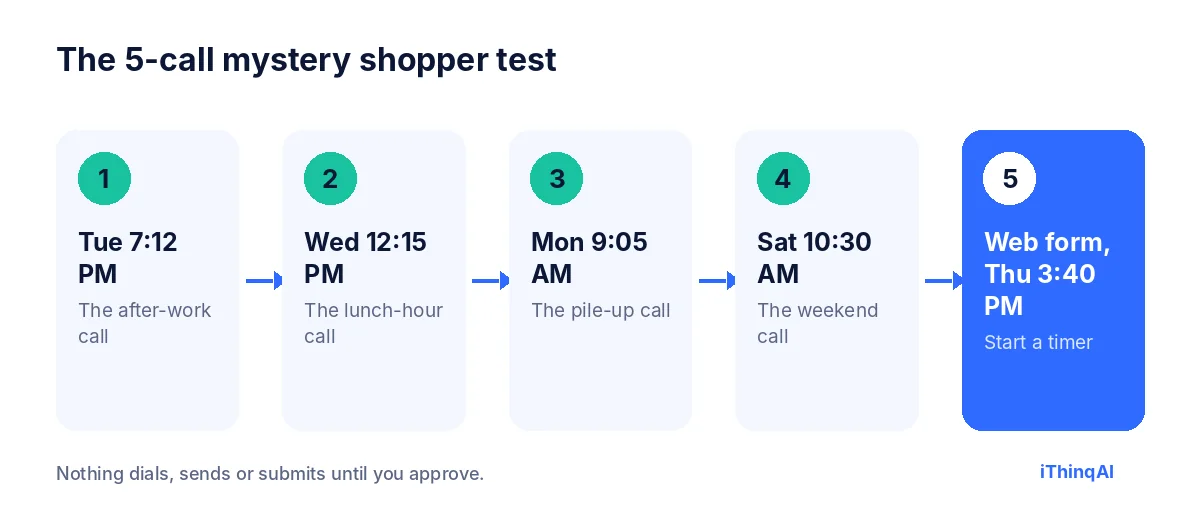
- Tuesday, 7:12 PM. The after-work call. This is when people finally have time.
- Wednesday, 12:15 PM. The lunch-hour call, when your front desk is eating.
- Monday, 9:05 AM. The pile-up call, when everybody calls at once.
- Saturday, 10:30 AM. The weekend call.
- Your web form, Thursday, 3:40 PM. Start a timer. Stop it when anyone contacts you.
The scorecard
| Test | Answered live within 3 rings? | Question answered? | Offered to book? | Callback within 1 hour if missed? | Score (0 to 4) |
|---|---|---|---|---|---|
| Tue 7:12 PM | |||||
| Wed 12:15 PM | |||||
| Mon 9:05 AM | |||||
| Sat 10:30 AM | |||||
| Web form Thu 3:40 PM | Contacted within 5 min? |
One point each for: answered live, question answered, booking offered, and a callback within one hour if missed. For the web form, give the first point if anyone contacts you within five minutes.
16 to 20: You're in great shape. Protect it. 10 to 15: You're leaking, probably at night and on weekends. Under 10: You're paying for marketing that sends customers to your competitors.
What most owners discover
No shame here. These are the usual findings when you call your own business:
- Evening and weekend calls go to voicemail.
- The Monday-morning call rings out because two people are already on the phone.
- The person who answers can't answer the pricing question and takes a message.
- Nobody offers to book. Invoca's 2026 research found 75% of business services companies don't ask leads to buy or book a meeting (Invoca).
- The web form gets a reply the next day, or never.
How to run a mystery shopper call, step by step
A good mystery shopper call is planned, not improvised. Follow these steps:
- Pick a realistic request. Use something your best customers actually ask: a price range, availability this week, whether you serve their area.
- Use a number your team won't recognize. A friend's phone or a spare line works.
- Write down the exact time you dial and how many rings it takes.
- Ask your question naturally and note whether you get a real answer or a promise to call back.
- Wait for the booking offer. Don't ask for an appointment right away; see if they offer one.
- If nobody answers, note whether you'd leave a message and how long the callback takes.
- Score it immediately, before your memory softens the result.
Run each mystery shopper call on a different day so you see the whole week, not one good afternoon.
What to listen for on each call
The score tells you what happened. Listening tells you why:
- The greeting. Was it clear who you reached, or did you have to ask?
- The wait. Hold music, a phone tree, or a person on the first ring?
- The answer. A real number or time, or "someone will get back to you"?
- The close. Did anyone ask, "Would you like to book a time?"
- The finish. Did you get a confirmation by text or email?
Small things decide big outcomes. The difference between "we'll call you back" and "I have Thursday at 10" is often the difference between a lost lead and a new customer.
Why you should call your own business every month
One test shows you a moment. Monthly tests show you a pattern. When you call your own business every month, you catch problems as they appear: a new hire who doesn't know the prices, a holiday schedule nobody updated, a web form that stopped sending notifications. Owners who call their own business regularly tend to fix problems before customers notice them. Owners who never do find out from their reviews.
Mystery shopper call scripts you can use
Keep the script short and realistic. Three examples:
- Home services: "Hi, my AC is blowing warm air. Do you have anything tomorrow, and roughly what does a service call cost?"
- Dental: "Hi, I'm new to the area and need a cleaning. Do you take my insurance, and when's your next opening?"
- Law firm: "Hi, I was in a car accident last week and wanted to talk to someone about my options. How does that work?"
Each one tests three things at once: whether the call is answered, whether the question is answered and whether anyone offers to book.
Secret shopper results by industry
Industry research shows the same gaps your own test is likely to find:
| Industry | What secret shopper and call data show |
|---|---|
| Law firms | Only 40% of firms answered the phone in Clio's 2024 secret shopper study |
| Business services | 75% of companies didn't ask leads to buy or book (Invoca, 2026) |
| Home services | A person answered 52% of inbound calls (Invoca, 2026) |
| Healthcare | A person answered 54% of calls; 41% of missed calls got a callback within 48 hours (Invoca; Quo) |
If large, established businesses score like this in a secret shopper study, a busy small office probably has gaps too. That's not a reason for guilt. It's an opportunity your competitors are also missing.
What a perfect mystery shopper call sounds like
Caller (7:12 PM): "Hi, do you service Henderson, and what does a furnace tune-up cost?"
Answer: "Thanks for calling Rivera Heating and Air. I'm the AI assistant. Yes, we serve Henderson. Tune-ups start at $129. I have Thursday at 10 AM or Friday at 2 PM. Would either work?"
Caller: "Thursday's great."
Answer: "You're booked for Thursday at 10. I'm texting a confirmation now."
That's a perfect score: answered on the first ring, question answered, booking offered, confirmation sent. It took under a minute, at 7:12 PM. Your own business can sound like that too.
How to share the results with your team
Share the scorecard, not blame. Show the team the five results, ask what got in the way on each failed call, and agree on one fix per month. Often the answers are about systems, not people: nobody covers lunch, the phone can't handle three calls at once, nobody owns web forms. Fix the system and the next secret shopper test improves on its own. Then run the next mystery shopper call and track the trend.
Common objections
"My team will feel spied on." Tell them a test is coming, just not when. The goal is to find gaps, not to catch people out.
"One bad call isn't representative." That's why it's five calls at five different times.
"We already know we miss calls." Hearing it as a customer is different. It turns a vague worry into a specific number you can fix.
Test your other channels too
Customers don't only call. Extend your secret shopper test to every way people reach you:
- Email: send a realistic inquiry and time the reply. In Clio's study, only 33% of law firms replied to email.
- Website chat: ask a pricing question and see whether you get an answer or a contact form.
- Instagram and Facebook messages: send a booking question at 9 PM and note when, or whether, anyone replies.
- Google Business Profile messages: check whether messaging is on, and who actually sees those messages.
A secret shopper who can reach you on the phone but not anywhere else will often choose the competitor who answers everywhere. One inbox for every channel is the fix.
Turn your score into a dollar figure
A score is easier to act on when it has a price. For each failed test, ask: how many real calls like this do we get in a typical week? Multiply by your close rate and your average customer value. If evening calls fail and you get eight real evening calls a week, at a 30% close rate and $400 per customer, that's roughly $960 a week, or about $4,000 a month. Your mystery shopper call just found a $4,000 leak.
A 30-day plan after your first test
Week 1: Run the five-call test and share the scorecard with your team.
Week 2: Fix the cheapest gap first, usually lunch coverage or a web-form owner.
Week 3: Cover evenings and weekends with an AI that answers, books and follows up.
Week 4: Call your own business again at the same five times and compare.
Most owners see the biggest jump between the first and second mystery shopper call, because the evening and weekend gaps close overnight.
Why these results matter
Each failed test is a customer who went somewhere else. In CallRail's 2025 survey, 82% of consumers said they'd call a competitor if a business didn't answer, and only 42% said they'd leave a voicemail (CallRail). And when a message is left, Quo found 69% of missed business calls get no callback within 48 hours (Quo).
A low score isn't a character flaw. It's a capacity problem. But it costs the same either way.
What great businesses do differently
When you score well, it's rarely luck. The businesses that ace these tests tend to share a few habits. They treat the phone as a sales channel, not an interruption. They answer every call the same way, whether it's 9 AM or 9 PM. They have clear answers to the five questions customers ask most, written down where anyone, or any AI, can use them. They always offer a specific time instead of asking the caller to call back. And they follow up in minutes, not days, with a record of every conversation. None of those habits require a big team. They require a system that never gets tired or busy.
The hidden lesson in every failed call
Every failed test points to the same root cause: there are more moments when customers want to reach you than there are people available to answer. You can't fix that by asking your team to try harder, and you can't afford to staff every hour of the week. What you can do is make sure the routine calls are handled instantly, so your people are free for the ones that need them.
That's the job an AI front office was built for: it answers every call at any hour, books the routine ones on the spot, and passes the rest to your team with notes, so the next test sounds the same at 7:12 PM as it does at 10 AM. Your customers will never know which one answered. They'll only know they got help.
Now run the same test on us
This is the point where we'd normally tell you how great our product is. Instead, call it.
Call 561-715-7686 at any of those five times. Midnight, if you want. Ask the same question you asked your own team. Ask it to book you.
Then compare the two scorecards. That's the whole sales pitch.
What fixes a bad score
iThinqAI runs on your existing number and fixes each failure point:
- Evenings and weekends: the AI agent answers 24/7 and says it's an AI.
- Monday pile-ups: it handles many calls at once. Nobody waits on hold.
- "Let me take a message": it answers from a knowledge base you control and books into your calendar.
- Never asking for the booking: it asks every time, because you told it to.
- Slow web-form follow-up: it calls new leads back after you approve the list, script and calling hours.
And it keeps working after the call. Its agent has its own computer, with a browser, files and your connected tools, so it logs the call in the CRM, sends the follow-up and books the next step without anyone typing.
The reason why this test beats any sales demo
Albert Lasker believed in giving people the reason why. Here it is: a sales demo shows you a product at its best. A mystery shopper call shows you your business at its worst, which is exactly what your customers experience at 7:12 PM. Once you've heard both, the decision makes itself.
What it costs
Starter is $299 a month; Growth, with outbound calling, is $799. Prices as of November 2026 (ithinq.ai/pricing).
P.S. Don't wait for next week. Put "7:12 PM: call the office" in your phone right now. Then call 561-715-7686 right after. The difference between those two calls is worth more than anything we could write.
Sources
Frequently Asked Questions
How do I secret shop my own business?
Call at the times customers call (evenings, lunch, Monday morning and weekends), use an unknown number, and score whether you're answered, helped and booked.
How many law firms answer the phone?
In Clio's 2024 secret shopper study of 500 firms, 40% answered the phone.
What if I fail the test?
Start with after-hours coverage. An AI agent on your number can answer, book and log calls while you're closed.
How often should I run a mystery shopper call?
Monthly is a good rhythm, and after any change to staffing, hours or phone setup.
Should my team know about the test?
Tell them it's coming, but not when. The goal is to find system gaps, not to catch people out.