AI Answering Service for HVAC: 7 Proven Ways to Win Calls
Quick answer: an AI answering service for HVAC answers every call to your shop, 24/7, on your existing number. It triages emergencies using your rules, books service calls and estimates on your calendar, alerts your on-call technician when a job can't wait, texts the customer a confirmation, and logs every job. CallRail's 2025 data shows only 48% of home services businesses respond to after-hours inquiries immediately, so answering every call puts your company ahead of half the market.
Key takeaways
- Emergency HVAC and plumbing calls go to whoever answers first. The second company rarely gets a chance.
- More than half of home services businesses don't answer after-hours inquiries right away.
- An AI answering service for HVAC books routine work, dispatches emergencies by your rules and follows up on estimates.
- iThinqAI answers on your number, books on the call and texts the customer. Hear it at 561-715-7686.
What is an AI answering service for HVAC?
An AI answering service for HVAC is a voice assistant that answers phone calls for heating, cooling and plumbing companies, gathers the customer's details and problem, sorts emergencies from routine requests, books appointments, and alerts on-call staff when needed. Unlike a traditional message-taking service, it books the job during the call and logs it in your system.
The call at 9:04 PM in July
It's 108 degrees outside and the AC just quit. The house is warming by the minute. There's a baby asleep upstairs. The homeowner searches "AC repair near me" and calls the first company with good reviews.
Voicemail: "Our office hours are 7 to 5. Please leave a message."
She hangs up and calls the next one. A calm voice answers, asks four questions, and tells her a technician can be there by 10:30 tonight, or first thing at 7:00 AM. She takes 10:30. That company also gets the follow-up: the new capacitor, the maintenance plan, and probably the system replacement in two years.
That's the real cost of a missed call for HVAC companies. Not one repair. A customer for a decade.
The data behind the missed call
CallRail's 2025 research found only 48% of home services businesses respond to after-hours inquiries immediately (CallRail). The same survey found 82% of consumers would call a competitor if a business didn't answer, and only 42% would leave a voicemail.
And when calls are missed, most aren't returned quickly: Quo's analysis of 16.7 million missed business calls found 69% got no callback within 48 hours (Quo).
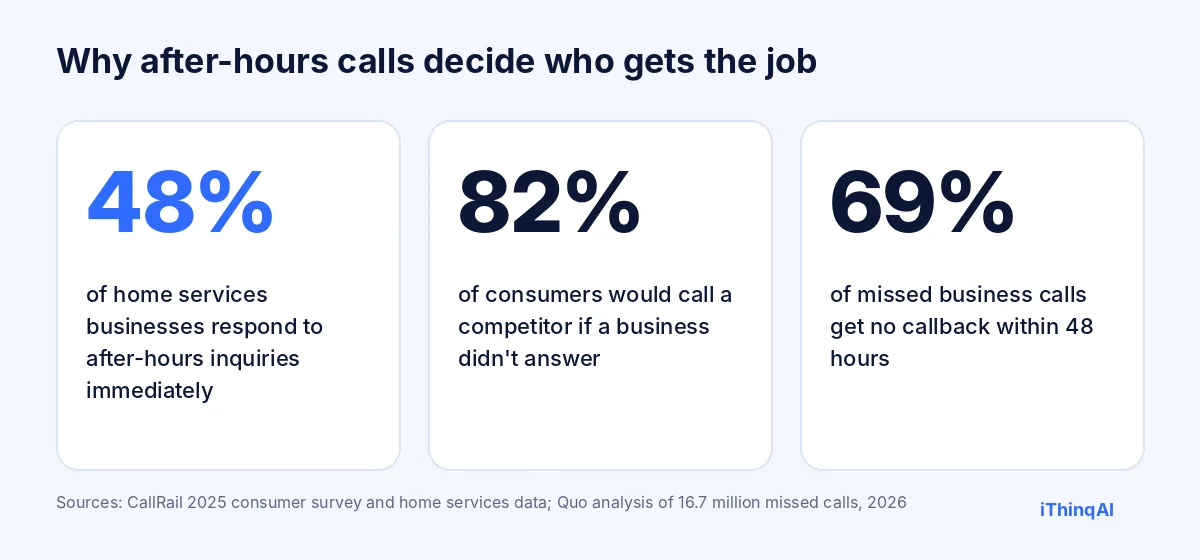
In HVAC and plumbing, 48 hours is forever. The emergency was fixed by someone else the same night.
What the AI handles for HVAC companies
| Call | What the AI does | What reaches your team |
|---|---|---|
| No cooling or no heat | Asks your triage questions, offers tonight or first-morning slots, alerts the on-call tech per your rules | A booked emergency job and a dispatched tech |
| Water leak or burst pipe | Gives your approved safety guidance (like shutting the main valve), books or dispatches | An urgent plumbing job with details |
| Gas smell | Tells the caller to leave the home and call the gas utility or 911, then alerts your team | A safety alert, never a booking first |
| Tune-up or maintenance | Books a routine visit in an open slot | A scheduled job |
| Replacement estimate | Collects home size, system age and timing, books the estimate | A qualified sales appointment |
| "Where's my tech?" | Checks the schedule you share and gives an update or a callback | Fewer frustrated customers |
How it works with iThinqAI
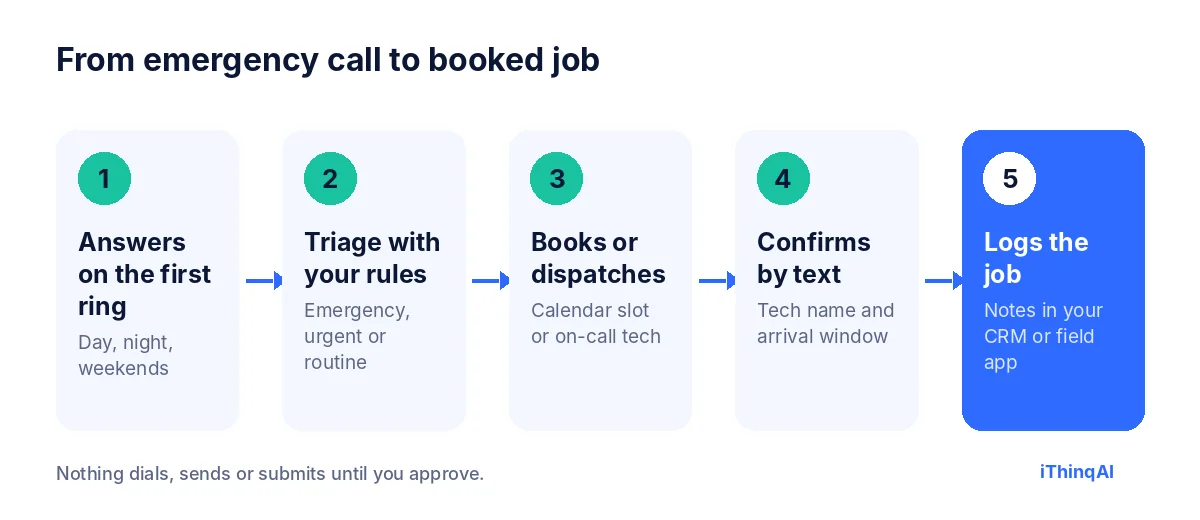
- It answers on the first ring on your existing number, day, night and weekends.
- It triages with your rules: emergency, urgent or routine, based on the questions you approve.
- It books or dispatches: routine work goes on the calendar; emergencies trigger your on-call alert.
- It confirms by text with the arrival window and what to expect.
- It logs the job with notes in your CRM or field app.
It has its own computer
Here's what separates iThinqAI from an answering service that just takes messages. On the Scale plan, the agent works on its own computer, with a browser, files and your connected tools. That means it can:
- Enter jobs into your web-based field service software when there's no direct integration.
- Look up a customer's equipment and service history before a callback.
- Pull a list of maintenance plan customers due for a tune-up and run the reminder campaign you approve.
- Draft estimate follow-ups for your review.
You can watch each step and stop it at any time. It asks before submitting anything.
Seven proven ways it wins more HVAC and plumbing calls
- It answers after hours. The calls most HVAC companies miss are the most urgent and most profitable.
- It answers during the day, too. When your dispatcher is on another line, the next call doesn't go to voicemail.
- It books on the call. A booked job beats a promised callback every time.
- It triages consistently. Same questions, same rules, every call, so true emergencies get handled first.
- It follows up on estimates. Replacement quotes that sit unanswered get a polite check-in.
- It runs seasonal campaigns. Spring AC tune-ups and fall furnace checks, to lists you approve.
- It keeps maintenance plans renewing. Customers hear from you before their plan lapses.
The reason why this works
Albert Lasker built ads on one rule: give the reason why. Here's the reason an AI answering service for HVAC works. When someone's AC or water heater fails, they aren't shopping for the best price or the nicest website. They're shopping for the first company that will actually pick up and promise to come. Answering is the product. Everything else comes after.
Safety rules come first
Set these with your team and follow local codes and utility guidance.
- Gas smell or CO alarm: the AI tells the caller to leave the building and call the gas utility or 911 from outside, then alerts your on-call staff. It does not troubleshoot.
- Electrical burning smell or sparks: same approach, with a recommendation to call 911.
- Active flooding: it can share approved guidance on shutting off the main water valve, then dispatch.
- No diagnosis by phone. It collects symptoms for your technician; it doesn't promise a cause or a price for repairs.
Seasonal playbook for HVAC companies
| Season | What callers need | What the AI does |
|---|---|---|
| Early spring | AC tune-ups | Runs approved reminder calls and texts to past customers |
| Summer | No-cooling emergencies | Answers 24/7, triages and dispatches by your rules |
| Early fall | Furnace checks | Books maintenance visits before the first cold snap |
| Winter | No-heat and frozen pipes | Handles emergency calls and plumbing overflow |
| Year-round | Replacement estimates | Books in-home estimates and follows up |
Plumbing calls work the same way
Many HVAC companies also do plumbing, and plumbing calls are just as urgent: burst pipes, backed-up drains, no hot water. The AI answers, asks your plumbing triage questions, gives approved safety guidance, and books or dispatches. For more on trade-specific setups, see our guide to AI voice assistants for contractors and plumbers.
A sample emergency call
Caller: "Our AC stopped working and it's 100 degrees in the house."
AI: "I'm sorry, that's miserable. I'm the AI assistant for Desert Air. Is anyone in the home elderly, an infant, or someone with a medical condition affected by heat?"
Caller: "Yes, my mom is 82."
AI: "Thank you. I'm marking this as urgent. Is the indoor unit running at all, or is everything off?"
Caller: "The fan runs but the air is warm."
AI: "Got it. Our on-call technician, Luis, can be there between 9:30 and 10:30 tonight. The after-hours service fee is $149, applied to the repair. Shall I book it?"
Caller: "Yes, please."
AI: "You're booked. I'm alerting Luis now, and I'll text you his name and arrival window."
What to measure
- Answer rate, day and after hours.
- Booked jobs per hundred calls.
- Emergency response time from call to dispatch.
- Estimate-to-sale conversion, with and without follow-up.
- Maintenance plan renewals.
A day at the shop, before and after
Before: the dispatcher is juggling three techs, a supply run and a customer who wants to know why the tech is late. The phone rings four times in ten minutes. Two calls go to voicemail. One was a replacement estimate worth five figures. At 5:00, the office closes and the phone keeps ringing into an empty room. By morning, there are seven voicemails, and three of those callers already booked with someone else.
After: every call is answered on the first ring. The estimate request is booked for Thursday with all the details attached. The customer asking about the late tech gets an update and a text. After 5:00, emergency calls are triaged and the on-call tech is alerted. Routine calls are booked for the morning. The dispatcher starts the next day with a full board, not a stack of messages.
What an AI answering service for HVAC says to price shoppers
Some callers just want a number. "How much to fix an AC?" is impossible to answer honestly without a diagnosis, and a bad answer loses the job either way. The assistant handles it the way your best CSR would: it explains that the technician will diagnose the problem on site, shares your approved diagnostic or trip fee, mentions that the fee applies toward the repair if that's your policy, and offers the next two available windows. Price shoppers get a clear, honest answer and an easy way to book. Most of them take it.
Estimates that don't go cold
Replacement estimates are where the big money is, and where many HVAC companies lose deals without knowing it. A homeowner gets three quotes, means to decide, and then life gets busy. The company that follows up politely, answers one more question and makes the next step easy usually wins.
With approved follow-up, the assistant checks in two days after the estimate, again a week later, and once more before any promotion or financing offer expires. Every reply goes to your comfort advisor with the full history. No pressure, no nagging, just a steady, professional presence that keeps you in the running.
Managing on-call without burning out your techs
Nothing wears out a technician faster than being woken up for a call that could have waited until morning. Clear triage rules protect your team. You decide what counts as an emergency: no heat below a certain temperature, no cooling with a vulnerable person in the home, active water leaks, and so on. Everything else gets booked for the first available morning slot, with the customer told exactly when to expect someone. Your on-call tech gets called for real emergencies only, and customers still feel taken care of.
Choosing an AI answering service for HVAC companies
Ask every vendor:
- Does it answer on our existing number, with no porting?
- Can it book directly into our calendar or field service software?
- Can it follow our triage rules and alert the on-call tech?
- Does it send text confirmations with arrival windows?
- Can it run seasonal tune-up and estimate follow-up campaigns from approved lists?
- Does it handle plumbing calls with separate triage questions?
- Are prices published?
An AI answering service for HVAC should answer every one of those in writing.
Maintenance plans: the quiet profit engine
Maintenance agreements smooth out the seasons. They give you steady work in the shoulder months, loyal customers and first shot at every replacement. But plans only pay if customers actually book their visits and renew each year. The assistant calls or texts plan members when their tune-up is due, books the visit in an open slot, and reminds them before the plan expires. Customers feel looked after, technicians stay busy in slow weeks, and renewals stop depending on someone remembering to pick up the phone.
Your first two weeks
Days 1 and 2: connect your number and calendar, and write the greeting, service area and fee policy.
Days 3 and 4: set your triage rules with your lead tech, including what wakes up the on-call person and what waits until morning.
Days 5 to 7: turn on after-hours answering first. Read every summary each morning.
Week 2: add daytime overflow, so calls your dispatcher can't get to are answered instead of missed. Then approve your first estimate follow-up list and compare booked jobs with the same weeks last year.
The math on one missed emergency call a week
Say an average emergency repair is worth $450, and one in four of those customers later buys a maintenance plan or a new system from the company that showed up. Miss one emergency call a week, and you lose about $23,000 a year in repairs alone, before counting the plans and replacements that would have followed. An AI answering service for HVAC costs a fraction of that. Run the numbers with your own average ticket, and the case usually makes itself.
Reviews after every job
The day after a repair, the assistant can text the customer a short thank-you, ask whether everything is working, and share a link to leave a review if they're happy. Problems get flagged to your office right away so you can fix them before they turn into a bad review. Over a season, that steady stream of fresh reviews helps you show up higher when the next homeowner searches for help at 9 PM.
Objections from shop owners
"My customers want to talk to a real person." They want their AC fixed. The AI books the tech who'll fix it, and transfers to a person whenever asked.
"It'll dispatch my tech for nothing." It follows your triage rules exactly. You decide what counts as an emergency.
"I already have an answering service." Ask if it books jobs into your calendar, texts confirmations and follows up on estimates. Most take messages.
What it costs
iThinqAI's published plans, as of November 2026:
| Plan | Price | Best for |
|---|---|---|
| Starter | $299/mo | Answering every call, booking, inbox and CRM (2 seats, 1,000 AI minutes) |
| Growth | $799/mo | Adds seasonal campaigns, estimate follow-ups, dialer and automations (5 seats, 5,000 AI minutes) |
| Scale | $1,999/mo | Adds computer use, multiple locations and numbers (15 seats, 15,000 AI minutes) |
Compare that with one system replacement. Prices at ithinq.ai/pricing.
Who it's not for
If you're a one-truck shop that's already booked three weeks out and doesn't take emergency calls, you may not need it yet. It pays off for HVAC and plumbing companies that take emergency work, run maintenance plans or lose calls when the office is busy.
Hear it now
Call 561-715-7686. Call it like a homeowner with no cooling on a 105-degree night, and listen to how it triages and books.
Then book a demo and bring your after-hours call log. We'll show you how every call would have been handled. More reading: after hours answering service, cost of missed calls and reactivate old leads.
P.S. The next heat wave is coming, and so are the 9 PM calls. Call 561-715-7686 today and hear the voice that would answer for your shop.
Sources
Frequently Asked Questions
Can an AI answering service dispatch my on-call tech?
Yes. It alerts your on-call technician based on the triage rules you set.
Does it work for plumbing calls too?
Yes. It uses separate triage questions and safety guidance for plumbing emergencies.
Can it quote prices?
It can share fees you approve, such as a diagnostic or after-hours fee. Repair pricing comes from your technician.
What happens if a caller smells gas?
It tells them to leave the building and call the gas utility or 911 from outside, then alerts your team.
Does it work with my field service software?
iThinqAI connects with 250+ tools. On the Scale plan, the agent can also work in web-based apps on its own computer.