AI Assistant for Insurance Agents: 7 Proven Ways to Win
Quick answer: an AI assistant for insurance agents answers every call to your agency, day or night, gathers quote details, books policy reviews on the right agent's calendar, runs renewal calls to approved lists, and logs everything in your CRM. Licensed agents stay in charge of advice and binding coverage. With auto shoppers collecting more quotes than ever, the insurance agency that answers first usually gets the first real conversation.
Key takeaways
- J.D. Power's 2025 study found 57% of auto insurance customers shopped in the past year, the highest rate in the study's 19-year history.
- Shoppers call several agencies. If yours goes to voicemail, the next one picks up.
- An AI assistant for insurance agents handles quotes intake, service requests, and renewal calls, and hands off to licensed people when advice is needed.
- iThinqAI answers on your existing number, books on the call and follows up. Hear it at 561-715-7686.
What is an AI assistant for insurance agents?
An AI assistant for insurance agents is software that answers calls, texts and messages for an insurance agency, collects information for quotes and service requests, schedules appointments with licensed staff, and makes approved outbound calls such as renewal reminders. It doesn't replace your agents. It handles the repetitive front-office work so agents spend their time advising and selling.
The shopper who calls three agencies
It's 6:40 PM. A homeowner just got a renewal notice with a premium increase that made her stomach drop. She searches "insurance agent near me," finds three agencies, and starts calling.
Agency one: voicemail. Agency two: voicemail. Agency three: a friendly voice answers, asks four quick questions, and books her for a quote review at 9:30 tomorrow.
Who do you think writes that policy?
This isn't rare. J.D. Power's 2025 U.S. Insurance Shopping Study found 57% of auto insurance customers shopped for a new policy in the past year, up from 49% and the highest rate in the study's 19-year history (J.D. Power). The 2026 edition saw shopping ease to 53%, but customers are collecting more quotes than ever (Repairer Driven News).
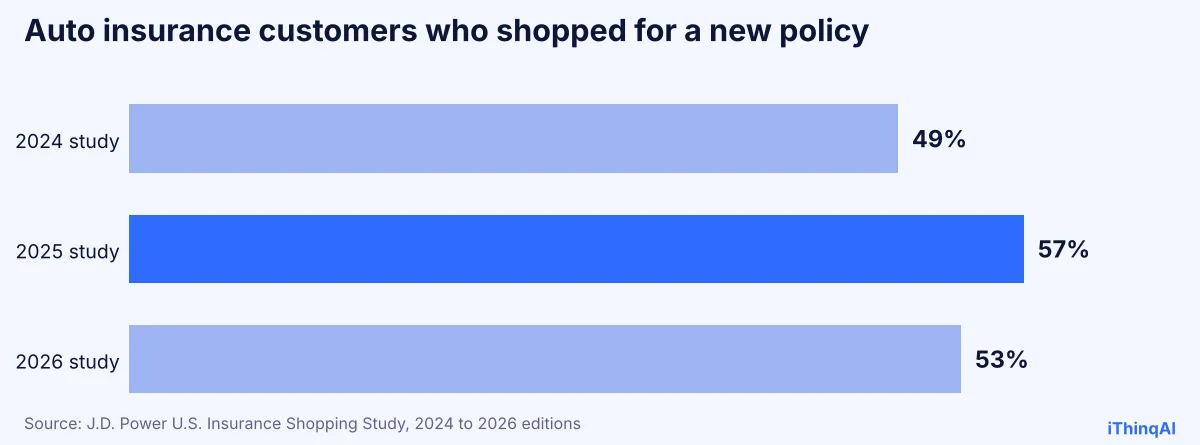
More quotes per shopper means more agencies competing for the same customer. Being reachable is now part of being competitive.
Why voicemail costs an insurance agency so much
CallRail's 2025 survey of 1,000 U.S. consumers found 82% would call a competitor if a business didn't answer, and only 42% would leave a voicemail (CallRail). And when businesses do miss calls, most never call back: Quo's analysis of 16.7 million missed business calls found 69% got no callback within 48 hours (Quo).
For an insurance agency, a missed call isn't one lost sale. It's a household that might have carried auto, home, umbrella and life with you for years.
What the assistant handles, call by call
| Call type | What the AI does | What reaches your team |
|---|---|---|
| New quote request | Collects drivers, vehicles, property details and current carrier, then books a review | A complete intake and a booked appointment |
| Policy change | Gathers the change details (new car, new driver, new address) | A service task with everything needed |
| Certificate of insurance | Captures the holder details and deadline | A ready-to-process request |
| Billing question | Answers general questions and routes payment issues | A note if follow-up is needed |
| Claim | Takes basic first-notice details and connects to the right number or person | An urgent alert, never a coverage opinion |
| Renewal question | Books a renewal review with the account's agent | A review on the calendar |
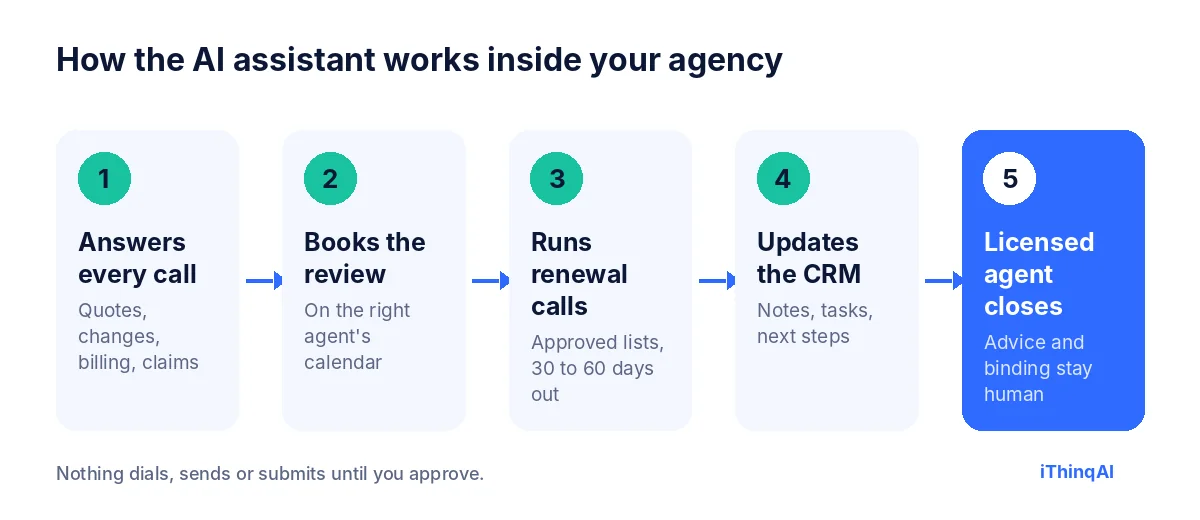
The rule is simple: the AI collects, schedules and routes. Licensed agents advise and bind.
Renewal calls that run themselves
Renewals are where agencies quietly lose clients. The premium goes up, nobody calls, and the client shops on their own.
With iThinqAI, renewal calls run from lists you approve:
- Pull the list of policies renewing in the next 30 to 60 days.
- Approve the script, calling hours and daily limits. Nothing dials before you say so.
- The AI calls or texts each client with a simple reason: "Your auto policy renews on March 14. Would you like a quick review with Sarah before then?"
- Interested clients get booked on the right agent's calendar. Others get a reminder for later.
- Every answer is logged so your team sees who's happy, who's shopping and who needs attention.
Proactive renewal calls turn a dreaded premium increase into a service moment. The client hears from you before they hear from a competitor.
It has its own computer
Here's what separates iThinqAI from a basic answering tool. On the Scale plan, the agent works on its own computer, with a browser, files and your connected tools. iThinqAI's own feature page says it can work in carrier portals and older vendor apps, the places your staff spends hours clicking through.
That means it can:
- Look up policy details in a portal before a review, so the agent walks in prepared.
- Pull renewal lists from a spreadsheet export and clean out duplicates.
- Update your CRM with notes and next steps after every call.
- Draft follow-up emails and texts for your approval.
You can watch the steps and stop it at any time, and it asks before actions like submitting a form. It works like a trained assistant who doesn't get tired at 4:30 on a Friday.
The reason why this works
Albert Lasker built ad campaigns on one principle: give people the reason why. Here's the reason an AI assistant for insurance agents works. Insurance shoppers don't buy the cheapest policy from the agency they called last. They buy from the agency that answered, listened, and made the next step easy. Speed signals competence. A booked review signals commitment. A renewal call signals that you're paying attention. All three are things an AI can do every time, without fail.
Compliance guardrails for insurance agencies
This section is general information, not legal advice. Check your state's rules and your carrier agreements with counsel.
- No advice from the AI. It doesn't recommend coverage, interpret policy language or bind anything. Those stay with licensed agents.
- Clear identification. The assistant says it's an AI working for your agency.
- Consent for outbound calls. AI-voice calls fall under the TCPA's artificial-voice rules, which generally require prior consent (Mayer Brown). Renewal calls to existing clients should use your documented consent.
- Do Not Call controls. Opt-outs are honored automatically.
- Records. Calls, summaries and opt-outs are logged for your file.
Where it fits: personal lines, commercial lines, life and health
| Line | Best first use | Typical win |
|---|---|---|
| Personal auto and home | After-hours quote intake | Shoppers booked before they call the next agency |
| Commercial lines | Certificate requests and renewal reviews | Faster service for busy business owners |
| Life | Follow-up on inquiries and booked consultations | Fewer leads lost between the first call and the meeting |
| Medicare and health | Appointment scheduling during enrollment periods | Calendars filled without staff overtime |
A sample after-hours call
Caller: "Hi, I just got my renewal and it went up a lot. Can someone look at it?"
AI: "Of course. I'm the AI assistant for Rivera Insurance. I can set up a review with one of our licensed agents. Is this for auto, home or both?"
Caller: "Both."
AI: "Got it. Who's your current carrier, and when does the policy renew?"
Caller: "Next month, the 14th."
AI: "Thanks. Sarah has openings tomorrow at 9:30 or 2:00. Which works?"
Caller: "9:30."
AI: "You're booked with Sarah at 9:30. I'll text you a confirmation and a short list of what to have ready."
Sarah starts her morning with a warm, prepared appointment, not a voicemail she'll return at noon.
What to measure in your agency
- Answer rate: calls answered ÷ calls received. The goal is every call.
- Quote intakes completed: how many callers gave enough information to quote.
- Reviews booked: appointments set per hundred calls.
- Renewal retention: policies renewed ÷ policies up for renewal, before and after.
- Time to first contact: minutes from inquiry to first conversation.
Compare the 90 days before and after, and you'll know whether the change paid for itself.
How renewal calls protect your book
Renewal calls are the cheapest retention tool an insurance agency has, and the one most often skipped. Busy service teams handle what's urgent today, and a renewal 45 days out never feels urgent until the client has already moved. When renewal calls run on a schedule, every client hears from you before their premium changes, gets a chance to ask questions, and is offered a review with the agent who knows their account.
A simple rhythm works for most agencies:
- 60 days out: a text letting the client know their renewal is coming and that a review is available.
- 45 days out: renewal calls to clients with large premium changes or multiple policies.
- 30 days out: a reminder call or text to anyone who hasn't responded.
- After renewal: a short thank-you and a check on anything else they need covered.
The AI handles the outreach and scheduling. Your licensed agents handle the review itself.
Five jobs an AI assistant for insurance agents does every day
- Answers overflow and after-hours calls so no shopper hits voicemail.
- Completes quote intake with drivers, vehicles, property and prior carrier details.
- Books reviews on the right agent's calendar, with reminders that cut no-shows.
- Runs renewal calls and follow-ups to lists you approve.
- Keeps the CRM current with summaries, tasks and next steps.
None of those jobs requires a license. All of them take time your licensed people could spend selling.
What an insurance agency gains in the first 90 days
The first change most owners notice is quiet: fewer voicemails to return in the morning. The second is a fuller calendar, because callers are booked while they're still on the phone. The third shows up at renewal time, when clients who would have shopped on their own instead sit down with their agent.
For an insurance agency, those three changes add up. More shoppers reached first. More reviews held. More policies kept. And because the AI logs every call, you finally have a clear picture of how many calls you were missing before.
Choosing an AI assistant for insurance agents: a checklist
Before you sign with any vendor, ask:
- Does it answer on the agency's existing number, or do we have to port?
- Can it book directly on each agent's calendar?
- Can it run renewal calls from approved lists, with Do Not Call and opt-out controls?
- Does it hand off to a licensed person on request, with a summary?
- Does it log every call in our CRM, and can we export the records?
- Can it work in carrier portals and web apps where there's no integration?
- What are the published prices, seats and minutes?
iThinqAI answers yes to each, and its prices are published. Any AI assistant for insurance agents you consider should be able to answer those questions in writing.
How to introduce it to your clients
Tell your clients what's changing and why. A short email works: "We've added an AI assistant so you can reach us any time. It can book reviews, take policy change requests and answer general questions. If you'd rather speak with your agent, just ask and it will connect you." Most clients appreciate the faster response. The ones who prefer a person still get one.
A day in the life, before and after
Before: the phones ring through lunch. A CSR juggles a certificate request, a billing question and a new quote while two more calls roll to voicemail. By 5:00, there are eleven messages to return. Three of them were shoppers. By the time anyone calls back the next morning, two have already bought elsewhere.
After: every call is answered on the first ring. The certificate request arrives as a complete task. The billing question is answered on the spot. The shopper is booked for 9:30 with a full intake attached. At 5:00, there are no voicemails, just a list of booked reviews and a few tasks marked for follow-up. The CSR spent the day helping clients instead of chasing messages.
What the AI says when it doesn't know
Good assistants know their limits. When a caller asks something that needs a licensed answer, such as whether a policy covers a specific loss or which deductible makes sense, the AI says so plainly: "That's a great question for your agent. I can book you with Sarah tomorrow morning, or have her call you back this afternoon. Which would you prefer?" The caller gets a real next step, and your agency avoids giving advice through the wrong channel.
Keeping the human touch
Clients stay with agencies because of relationships, and that doesn't change. The AI handles the first ring, the paperwork and the reminders. Your agents handle the conversation that builds trust: reviewing coverage, explaining options, checking in after a claim. In practice, agents get more time for exactly those conversations, because they're no longer the agency's switchboard.
Common objections from agency owners
"My clients want a person." They want an answer. The AI answers immediately, books them with a person, and hands off whenever they ask.
"It might say something wrong about coverage." It's set up not to give coverage opinions. Those questions get booked with a licensed agent.
"We already have an answering service." Ask what happens after the message is taken. iThinqAI books the appointment, updates the CRM and runs the renewal calls.
How much does it cost?
iThinqAI's published plans, as of November 2026:
| Plan | Price | Best for |
|---|---|---|
| Starter | $299/mo | Answering every call, booking, inbox and CRM (2 seats, 1,000 AI minutes) |
| Growth | $799/mo | Adds renewal and follow-up campaigns, dialer and automations (5 seats, 5,000 AI minutes) |
| Scale | $1,999/mo | Adds computer use in carrier portals, multiple locations (15 seats, 15,000 AI minutes) |
Compare that with the lifetime value of one multi-line household. Prices at ithinq.ai/pricing.
Who it's not for
If your agency is a one-person book with a handful of calls a week and you answer every one yourself, you may not need it yet. It pays off for agencies with steady call volume, regular renewals, and staff stretched between service and sales.
Your first two weeks
Days 1 to 3: connect your number, calendar and CRM; write the greeting and quote-intake questions.
Days 4 to 7: run test calls with your team; turn on after-hours answering.
Week 2: go live during business hours, approve your first renewal list, and review every summary each evening.
Hear it now
Call 561-715-7686. Ask it about a renewal, a new auto quote or a certificate request, the way your clients would.
Then book a demo and bring your renewal list for next month. We'll show you exactly how the calls would run. More reading: AI appointment setter, reactivate old leads and after hours answering service.
P.S. Tonight, somewhere in your town, a homeowner with a renewal notice is calling agencies. Call 561-715-7686 and hear the voice that would answer for you.
Sources
Frequently Asked Questions
Can an AI assistant quote insurance?
It collects the details needed to quote and books a review. Licensed agents prepare and present the quote.
Can it bind coverage or give advice?
No. Coverage advice and binding stay with licensed agents.
Can it make renewal calls?
Yes, to lists you approve, with documented consent, inside your calling hours and daily limits.
Does it work with my agency management system?
iThinqAI connects with 250+ tools. Where there's no connector, on the Scale plan the agent can work in web apps and portals on its own computer.
Will clients know it's an AI?
Yes. It identifies itself as your agency's AI assistant, and connects clients to a person whenever they ask.