AI Receptionist for Dental Office: 7 Easy, Proven Wins
This article is general information, not legal or compliance advice. Confirm HIPAA requirements with your compliance advisor.
Quick answer: an AI receptionist for dental office teams answers every patient call, day or night, on your existing number. It books new patients and recall visits on the call, sends confirmations and reminders by text, and calls your approved waitlist when someone cancels. Fewer missed calls and fewer patient no-shows mean fewer empty chairs. iThinqAI offers a HIPAA business associate agreement (BAA).
Key takeaways
- Published studies show missed dental appointments are common: 14.3% of visits in one U.S. academic clinic, and 24% for teenagers.
- Most new patients won't leave a voicemail. They call the next practice.
- An AI receptionist for dental office teams answers, books, confirms and refills cancellations, so your front desk can focus on the patients in front of them.
- iThinqAI answers on your number, books on the call and files referral faxes. Hear it at 561-715-7686.
What is an AI receptionist for dental office teams?
An AI receptionist for dental office teams is a voice and text assistant that answers a practice's phone, schedules and reschedules appointments, confirms visits, answers common questions about hours, insurance and location, and routes urgent or clinical questions to staff. It works 24 hours a day, follows rules your practice approves, and logs every conversation for your team.
The toothache at 7:15 PM
It's Tuesday evening. A man has had a throbbing molar since lunch. He's never been to your practice, but you're close to his house and your reviews are good. He calls at 7:15 PM.
He hears your voicemail greeting, hangs up and calls the next office on the map. They answer, book him for 8:00 AM, and he becomes their patient for the next ten years: cleanings, a crown, his wife and kids.
Your front desk will never know he called.
CallRail's 2025 survey of 1,000 U.S. consumers found 82% would call a competitor if a business didn't answer, and only 42% would leave a voicemail (CallRail). In a dental practice, one lost new patient isn't one visit. It's years of care.
The other half of the problem: patient no-shows
Missed calls lose patients before they book. Patient no-shows lose them after.
How common are missed appointments? In a U.S. academic pediatric dental clinic, researchers found 14.3% of 7,379 scheduled visits were no-shows, rising to 24% for patients aged 12 to 17 (PMC). A Swedish study of 16- to 19-year-olds found 13.1% of 23,522 booked dental appointments were missed (PMC).
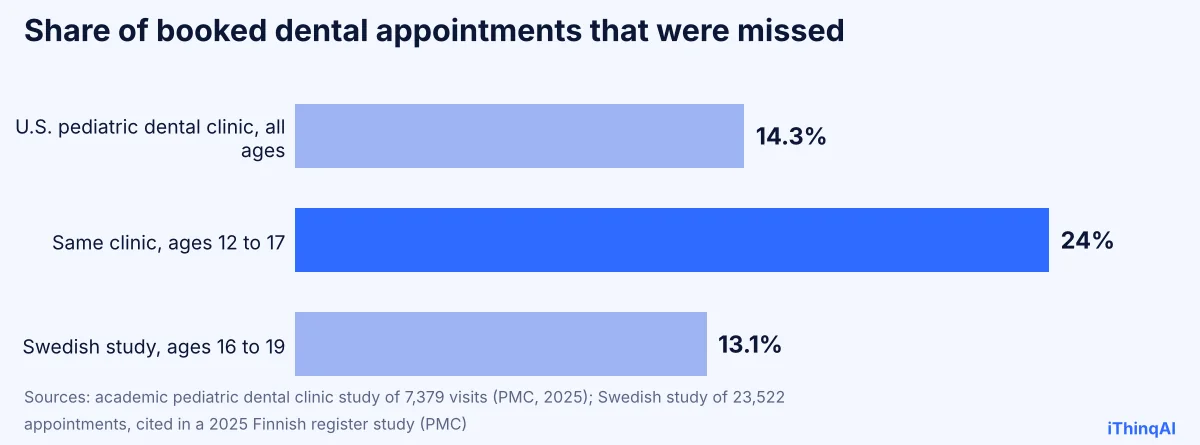
Every missed visit is an hour of chair time, a hygienist's schedule and a treatment plan that slips. Rates vary by practice and patient mix, but no office can afford to ignore them.
What the receptionist handles in a dental office
| Call or message | What the AI does | What your team sees |
|---|---|---|
| New patient | Collects name, contact, insurance and reason, books the right appointment type | A new patient on the schedule |
| Toothache or emergency | Asks screening questions you approve, offers the next emergency slot, alerts staff | An urgent visit booked, staff notified |
| Reschedule or cancellation | Moves the visit and offers the opening to the waitlist | A refilled slot instead of a gap |
| Recall reminder | Calls or texts patients due for cleanings | Recall visits booked |
| Insurance question | Shares general information you approve, routes specifics | A task if staff follow-up is needed |
| Referral from a specialist | Receives and files referral faxes, books the visit | Paperwork filed, patient booked |
How it works with iThinqAI
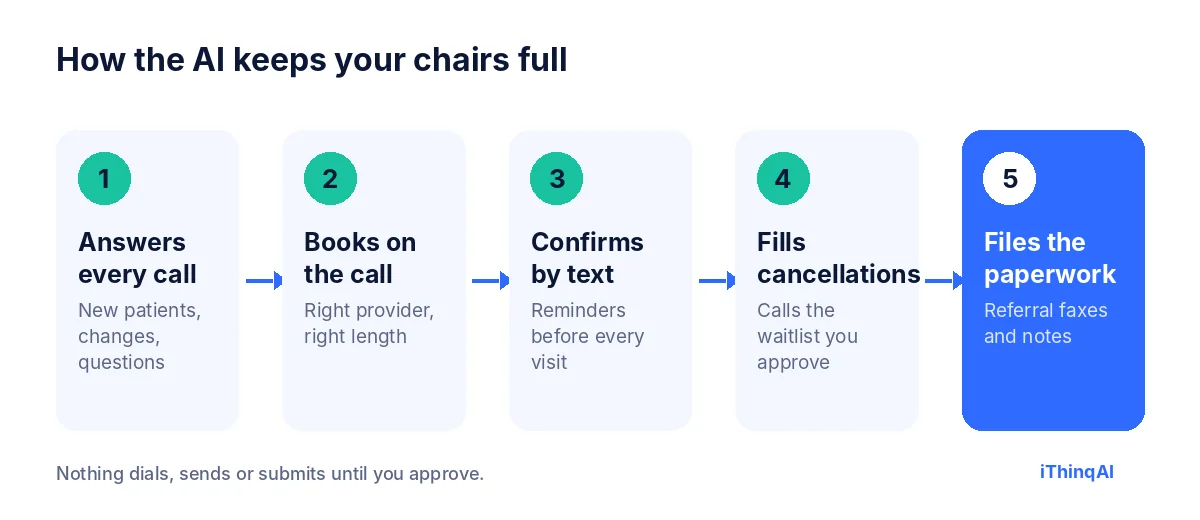
- It answers every call on your existing number: during lunch, after hours, on weekends and when your front desk is with a patient.
- It books on the call, using the right provider, appointment type and length.
- It confirms by text after booking, and again before the visit.
- It fills cancellations by calling or texting the waitlist you approve, so a cancelled 2:00 becomes a booked 2:00.
- It files the paperwork, including referral faxes, in the same inbox as your calls.
It has its own computer
Here's where iThinqAI goes beyond a typical answering service. On the Scale plan, the agent works on its own computer, with a browser, files and your connected tools. iThinqAI's own dental example says the agent sends and files referral faxes.
In a dental or medical office, that means it can:
- File incoming referral faxes and attach them to the right patient's record.
- Look up a patient's next visit in a web-based scheduling system before a call.
- Prepare the daily list of unconfirmed appointments and run the confirmation calls.
- Draft recall messages for your review.
You can watch each step and stop it at any time. It asks before submitting anything.
How to cut patient no-shows
Patient no-shows usually come down to three things: people forget, plans change, or the visit didn't feel important. Each has a fix.
- Confirm right after booking. A text with the date, time and address.
- Remind before the visit. A text two days out and a reminder the day before, with an easy way to reschedule.
- Make rescheduling easier than skipping. "Reply R to reschedule" beats a patient who just doesn't show.
- Call the unconfirmed. The AI calls anyone who hasn't confirmed by the afternoon before.
- Refill every gap. When someone cancels, the waitlist hears about the opening in minutes.
Practices with structured reminder programs routinely report fewer missed visits. Track your own rate before and after, and you'll see the difference in your schedule.
The reason why this works
Albert Lasker built campaigns on the reason why. Here's ours. Patients don't leave practices because the dentistry is bad. They leave because they couldn't get through, couldn't get a time, or forgot and felt awkward rebooking. An AI receptionist for dental office teams removes every one of those excuses. It answers. It books. It reminds. It makes coming back easy.
HIPAA and patient privacy
General information, not compliance advice.
Patient calls contain protected health information. Under HIPAA, a vendor that handles that information for your practice is generally a business associate, and you need a signed business associate agreement before patient calls go live (HHS). iThinqAI offers a BAA. Ask for it, review it with your compliance advisor, and set rules for what the AI can and can't discuss. Clinical advice always stays with your dentists and hygienists. For more, see our guide to a HIPAA compliant AI receptionist.
Dental, orthodontic and medical office setups
| Practice | Best first use | Typical win |
|---|---|---|
| General dentistry | After-hours and lunch-hour answering | New patients booked instead of lost |
| Pediatric dentistry | Parent reminders and rescheduling | Fewer missed visits for teens |
| Orthodontics | Consult booking and adjustment reminders | Fuller consult calendar |
| Oral surgery | Referral intake and fax filing | Faster scheduling from referrals |
| Medical office | Appointment booking and refill-request routing | Front desk freed for patients in the room |
A sample new-patient call
Caller: "Hi, I have a really bad toothache. Do you take new patients?"
AI: "Yes, we do. I'm the AI assistant for Bright Smile Dental. I'm sorry you're in pain. Is there any swelling in your face or trouble breathing or swallowing?"
Caller: "No, just pain."
AI: "Thank you. Our next emergency opening is tomorrow at 8:00 AM with Dr. Patel. Would you like it?"
Caller: "Yes, please."
AI: "You're booked. Do you have dental insurance you'd like us to have on file?"
Caller: "Delta Dental."
AI: "Got it. I'll text you the address and new-patient forms. If the pain gets worse tonight or you notice swelling, please call 911 or go to urgent care."
What to measure
- Answer rate: calls answered ÷ calls received, including lunch and after hours.
- New patients booked per week.
- No-show rate: missed visits ÷ scheduled visits.
- Cancellations refilled: slots rebooked ÷ slots cancelled.
- Recall visits booked from reminder campaigns.
Seven easy wins from an AI receptionist for dental office teams
- Lunch-hour calls get answered. The hour your front desk eats is the hour many working patients call.
- After-hours new patients get booked. The 7:15 PM toothache becomes an 8:00 AM appointment.
- Patient no-shows drop. Confirmations, reminders and easy rescheduling keep visits on the calendar.
- Cancellations get refilled. The waitlist hears about openings in minutes, not tomorrow.
- Recall visits get booked. Patients due for cleanings get a call or text, not a postcard.
- Referral faxes get filed. Paperwork lands in the right place, next to the patient's conversations.
- Your front desk breathes. Staff focus on the patients in the room instead of the ringing phone.
A day at the front desk, before and after
Before: the phones ring while two patients check in and a third asks about a bill. Calls roll to voicemail. At lunch, nobody answers. By 5:00, there are nine voicemails, two cancellations for tomorrow and a referral fax sitting in the tray. Tomorrow starts with phone tag and two empty chairs.
After: every call is answered. New patients are booked with their insurance on file. The two cancellations were offered to the waitlist and refilled by 3:00. The referral fax was filed and the patient booked. Unconfirmed patients for tomorrow got a call at 4:00. Your front desk spent the day with patients, and tomorrow's schedule is full.
Why patient no-shows hurt more than they look
A single missed visit looks small: one hour, one patient. But patient no-shows ripple. The hygienist's hour is paid either way. The treatment plan slips, so a small filling becomes a crown. The patient who skipped feels awkward and often doesn't rebook at all. And the patient on the waitlist who would have taken that slot went elsewhere. Reducing no-shows is one of the fastest ways to raise production without adding a single new patient.
Choosing an AI receptionist for dental office use: a checklist
- Does it answer on our existing number, without porting?
- Can it book directly into our schedule with the right appointment types and lengths?
- Does it send confirmations and reminders by text, with easy rescheduling?
- Can it call a waitlist when someone cancels?
- Will the vendor sign a BAA?
- Can it receive and file referral faxes?
- Does it route clinical questions to staff and emergencies to 911 or urgent care?
- Are prices published?
Any AI receptionist for dental office teams should answer those questions in writing before your first patient call.
Rolling it out in your practice
Week 1: sign the BAA, connect your number and scheduling, and write the greeting, appointment types and emergency screening questions with your dentist.
Week 2: turn on lunch-hour and after-hours answering. Read every call summary.
Week 3: start confirmation and reminder texts, and set up the cancellation waitlist.
Week 4: launch your first recall campaign to patients overdue for cleanings. Compare new patients, no-shows and refilled slots with the month before.
Using it in a medical office
Everything above works the same way in a medical office. A family practice, pediatric clinic or specialist's medical office faces the same problems: phones that ring while staff check patients in, callers who won't leave a voicemail, and patient no-shows that leave gaps in the day. The assistant books visits by provider and visit type, sends reminders, routes prescription refill requests and clinical questions to the right staff member, and files incoming referral faxes. Clinical judgment, test results and medical advice always stay with your clinicians. For a medical office with several providers, it can also balance the schedule, offering the first available slot with any provider when a patient doesn't need a specific one.
How the waitlist turns cancellations into production
Most practices keep a list of patients who'd like an earlier visit, but few have time to call it when a slot opens. With the assistant, a cancellation triggers a short text to the patients on your approved waitlist: "An opening just came up tomorrow at 2:00 with Dr. Patel. Reply YES to take it." The first yes gets booked and confirmed, and everyone else gets a polite note that the slot is filled. A cancellation at 9:00 AM can be a booked chair by 9:20. Over a month, that's hours of chair time recovered without anyone picking up the phone.
What patients notice
Patients notice three things: they got through on the first try, they got a time that worked, and they got a reminder they didn't have to ask for. They rarely care whether the voice that booked them was a person or an assistant, as long as it was clear, polite and right. The ones who want to speak with a team member still can, and the assistant connects them or books a callback.
The math on one empty chair a day
Say your average appointment produces $200 and you lose one visit a day to a missed call or a no-show. Over 20 working days, that's $4,000 a month and about $48,000 a year, before counting the new patients who never booked at all. An AI receptionist for dental office teams costs a fraction of that. Run the numbers with your own production per visit, and the decision usually makes itself.
Objections from practice owners
"Our patients like our front desk." They'll still see your front desk. The AI catches the calls your team can't get to.
"What if someone has an emergency?" It follows the screening questions you approve and directs true emergencies to 911 or urgent care.
"We already send reminders." Reminders are one piece. The AI also answers, books, refills cancellations and files referrals.
What it costs
iThinqAI's published plans, as of November 2026:
| Plan | Price | Best for |
|---|---|---|
| Starter | $299/mo | Answering every call, booking, inbox and CRM (2 seats, 1,000 AI minutes) |
| Growth | $799/mo | Adds recall and reminder campaigns, dialer and automations (5 seats, 5,000 AI minutes) |
| Scale | $1,999/mo | Adds computer use, multiple locations and numbers (15 seats, 15,000 AI minutes) |
Compare that to the lifetime value of one new family. Prices at ithinq.ai/pricing.
Who it's not for
If your practice is booked months out with a long waitlist and every call is answered live, you may not need it. It pays off for practices that miss calls at lunch and after hours, struggle with patient no-shows, or want to grow new-patient volume.
Hear it now
Call 561-715-7686. Call it the way a new patient with a toothache would, and listen to how it books.
Then book a demo and bring last month's no-show count. We'll show you how the reminders and waitlist would run. More reading: after hours answering service, cost of missed calls and AI appointment setter.
P.S. Tonight, someone with a toothache will call your office. Call 561-715-7686 now and hear what they'd hear if your practice answered every time.
Sources
Frequently Asked Questions
Can an AI receptionist book dental appointments?
Yes. It books the right appointment type and provider on the call and sends a text confirmation.
Does it reduce patient no-shows?
It sends confirmations and reminders, calls unconfirmed patients and refills cancellations from your waitlist. Track your rate before and after.
Is it HIPAA compliant?
HIPAA compliance depends on how you set it up and on a signed BAA. iThinqAI offers a BAA; review it with your advisor.
Can it handle dental emergencies?
It follows screening questions you approve, books emergency slots and directs true emergencies to 911 or urgent care.
Does it work for a medical office too?
Yes. The same booking, reminder and routing features work for medical practices.