Call Answer Rate Killing Sales? 7 Proven Fixes That Win
Quick answer: your call answer rate is the share of outbound calls that a real person picks up. To raise it, make every call recognizable and expected: register your numbers for branded caller ID, text before you call, call within minutes of an inquiry, call during the hours your customers actually answer, and follow up by voicemail and text when they don't. Hiya's 2026 research found 86% of people won't answer unknown calls, so the biggest gains come from not looking like one.
Key takeaways
- Most people don't ignore you. They ignore unknown calls, and your number looks unknown.
- Branded caller ID, an expected call and fast follow-up do more for your call answer rate than any script.
- A call made minutes after someone asked for it gets answered far more often than one made tomorrow.
- iThinqAI calls back from your verified business number, texts first, and follows up on every channel. Hear it at 561-715-7686.
What is a call answer rate?
A call answer rate is the percentage of outbound calls answered by a live person, rather than going unanswered, to voicemail, or being rejected. If you place 100 calls and 18 people pick up, your call answer rate is 18%. It's the first number in every phone-based sales and service process, because nothing else happens until someone answers.
There are two sides to it. Your outbound call answer rate measures how many people answer when you call. Your inbound answer rate measures how many of your incoming calls your business actually answers. This guide focuses on the first, then shows why the second quietly decides it.
The problem: your phone looks like a scammer's phone
Picture your best salesperson. Great on the phone. Knows the product cold. Ready to help.
Now picture what the customer sees: a ten-digit number they don't recognize, maybe flagged "Spam Risk," ringing in the middle of a meeting. They do what most people now do. They let it ring.
That's not a guess. Hiya's State of the Call 2026, a survey of more than 12,000 consumers in six countries, found 86% of consumers won't answer unidentified calls, and only 14% answer right away (Hiya). The same research found 41% ignore the call and check for a voicemail, and 28% reject it immediately.
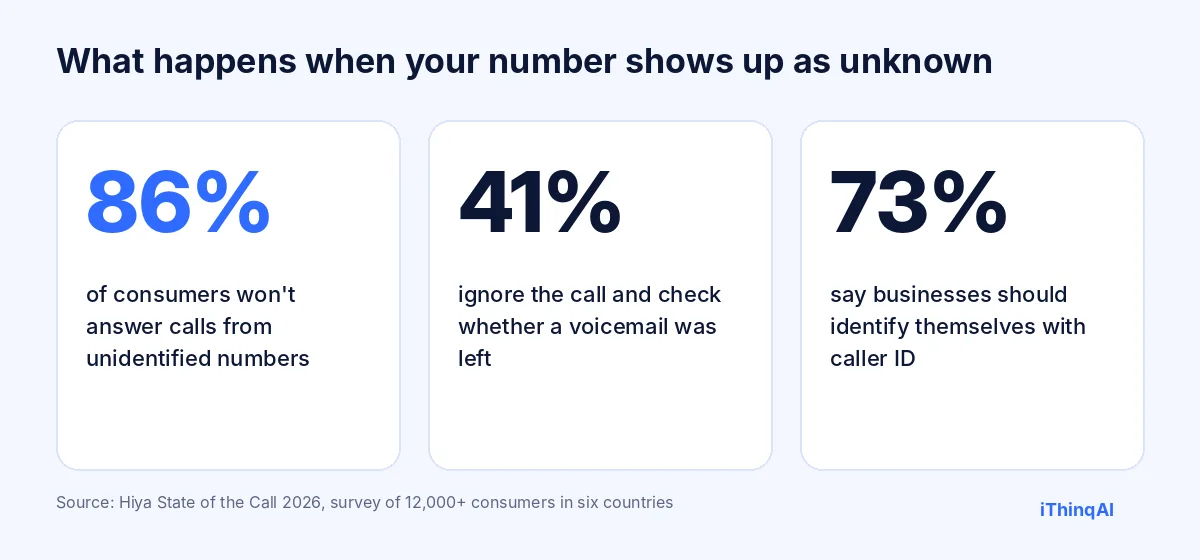
People have been trained by years of robocalls. Every unknown number is guilty until proven innocent. Your salesperson never gets the chance to be great.
Why unknown calls get ignored
Three forces push your call answer rate down:
- Fraud and spam. Hiya found that nearly one in three people (31%) received a deepfake voice call in the past year (Hiya). People are right to be careful.
- Carrier labeling. Numbers that place lots of calls, especially to people who don't answer, can get labeled "Spam Likely" or "Scam Risk." Once that label shows, almost nobody answers.
- No context. A call from a number that isn't saved, with no name and no warning, gives the person no reason to pick up.
The good news: all three are fixable. And the fixes compound.
Seven proven fixes for your call answer rate
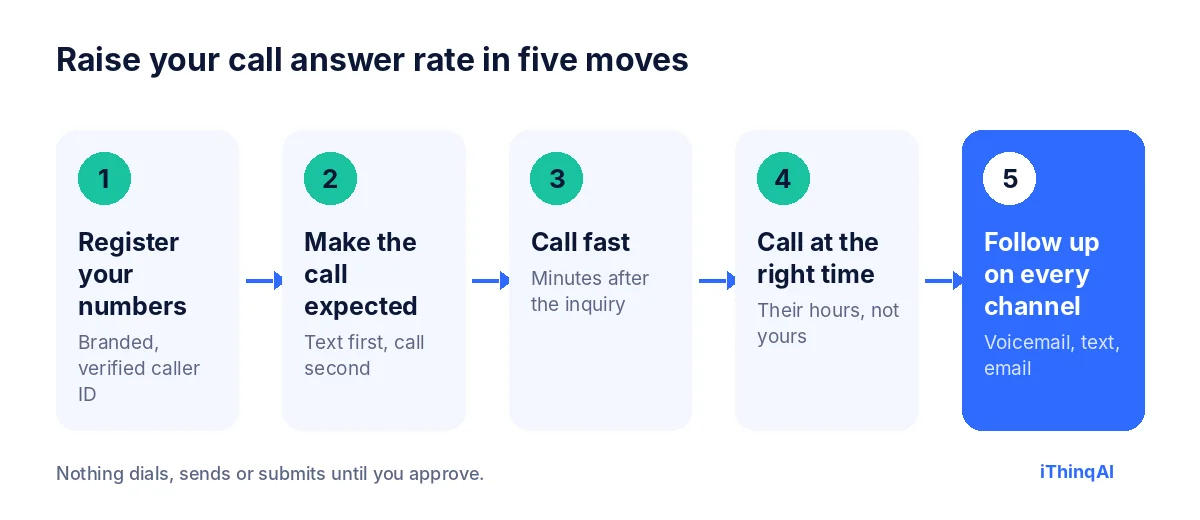
1. Register your numbers and show a branded caller ID
Hiya's research found 73% of consumers agree businesses should identify themselves with caller ID. Register every number you call from with the major carrier and analytics programs, and use branded caller ID where it's available so your business name, not just digits, shows on screen. Keep the same numbers over time; new numbers have no reputation, good or bad.
2. Make the call expected
The single biggest lift comes from a short text before the call: "Hi Dana, it's Rivera Plumbing. You asked for a water heater quote. We'll call you in a few minutes from 702-555-0100." Now the call isn't from a stranger. It's the call they were told about.
3. Call within minutes, not hours
A person who filled out your form five minutes ago still has their phone in their hand and your business on their mind. The same person tomorrow morning has moved on. The 2011 Harvard Business Review study of 2,241 companies found firms that contacted leads within an hour were nearly seven times as likely to qualify them as firms that waited even one hour longer (HBR). Speed improves your call answer rate and your conversion rate at the same time.
4. Call when people actually answer
Not at 8 AM on a Saturday. Not during school pickup. Look at your own data: which hours and days produce the most conversations? Weight your calling toward those windows, and respect each person's time zone.
5. Leave a short voicemail every time
Since 41% of people check for a voicemail before deciding, a 15-second message with your business name, the reason for the call and a callback number turns a missed call into a callback. Keep it plain: who you are, why you called, how to reach you.
6. Follow the voicemail with a text
"Just tried you about your quote. Reply with a good time, or book here." Many people who won't answer unknown calls will reply to a text from a business they recognize.
7. Protect your number's reputation
Don't call stale purchased lists. Don't hammer the same person five times a day. Honor every opt-out instantly. Reputation is built slowly and lost quickly, and once a number is flagged, every call from it suffers.
The math: what a better call answer rate is worth
Small changes in your call answer rate move revenue more than most owners expect.
| Calls per week | Answer rate | Conversations | Booked (25% of conversations) |
|---|---|---|---|
| 500 | 10% | 50 | 12 |
| 500 | 15% | 75 | 19 |
| 500 | 20% | 100 | 25 |
| 500 | 30% | 150 | 37 |
Same list. Same team. Same script. Going from 10% to 20% doubles your booked appointments without adding a single lead. Plug in your own numbers; the multiplier holds.
How it works with iThinqAI
Here's what happens when a lead comes in and iThinqAI handles the follow-up:
- A text goes out in seconds confirming the request and saying a call is coming.
- The call comes from your verified business number, the one your customers already know, not a random number from a call center.
- The AI introduces itself clearly: your business name, that it's an AI assistant, and why it's calling.
- If nobody answers, it leaves a short voicemail and sends a follow-up text with a booking link.
- Everything lands in one inbox with the full history, so the next call, text or email knows what came before.
Your team picks up the conversations that are ready for a human. Nobody spends the afternoon dialing numbers that never answer.
Why the inbound side decides your call answer rate
Here's the part most people miss. When you call someone and they don't answer, what do they do next? Often, they call you back.
If that callback goes to voicemail, you've wasted the whole effort. CallRail's 2025 survey of 1,000 U.S. consumers found 82% would call a competitor if a business didn't answer, and only 42% leave a voicemail (CallRail).
So the fix has two halves: make your outbound calls recognizable, and answer every inbound call, every time. iThinqAI does both. It answers on the number you already have, books the appointment on the call, and texts a confirmation. The person who ignored your unknown call at 2:00 and called back at 2:07 reaches someone who can help.
It has its own computer, so the follow-up actually happens
Most phone tools stop at the call. iThinqAI's agent works on its own computer, with a browser, files and your connected tools. On the Scale plan, that means it can:
- Pull a list of quotes that never closed from a spreadsheet, clean it and flag missing numbers.
- Look up a lead's record in a portal before calling, so the conversation starts with context.
- Update your CRM after every call, with notes, next steps and the outcome.
- Draft the text and email follow-ups for each segment, then bring them to you for approval.
The result is fewer calls to the wrong people, more calls at the right moment, and a higher call answer rate because every call has a reason.
The reason why this works
Albert Lasker built his career on one idea: tell people the reason why. Your call answer rate follows the same rule. People answer calls they understand. A branded caller ID tells them who. A text tells them why. Speed tells them it's about the thing they just asked for. Give people the reason, and they pick up.
Caller ID mistakes that quietly kill your answer rate
- Rotating numbers to dodge spam labels. It looks clever and makes things worse. New numbers have no reputation, and carriers notice the pattern.
- Calling from a number nobody can call back. If someone returns your call and hits a dead line, you've taught them to ignore you next time.
- Showing a personal cell. Customers don't recognize it, and it can't be branded.
- Mismatched names. If your texts say "Desert Air" and your caller ID says "DA Services LLC," people get suspicious.
- Never checking how your numbers display. Call a few phones on different carriers every month and see what shows on screen.
How to measure your call answer rate
Track these each week:
| Metric | How to calculate | What it tells you |
|---|---|---|
| Call answer rate | Calls answered by a person ÷ calls placed | Whether people trust your calls |
| Callback rate | Inbound callbacks ÷ unanswered outbound calls | Whether voicemails and texts work |
| Conversation rate | Conversations over one minute ÷ calls placed | Whether the opening holds attention |
| Booked rate | Appointments ÷ conversations | Whether the script works |
| Opt-out rate | Stop requests ÷ contacts | Whether the list or message is wrong |
Compare by hour, day, lead source and number. Patterns show up within two weeks.
Industry examples
| Industry | What lowers the answer rate | What raises it |
|---|---|---|
| Home services | Calling hours after the form fill | Text plus call within minutes |
| Insurance | Generic numbers during renewal season | Branded caller ID and a renewal-date reason |
| Real estate | Calling portal leads the next day | Instant call while they're still browsing |
| Dental and medspa | Reminder calls from unknown lines | Calls from the office's own number, with text confirmations |
| B2B services | Cold lists with no context | Warm lists and a reason tied to their request |
A sample call that gets answered
Text (sent at 2:01 PM): "Hi Marcus, thanks for requesting a roof inspection with Summit Roofing. Our assistant will call you in a couple of minutes from 702-555-0144."
Call (2:03 PM), caller ID shows "Summit Roofing": "Hi Marcus, this is the AI assistant for Summit Roofing calling about the inspection you just requested. Do you have a minute to pick a time?"
Marcus picks up because he knows who it is and why. Thirty seconds later, he's booked for Thursday at 10.
What to say in the first five seconds
The opening line decides whether the person stays on. Lead with three things, in this order: your business name, that this is about something they asked for, and a simple question. "Hi Priya, this is the assistant for Lakeside Dental, calling about the cleaning you requested online. Is now a good time to pick a day?" No small talk, no "how are you today," no pitch before permission. If the answer is "not now," offer a text with a booking link and ask when to call back. People forgive a brief call. They don't forgive a long one they didn't want.
A weekly routine that keeps numbers healthy
Every Monday, look at last week's calls by number. If one line suddenly gets far fewer pickups than the others, check how it displays on a few phones and with your registration provider. Every Wednesday, review a sample of call summaries and the moments where people hung up. Every Friday, remove anyone who asked not to be contacted and confirm the list for next week is fresh. Fifteen minutes a week keeps your phone reputation clean and your team out of trouble.
Why speed and reputation work together
Fast calls get answered more often, and answered calls protect your reputation. Carriers and analytics firms watch patterns: numbers that reach real people, have real conversations and rarely get complaints look like legitimate businesses. Numbers that blast thousands of short, unanswered calls look like spammers. Calling warm leads quickly, at good hours, with a clear reason, is the most reliable way to keep your numbers trusted month after month.
What your team does with the extra conversations
When more people pick up, the work shifts. Your reps stop spending mornings dialing and start spending them in real conversations with people who are ready. Give them a simple rule: the AI handles first contact, scheduling and reminders; people handle pricing, negotiation and anything sensitive. Each handoff arrives with a short summary, so nobody asks the customer to repeat themselves. Most teams find they can absorb the extra appointments without hiring, because the hours they used to lose to unanswered dialing come back.
Objections we hear
"People hate AI calls." People hate surprise calls. A clearly identified assistant calling about something they asked for, from a number they recognize, is a different experience.
"Branded caller ID is too complicated." It's a one-time setup per number, and your onboarding covers it.
"We already call fast." Measure it. Most businesses think they call within minutes and actually call within hours.
Compliance in one paragraph
Call people who gave you permission to call, inside reasonable hours, with clear identification and an easy way to opt out. AI-voice calls fall under the TCPA's artificial-voice rules, which generally require prior consent (Mayer Brown). With iThinqAI, nothing dials until you approve the list, the hours and the script, and every opt-out is honored automatically.
What it costs
iThinqAI's published plans, as of November 2026:
| Plan | Price | What's included |
|---|---|---|
| Starter | $299/mo | Inbound AI voice agent, unified inbox, CRM, pipeline, calendar (2 seats, 1,000 AI minutes) |
| Growth | $799/mo | Adds AI calling campaigns, dialer, automations (5 seats, 5,000 AI minutes) |
| Scale | $1,999/mo | Adds computer use, multiple locations and numbers (15 seats, 15,000 AI minutes) |
Check current pricing before you decide.
Who this is not for
If you only make a handful of outbound calls a month, a branded caller ID and a habit of texting first may be all you need. iThinqAI pays off when follow-up volume is high enough that speed and consistency matter: dozens of leads a week, quotes that need chasing, renewals that need reminders.
Hear it before you change anything
Call 561-715-7686 right now. That's the AI that would call your leads back. Ask it a question a customer would ask, and notice how quickly you forget it's an AI.
Then book a demo. Bring last month's call log and we'll show you where your call answer rate is leaking. Related reading: speed to lead, AI dialer vs. power dialer and missed call statistics.
P.S. Every unanswered call is a person who wanted to hear from you and didn't know it was you. Call 561-715-7686 today, and hear the call they'd pick up.
Sources
Frequently Asked Questions
What is a good call answer rate?
It depends on the list. Cold lists answer far less than warm leads who just asked to be called. Measure your own baseline, then improve it week by week.
Does branded caller ID really help?
Hiya found 73% of consumers think businesses should identify themselves with caller ID. Showing your name gives people a reason to answer.
Why are my calls marked as spam?
Usually high call volume, low answer rates, many short calls or complaints. Register your numbers, call warm lists and honor opt-outs.
Should I text before calling?
Yes, when you have permission. A short text that says who's calling and why makes the call expected.
Can an AI improve my call answer rate?
It can call within seconds, from your verified number, at the right hours, with a voicemail and text on every unanswered call. That consistency is what lifts the rate.