Insurance Agent Recruiting: 7 Proven Steps That Win Recruits
Quick answer: insurance agent recruiting works best as a weekly system, not an occasional push: find candidates (newly licensed agents, career changers and referrals), send a short sequence of compliant recruiting emails, answer every reply within minutes, book interviews on the spot, and support new agents from their first day so they stay. iThinqAI's AI employee runs that loop for you. It builds candidate lists, sends approved emails from its own inbox, answers replies and callbacks, books interviews and helps with agent onboarding.
Key takeaways
- Recruiting is permanent in insurance because turnover is permanent. The teams that grow treat it like a weekly habit.
- Most recruiting emails fail because they're generic. Specific, short and honest wins replies.
- Speed of reply decides who gets the interview, so someone has to watch the inbox every day.
- iThinqAI finds candidates, sends approved recruiting emails, answers every reply and books interviews. Hear it at 561-715-7686.
What is insurance agent recruiting?
Insurance agent recruiting is the process an agency, team leader or marketing organization uses to find, contact, interview and sign new insurance agents. It covers sourcing candidates, outreach, screening, interviews, contracting and the first months of agent onboarding. Because turnover is high across the industry, most growing teams recruit continuously.
The leader who sells all day and recruits at midnight
You're good at this business. You write policies, you train your team, you handle the hard client calls. And at 11 PM, after the kids are asleep, you open a spreadsheet of names and try to write recruiting emails.
Half of them never go out. The ones that do get replies at odd hours, and by the time you answer, the candidate has already met with someone else.
Insurance agent recruiting fails for most leaders not because they're bad at it, but because there's no one doing it consistently. It's the job that always gets pushed to tomorrow.
Why insurance agent recruiting never ends
LIMRA reports that 68% of new financial professionals leave within their first two calendar years, and base-force turnover runs around 24% a year (LIMRA). If you want to grow, you have to recruit faster than people leave, and you have to get better at keeping the ones you sign.
That's why the best insurance agent recruiting teams don't run campaigns. They run a machine that works every week, whether the leader has time or not.
Seven proven steps for insurance agent recruiting
1. Know who you're looking for
Write down your ideal recruit: license line, state, availability, and the traits of your best current agents. A clear target makes every email sharper.
2. Build a steady flow of candidates
Use more than one source:
| Source | Why it works | What to say |
|---|---|---|
| Newly licensed agents | They haven't chosen a team yet | Training, leads and support |
| Career changers | Motivated, often with sales or service experience | Income potential and flexibility |
| Experienced agents | Faster production | Better tools, support or splits |
| Referrals from your agents | Trust is built in | "Your friend Ana suggested we talk" |
| Your own website and social | Candidates who come to you | A clear "join our team" page |
iThinqAI currently includes insurance agent lists for Florida and Texas on every plan: newly licensed agents and agents renewing their license, every license type, pulled on demand, with back data. Read our guide to newly licensed insurance agents for the details.
3. Send a short sequence, not a blast
Three recruiting emails over two weeks beat one long message:
- Email 1: congratulations or a personal reason for writing, one concrete benefit, one easy question.
- Email 2 (day 4): a short story about a new agent who succeeded on your team.
- Email 3 (day 10): "Should I close your file?" Simple, polite, often the one that gets a reply.
4. Answer every reply within minutes
Candidates reply at night, on weekends and between other interviews. The first team to answer usually gets the meeting. This is where an AI employee earns its keep: it reads the reply, answers questions from your approved information and offers interview times right away.
5. Book the interview, then remind
Every reply should end with a time on the calendar. Send a confirmation and a reminder the day before, with a link to join or an address.
6. Make the offer clear
After the interview, send a plain summary: training plan, compensation, leads, tools, costs and next steps. Confusion kills more offers than competition does.
7. Run agent onboarding like a product
The first 90 days decide whether a recruit stays. Agent onboarding should include licensing and appointment checklists, a training calendar, a mentor, weekly check-ins and tools that help them sell from day one.
How the AI employee runs your recruiting
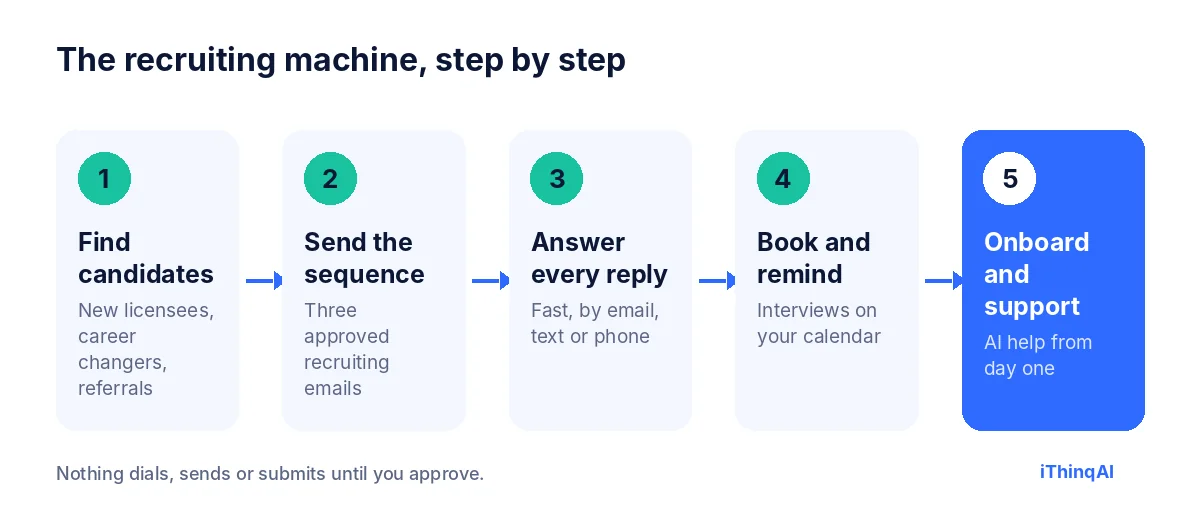
- It finds candidates from the Florida and Texas agent lists, pulled on demand, or from licensing data and lists you approve in other states.
- It sends the approved sequence from its own email address (you connect one for it on any plan; recruiting campaigns start on Growth), with your address and an opt-out in every message.
- It answers every reply by email, and answers callbacks on your business number, day or night.
- It books interviews on the right leader's calendar, then sends reminders.
- It supports agent onboarding, with checklists, reminders and an AI assistant that helps new agents answer and follow up with their own leads.
You approve lists, messages and sending limits before anything goes out.
It has its own computer
Most recruiting tools stop at sending email. iThinqAI's agent works on its own computer, with a browser, files and your connected tools. On the Scale plan, it can:
- Look up a candidate's license status on a public lookup before outreach.
- Pull an export from a data provider's portal and clean it.
- Update your recruiting pipeline after every reply, interview and contract.
- Prepare onboarding checklists and reminders for each new agent.
You can watch every step and stop it at any time. It asks before submitting anything.
The reason why this works
Albert Lasker built ads on one principle: give people the reason why. Here's the reason this works for insurance agent recruiting. Candidates join the team that seems most organized and most likely to help them succeed. When a candidate gets a thoughtful email, a fast answer, an interview booked in one exchange and a clear plan afterward, your team looks like the safest bet. Consistency is the pitch.
A recruiting email sequence you can adapt
Email 1, subject: "Your new life license, and a quick question" Hi Darnell, congratulations on getting licensed. Our team trains new agents for 90 days, provides warm leads, and gives every agent an AI assistant that answers their phone and books their appointments. Would a 20-minute call next week be useful? — Sarah Kim, Kim Agency Group, 400 Main St, Henderson, NV. Reply STOP to opt out.
Email 2, day 4, subject: "How Ana wrote 11 policies in her first 60 days" A two-sentence story, then: "Want to hear how her first month worked?"
Email 3, day 10, subject: "Should I close your file?" "I don't want to clutter your inbox. If now isn't the right time, no problem. If you'd like to talk, reply with a good time."
Replace the story with a real one from your team. Never invent results.
Recruiting emails and the law
This is general information, not legal advice.
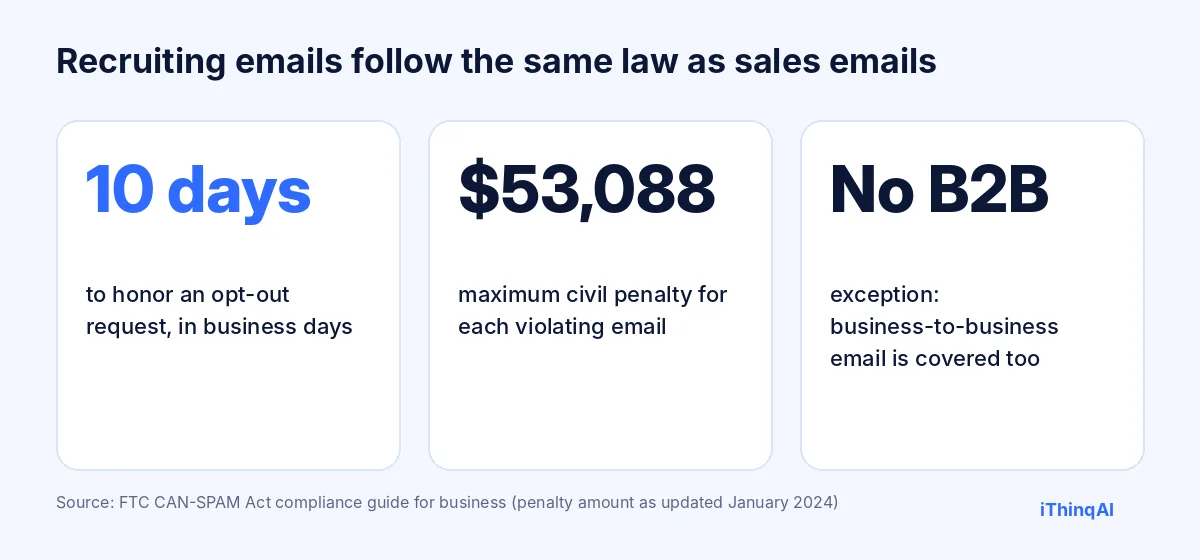
The CAN-SPAM Act covers recruiting emails just like sales emails. The FTC says the law makes no exception for business-to-business email, requires accurate headers and honest subject lines, a valid physical postal address and a clear way to opt out, and says opt-outs must be honored within 10 business days. Penalties can reach $53,088 for each violating email (FTC).
Calls are a separate matter. AI-voice calls fall under the TCPA's artificial-voice rules, which generally require prior consent (Mayer Brown). iThinqAI calls only candidates who replied or asked to be called.
Agent onboarding that keeps people
Recruiting without retention is a treadmill. Use agent onboarding to give every new agent early wins:
| Week | Focus | How the AI helps |
|---|---|---|
| 1 | Licensing, appointments, systems | Checklists and reminders |
| 2 to 4 | Product training and first appointments | Answers their calls and books their meetings |
| 5 to 8 | First sales and follow-up habits | Follows up with every lead automatically |
| 9 to 12 | Building a pipeline | Reactivates old leads and tracks results |
A new agent with booked appointments in week three is far more likely to still be with you in month six.
Recruiting for team-based agencies
Team-based agencies that grow through recruiting have a special advantage: every new agent can recruit too. Give leaders at every level the same system. With 15 seats on the Scale plan, a team leader can put new agents on the same AI-powered front office, so every agent has a phone that's always answered, follow-up that always happens and a recruiting inbox that never goes cold. That's a recruiting pitch in itself: "Join us and you get the same tools I use."
What to measure
- Candidates contacted per week.
- Reply rate to recruiting emails.
- Time to first reply from your team or AI.
- Interviews booked and show rate.
- Contracts signed per interview.
- 90-day and six-month retention of new agents.
How to run a 20-minute interview that converts
Keep the first interview short and focused on the candidate. Spend five minutes on their story: why insurance, what they want to earn, what worries them. Spend ten minutes on a real week in your team: training times, how leads arrive, who they'll call when they're stuck. Spend the last five minutes on next steps, with dates. Don't oversell. Candidates who join with honest expectations stay longer than candidates who join because of a big promise.
After the call, the AI sends a short recap with the next steps, the documents needed and a link to book the follow-up. If the candidate goes quiet, it checks in two days later. Nothing depends on you remembering.
What candidates check before they reply
Today's candidates research you before they answer. They look at your website, your reviews, your social media and your team's profiles. Make sure each one tells the same story as your email:
- A clear "join our team" page with the training plan and a booking link.
- Recent posts that show real agents, real events and real wins, never invented ones.
- Reviews from clients that show your team treats people well.
- A phone number that's actually answered, because many candidates call before they reply.
That last point matters more than most leaders think. A candidate who calls your office and hears a voicemail starts to wonder how you'll support them. A candidate who reaches a friendly assistant that answers their questions and books a time feels like they've already been welcomed.
Mistakes that kill recruiting results
- Vague promises. "Unlimited income" reads like a scam. Specific training and support read like a plan.
- Long emails. If it scrolls, it doesn't get read.
- Slow replies. A reply answered two days later is usually a candidate lost.
- No follow-up. Most replies come after the second or third message.
- No plan after signing. New agents without a clear first month are the first to leave.
- Hiding costs. If there are fees for licensing, training or software, say so early. Surprises destroy trust.
Building a recruiting culture on your team
The strongest teams make recruiting everyone's job, without making it everyone's chore. Celebrate agents who refer good candidates. Share wins from new agents in team meetings. Ask your best producers to join an interview now and then, so candidates meet real people who succeeded. And keep the system running in the background, so the busywork never falls on the people who should be selling.
A week of recruiting, before and after
Before: Monday, you mean to send recruiting emails but spend the day on client calls. Wednesday, you send a few at midnight. Thursday, two candidates reply while you're in appointments. Friday, you answer them. One already joined another team. The other asks for a call next week, and you forget to send the link.
After: Monday morning, fresh candidates are on the list and the first emails go out. By Wednesday, replies are answered within minutes and three interviews sit on your calendar with reminders. Thursday, you run the interviews. Friday, recaps and offers go out automatically, and a new agent starts onboarding next Monday. You spent your time on conversations, not on admin.
Keep candidates warm between steps
Licensing, appointments and contracting take time, and candidates cool off while they wait. Send a short note every few days during that gap: a training video, a welcome from their future mentor, a checklist update. Small touches tell a new recruit they made the right choice, before doubts set in.
Common objections from agency leaders
"Recruiting is about relationships." Agreed. The AI handles the busywork so you have time for the relationship part: the interview and the mentoring.
"Candidates will know it's automated." They'll know it's fast. Every message is approved by you and written for a specific kind of candidate.
"We already buy lists." A list is only the start. The value is in what happens after: the sequence, the fast replies, the booked interviews and agent onboarding.
What it costs
iThinqAI's published plans, as of November 2026:
| Plan | Price | What it adds for recruiting |
|---|---|---|
| Starter | $299/mo | Answers every candidate call, books interviews, includes Florida and Texas agent lists (currently on every plan), gives the AI its own email address to answer candidates, inbox and CRM (2 seats, 1,000 AI minutes) |
| Growth | $799/mo | Adds recruiting campaigns, prospect discovery with 200 research credits, dialer and automations (5 seats, 5,000 AI minutes) |
| Scale | $1,999/mo | Adds computer use for portals and lookups, plus multiple locations and numbers (15 seats, 15,000 AI minutes) |
Every business number also receives faxes. Prices at ithinq.ai/pricing.
Who it's not for
If you add one agent every year or two by word of mouth, you don't need this. It pays off for leaders who want to add agents every month and are tired of recruiting at midnight.
Your first 30 days
Week 1: define your ideal recruit, pick sources and write the three-email sequence.
Week 2: send to a small batch and let the AI answer replies and book interviews.
Week 3: run interviews, send clear offers and start agent onboarding for new signings.
Week 4: review the numbers and scale the sources that produced the best recruits.
Hear it now
Call 561-715-7686. Ask it what a candidate would ask: "Do you provide leads? How does training work?" Hear how it answers and books.
Then book a demo and bring your current recruiting process. Related: newly licensed insurance agents, AI assistant for insurance agents and is AI cold calling legal.
P.S. The recruit who would have become your next top producer is reading someone else's email right now. Call 561-715-7686 today, and make sure the next reply they get is yours.
Sources
Frequently Asked Questions
How do I recruit insurance agents faster?
Use several candidate sources, send a short email sequence, answer replies within minutes and book interviews in the same exchange.
Do CAN-SPAM rules apply to recruiting emails?
Yes. The FTC says there's no exception for business-to-business email. This isn't legal advice.
Can AI send recruiting emails for me?
Yes. On every plan, the AI has its own email address to send your approved emails and answer replies, and Florida and Texas agent lists are currently included. Recruiting campaigns start on the Growth plan.
How many recruiting emails should I send?
Usually three over about two weeks, then a check-in after 30 to 60 days.
How do I keep new agents from quitting?
Strong agent onboarding: a clear 90-day plan, a mentor and tools that help them land early appointments and sales.