Newly Licensed Insurance Agents: 7 Proven Ways to Win Them
Quick answer: to recruit newly licensed insurance agents, reach them in their first days after licensing, before they've committed to a team. Pull new licenses from licensing data you're allowed to use, send a short, specific email that gives a real reason to talk, follow up only with people who reply, and book an interview while interest is high. iThinqAI's AI employee builds the list, sends approved emails from its own inbox, answers every reply and callback, and books interviews on your calendar.
Key takeaways
- New agents decide quickly. The first team that reaches them with a clear offer usually gets the first meeting.
- Turnover is constant: LIMRA reports most new financial professionals leave within two years, so new agent recruiting never stops.
- Lead with what a new agent actually needs: training, leads and a system that helps them sell from day one.
- iThinqAI finds new licensees, runs approved email outreach, answers callbacks and books interviews. Hear it at 561-715-7686.
Who are newly licensed insurance agents?
Newly licensed insurance agents are people who have just passed their state licensing exam and received a producer license, usually for life and health or property and casualty lines. Most haven't yet chosen an agency, an upline or a carrier to work with. That makes the first weeks after licensing the most important window for any agency, team leader or marketing organization that recruits.
The race that starts the day the license is issued
Picture Maria. She passed her life and health exam last month. Her license number showed up in the state's records on Tuesday. She's excited, a little nervous, and she has no idea which agency to join.
By Friday, she'll have heard from two or three teams. One sent a generic "career opportunity" email. One called and pitched hard. One sent a short note that said: "Congratulations on your license. We train new agents for 90 days, give you warm leads, and set you up with an AI assistant that answers your phone. Want a 20-minute call to see if it fits?"
Which one do you think gets the meeting?
Speed matters, but so does the message. Newly licensed insurance agents don't need a hype video. They need a reason to believe they'll actually make money.
Why new agent recruiting never stops
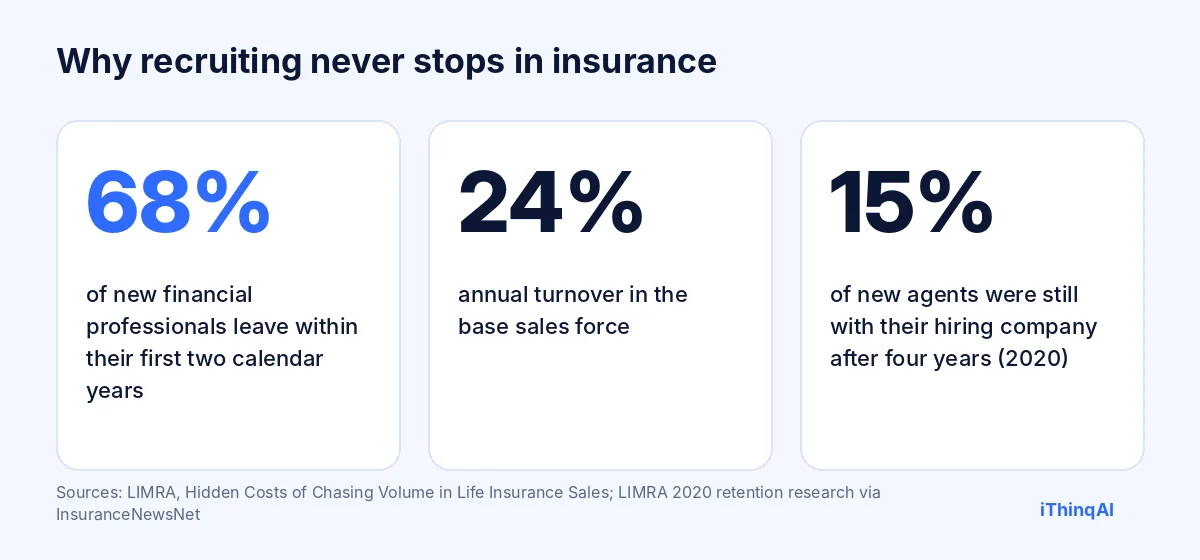
Agency owners know the hard truth: most new agents don't last. LIMRA reports that 68% of new financial professionals leave within their first two calendar years, and annual turnover in the base force runs around 24% (LIMRA). Separate LIMRA research found only 15% of full-time financial professionals stayed with their hiring company after four years (InsuranceNewsNet).
That means two things. First, recruiting is a permanent job, not a one-time push. Second, the agencies that win aren't just good at finding newly licensed insurance agents. They're good at keeping them, which starts with what you promise in the first message.
Where licensing data comes from
Insurance licenses are public records in most states, and many state insurance departments publish or sell lists of recently licensed individuals. California, for example, offers a Recently Licensed List that can be requested by license type (California Department of Insurance). Commercial data providers repackage the same licensing data with contact details added.
Two rules before you use any list:
- Check the terms. Each state and data provider sets its own rules for how licensing data may be used. Read them.
- Check the contact rules. Email has its own law (more below), and calls with an AI voice generally need prior consent.
iThinqAI currently includes insurance agent lists for Florida and Texas on every plan: newly licensed agents and agents renewing their license, every license type, pulled on demand, with back data. So you're not copying names out of a state website one at a time. In other states, start from licensing data you're allowed to use, and the AI does the rest.
Seven proven ways to win newly licensed insurance agents
1. Reach them in the first week
The earlier you write, the fewer offers they've already heard. Set your list to refresh on a schedule so new licensees reach your outreach within days, not months.
2. Lead with what they need, not what you want
A new agent's three fears: "I don't know how to sell," "I don't have leads," and "I can't afford to fail." Answer all three in one sentence: training, leads and support.
3. Make the first email short and specific
Congratulate them, name their license line and state, give one concrete reason to talk, and ask one easy question. Five sentences, tops.
4. Offer a tool they can't get alone
Here's a recruiting edge most teams don't have: "Every agent on our team gets an AI assistant that answers your phone, books your appointments and follows up with your leads." For someone starting from zero, that's a powerful reason to pick you.
5. Answer every reply fast
When a new agent replies at 9 PM, the answer should arrive at 9:01, not the next afternoon. An AI employee watching the inbox makes that possible.
6. Book the interview in the conversation
"Would Tuesday at 4 or Wednesday at noon work for a 20-minute call?" Then put it on the calendar with a reminder. No phone tag.
7. Keep in touch with "not yet"
Plenty of new agents aren't ready this month. A friendly check-in 30 and 60 days later catches the ones whose first choice didn't work out, which, given the turnover numbers, is a lot of them.
How the AI employee runs it
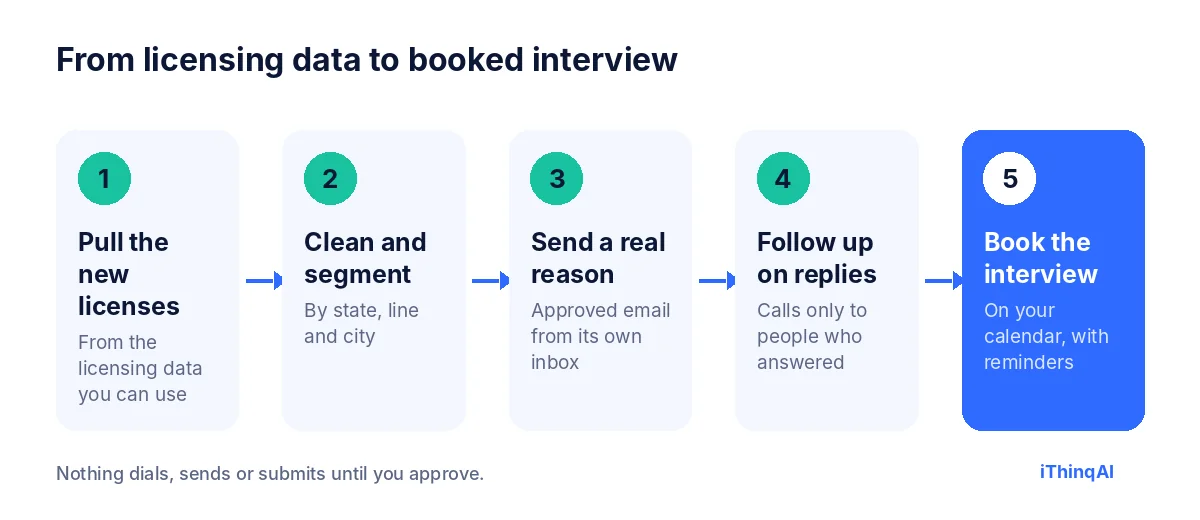
- It pulls the new licenses on demand. In Florida and Texas, the agent lists are currently included on every plan. Elsewhere, it works from licensing data you're allowed to use.
- It cleans and segments the list by state, license line and city, and drops duplicates.
- It sends your approved email from its own email address (you connect one for it on any plan; recruiting campaigns start on Growth), one person at a time, with an opt-out in every message.
- It answers replies and callbacks. When a new agent writes back or calls your number, the AI answers, asks a few screening questions and offers interview times.
- It books the interview on the right recruiter's calendar and sends reminders.
You approve the list, the message and the sending limits before anything goes out. Nothing sends without your OK.
It has its own computer
This is where iThinqAI differs from a mail-merge tool. The agent works on its own computer, with a browser, files and your connected tools. On the Scale plan, it can:
- Check a public licensing lookup to confirm a license is active before outreach.
- Pull a fresh export from a data provider's portal and clean it.
- Update your recruiting pipeline in the CRM after every reply.
- Draft personalized follow-ups for your review.
You can watch each step and stop it at any time. It asks before submitting anything.
The reason why this works
Albert Lasker's rule was to give people the reason why. Here's the reason this approach wins newly licensed insurance agents: they're making one of the biggest decisions of their new career with very little information. The team that shows up first, speaks to their real fears and makes the next step easy looks like the team that will take care of them. That impression is formed in the first message. Get it right, and the interview is half won.
A first email that gets replies
Subject: Congrats on your Nevada life license, Maria
Body: Hi Maria, congratulations on getting licensed. I lead a team of 22 agents in Las Vegas. New agents with us get 90 days of hands-on training, a steady flow of warm leads, and an AI assistant that answers their phone and books their appointments. Would a 20-minute call this week be useful? Reply with a good time, or pick one here. — Jordan Lee, Lee Financial Group, 123 Main St, Las Vegas, NV. Reply STOP to opt out.
Short. Specific. A real reason. An easy yes. And the address and opt-out the law requires.
What the law says about recruiting outreach
This is general information, not legal advice. Check with counsel and your state's rules.
- Email: the CAN-SPAM Act applies to business email too; the FTC says the law makes no exception for business-to-business messages. Use accurate sender details, honest subject lines, a physical postal address and a clear opt-out, and honor opt-outs within 10 business days (FTC).
- Calls with an AI voice: they fall under the TCPA's artificial-voice rules, which generally require prior consent (Mayer Brown). That's why the AI calls only people who replied or asked to be called.
- Data use: follow the terms of the state or provider that supplied the licensing data.
New agent recruiting by team type
| Team type | Best first message | What wins the meeting |
|---|---|---|
| Team-based agency that recruits heavily | Training, mentorship and a clear path to leadership | A fast reply and a booked interview |
| Independent agency hiring producers | Book of business support and carrier access | Specific products and markets |
| Captive agency | Brand, training and benefits | A clear first-year plan |
| Medicare and health specialists | Enrollment-season support and lead flow | Seasonal readiness |
| P&C agency | Commercial or personal lines focus | Local market and mentorship |
What to measure
- Days from license to first contact. Shorter is better.
- Reply rate to the first email.
- Interviews booked per hundred new licensees contacted.
- Contracts signed per interview.
- Six-month retention of the agents you sign.
The last number matters most. A recruit who leaves in month three cost you time and money.
Help them stay, not just join
Since most new agents leave early, the best recruiting strategy is also a retention strategy. Give every new agent the tools that make the first months less lonely and more productive:
- An AI assistant that answers their calls while they're in training or with clients.
- Automatic follow-up with every lead they get, so nothing is wasted.
- Appointment reminders that cut no-shows.
- A CRM that's updated after every conversation, so their manager can coach from real data.
When new agents see early wins, they stay. When they stay, your recruiting gets easier, because your best recruiters are happy agents.
What newly licensed insurance agents ask before they join
Newly licensed insurance agents tend to ask the same questions, and the team with clear answers wins the meeting. Prepare short, honest answers to each, and load them into your AI employee so every reply is consistent:
- "Do you provide leads?" Say exactly how leads work, who pays for them and how many a new agent typically gets.
- "How does training work?" Describe the first 90 days week by week.
- "How do I get paid?" Explain commission and any advances plainly.
- "Are there fees?" Be upfront about licensing, appointment or software costs.
- "Who will help me?" Name the mentor or manager they'll work with.
Honest answers do two jobs. They win the right recruits, and they filter out the ones who would have left in month three anyway.
New agent recruiting with licensing data: a weekly rhythm
The best new agent recruiting teams run on a simple weekly loop. Monday, the AI refreshes the list from the latest licensing data and removes anyone already contacted. Tuesday, it sends the approved first email to the new names. Wednesday through Friday, it answers replies, follows up once with people who opened but didn't answer, and books interviews. Friday afternoon, you review the numbers: new licensees found, replies, interviews booked and contracts signed. Fifteen minutes of review a week keeps the whole machine honest.
Why speed matters more for newly licensed insurance agents
Newly licensed insurance agents are hearing from multiple teams at once, and most make a decision within weeks. Every day you wait, another team gets the first conversation. When licensing data refreshes weekly and the AI writes the same day, your team is often the first serious offer a new agent sees. That head start, repeated every week, is how small agencies out-recruit bigger ones.
Interviews that turn into contracts
Getting the meeting is half the job. Make the interview easy to say yes to: keep it to 20 minutes, show a real week in the life of a new agent, and introduce the mentor they'll work with. Send a short summary afterward with next steps and dates. The AI can send that summary, book the follow-up and remind the recruit about licensing or appointment paperwork. Momentum is everything in the first month, so every step should arrive on time.
Common objections from agency leaders
"Everyone already emails new licensees." Most send generic blasts. A specific message, a fast reply and a booked call still stand out.
"We prefer to call." Calls work best after a reply. AI-voice cold calls generally need consent, and a person calling a stranger cold rarely beats a well-written email followed by a quick answer.
"I don't have time to manage outreach." That's the point. The AI builds the list, sends the approved emails, answers replies and books interviews. You show up to the interview.
What it costs
iThinqAI's published plans, as of November 2026:
| Plan | Price | What it adds for recruiting |
|---|---|---|
| Starter | $299/mo | Answers every call to your number, books interviews, includes Florida and Texas agent lists (currently on every plan), gives the AI its own email address to send and answer email, inbox and CRM (2 seats, 1,000 AI minutes) |
| Growth | $799/mo | Adds recruiting email and calling campaigns, prospect discovery with 200 research credits, dialer and automations (5 seats, 5,000 AI minutes) |
| Scale | $1,999/mo | Adds computer use, so the AI can work in licensing lookups and data portals, plus multiple locations and numbers (15 seats, 15,000 AI minutes) |
Every business number also receives faxes, on every plan. Prices at ithinq.ai/pricing.
Who it's not for
If you hire one agent a year through referrals, you don't need a recruiting system. It pays off for agencies and team leaders who recruit every month and lose good candidates to faster teams.
Your first two weeks
Days 1 and 2: decide which states and license lines to target, and confirm the terms of the licensing data you'll use.
Days 3 and 4: write your first email and two follow-ups, with your address and opt-out. Approve them.
Days 5 to 7: send to a small first batch. Read every reply.
Week 2: adjust the message, turn on a weekly refresh of new licenses, and book your first interviews. Track days-to-first-contact from the start.
Hear it now
Call 561-715-7686. Ask it the questions a new agent would ask: "What training do you offer? Do you provide leads?" Listen to how it answers and offers a time.
Then book a demo, and we'll show you the Florida and Texas agent lists. Related reading: insurance agent recruiting, AI assistant for insurance agents and speed to lead.
P.S. Somewhere in your state, a new license was issued this morning. Call 561-715-7686 today, and make sure your team is the first one that new agent hears from.
Sources
- LIMRA: Hidden Costs of Chasing Volume in Life Insurance Sales
- InsuranceNewsNet: A Path to Better Agent Retention (LIMRA 2020 data)
- California Department of Insurance: Recently Licensed Individuals
- FTC: CAN-SPAM Act compliance guide for business
- Mayer Brown: FCC ruling on AI-generated voice calls (2024)
- iThinqAI pricing
Frequently Asked Questions
How do I find newly licensed insurance agents?
Through licensing data: many state insurance departments publish or sell recently licensed lists, and data providers repackage them. iThinqAI currently includes Florida and Texas agent lists, newly licensed and renewing, on every plan.
When should I contact a new licensee?
As early as you can, ideally within the first week, with a specific reason to talk.
Is it legal to email newly licensed agents?
Generally yes, if you follow CAN-SPAM: accurate sender details, honest subject lines, a postal address and a working opt-out. This isn't legal advice.
Can AI call newly licensed agents?
AI-voice calls generally need prior consent. iThinqAI calls only people who replied or asked to be called.
What should my first email say?
Congratulations, one concrete reason to join (training, leads, tools) and one easy question.